Abstract:
Disease surveys were conducted to appraise the incidence and severity of major leaf diseases of rubber in the non-traditional rubber growing areas of South India. Abnormal leaf fall (ALF) disease caused by Phytophthora sp., powdery mildew (PM) caused by Oidium heveae, colletotrichum leaf spot (CLS) caused by Colletotrichum spp and corynespora leaf fall (CLF) caused by Corynespora cassiicola were the disease included in the study. The study revealed that ALF, PM and CLS occured consistently in almost all the plantations surveyed, while CLF was not so wide spread in hilly areas. In Subramanya, Puttur, Belthangady, Kundapura and Sullia areas the incidences of both CLS and CLF occurred to aggravate the damage. Hevea brasiliensis, or rubber tree, is the primary source of natural rubber, and second major commodity crop in Malaysia after oil palm. It is known that rubber trees are prone to a wide range of foliar diseases, resulting in significant yield losses. To date, a new emerging severe leaf disease epidemic tentatively termed as Pestalotiopsis secondary leaf fall was identified affecting many rubber plantations in rubber producing countries. In addition, five major leaf diseases that have been conclusively identified affecting rubber plantations nation-wide in Malaysia were also reviewed in this paper. These leaf diseases include secondary leaf falls of Oidium, Colletotrichum, and Corynespora, as well as Fusicoccum leaf blight and Phytophthora abnormal leaf fall. In general, this present paper reviews the recent epidemic and the major leaf diseases by focusing on causal pathogens, symptoms and its effects on rubber plantations. Information presented in this review would be useful in planning and initiating better control measures for rubber growing regions in an attempt to reduce or even prevent losses of latex yield.
Keyword: Leaf diseases; Rubber tree,CNN algorithm
Introduction:
Hevea brasiliensis (family Euphorbiaceae) is a tropical tree native to the Amazon Forest of South America (Noordin et al., 2012). In the 1960s, Malaysia was one of the world’s leading natural rubber producers in the world. However, Malaysia was in the third ranking by only producing 8% of the total natural rubber globally, (Fox and Castella, 2013). Currently, natural rubber production is facing many challenges including fluctuations in price, lack of competent tappers and the risks of destructive epidemics (Heng and Joo, 2017). Recently, a severe epidemic of new leaf disease on rubber plantations was reported. The disease bears a symptom of brown circular spots, that was never been reported before. Presently, the causal agent was identified as Pestalotiopsis sp., but it is yet to be confirmed by various on-going research.
Problem statement:
The hevea tree is economically significant for rubber production but is susceptible to various diseases that affect leaf health, leading to decreased yield and economic losses for farmers.
Objective:
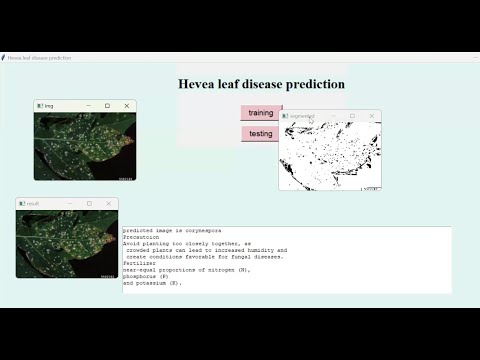
Developing an automated system using computer vision techniques, specifically CNNs, can aid in early detection and classification of these diseases, enabling timely intervention and mitigation strategies.and precaution of hevea leaf disease,fertilizer of particular hevea leaf disease.
Block Diagram