ABSTRACT:
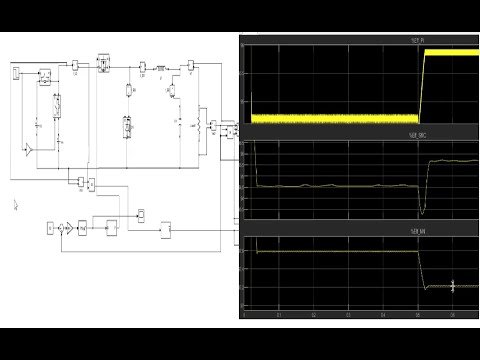
In this, a new nonlinear voltagemode controller is proposed for a PWM dc-dc buck converter operating incontinuous conduction mode. The sliding-mode control techniqueis used to derive a simplified equivalent control law based onthe averaged dc-dc buck converter dynamics. As opposed to thereported design approaches, the proposed control scheme onlyrequires the output voltage in the feedback loop without theneed to the capacitor current. Thus, the analogue implementationcost is reduced and the drawback of adding a capacitor currentsensor to the power converter is eliminated. The control equationis realized in a simple analogue circuit using few op-amps andresistors, which is suitable for industrial applications. The systemmodeling and control design procedure along with the derivationof the existence and stability conditions are presented. The proposed systemis simulated in MATLAB/Simulink software.
INTRODUCTION:
TheLinear control techniques such as the classical voltage- andcurrent-mode control of dc-dc converters are utilized in severalapplications, such as dc motor drives, electric vehicles, andhome appliances. Linear controllers tend to be effective forsmall variations around a local operating condition becausethey are designed based on the small-signal model. Thus theircontrol objectives may fail under large-signal disturbances.Therefore, much research has been dedicated to apply thesliding-mode control (SMC) technique as an alternative optionbecause of its robustness, large-signal stability, and suitabilityfor variable structure systems (VSS). Despite theexcellent features of sliding-mode (SM) controllers, linear controllers are still dominant in most industrial applications. Thisis because the classical controllers require less design effortand can be implemented in a simple analogue form, whereasthe design of SM controllers require more mathematical computations and sophisticated control schemes. Additionally, theSMC method results in practical issues like the chattering andvariable switching frequency.Several research endeavors have been introduced to implement the SMC of dc-dc converters using embedded systemplatforms, whereas other researchers have proposed analogue SMC schemes. The embedded systemsapproaches have been conducted using a FPGA, DSPand micro-controller. In addition, LabView, dSPACE, digital signal controllersand DAQ-Advantech have been implemented.The previous control schemes are characterized by superiorfeatures like programmability, accuracy, and fast signal processing capability, but are not cost-effective for commercialapplications.On the other hand, some analogue SMC schemes havebeen introduced as competitive candidates against analoguelinear controllers. The HM-based SMC has been proposed, but falls short of maintaining a constant switchingfrequency, which complicates the design of input and outputfilters of power converters. In other research efforts,synchronization to external triggers, adaptive HM-basedSMC, and HM/PWM seamless control have beenpresented to maintain constant switching frequency; however,complicated circuitry is required. Alternatively, PWM-basedSMC circuits that consist of op-amps and analogue components have been reported for various powerconverters. A systematic procedure to design analogue SM voltage controllersfor basic dc-dc converters and addressed most of the practicallimitations associated with SMC. However, the simplificationof the analogue PWM-based SMC design is still demandedto develop robust nonlinear alternatives for the conventionallinear controllers.
PROBLEM STATEMENT:
In this, a new simplified SM voltage control(SSMVC) of PWM dc-dc buck converter in CCM, whichis developed based on the averaging technique. The complexity and cost of the controlcircuitis reduced with proposed control system as it does not require a capacitor current branch. The SSMV controlled PWM dc-dc buck converter is designed and tested under steady-state operationand with large disturbances to validate the design methodology. The tracking performance of the SSMVC system isalso compared with other conventional controllers.
Block Diagram