Abstract
Weed management is a critical task in agriculture, as unwanted plants compete with crops for water, nutrients, and sunlight, ultimately reducing yield and affecting overall crop health. Traditional methods such as manual hand-weeding are labor-intensive, time-consuming, and costly, while chemical herbicides pose serious environmental and health risks. To overcome these challenges, modern agricultural systems are shifting toward automation using artificial intelligence, robotics, and deep learning. This project, Deep Learning Based Weed Detection and Plucking System, aims to design a fully automated solution capable of identifying and removing weeds accurately without damaging crop plants.
The core intelligence of the system is based on Deep Learning, particularly Convolutional Neural Networks (CNN) or advanced object detection architectures like YOLOv8 or Faster R-CNN. These models are trained on a large dataset of weed and crop images to learn distinguishing features such as shape, color, leaf texture, and structural patterns. Once deployed on an embedded computing platform like Raspberry Pi, the system uses a camera module to capture live field images. The deep learning model processes each frame in real time to detect weed locations with bounding boxes and high confidence scores. Environmental factors like varying light, soil backgrounds, and different weed species are also handled effectively by the trained network.
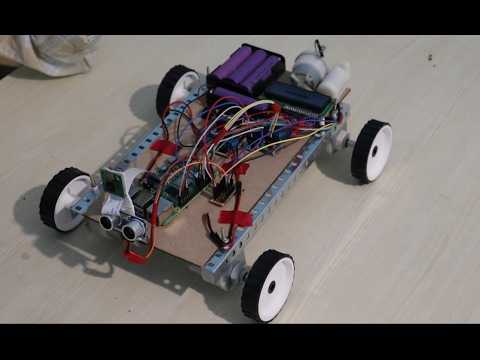
After detection, the next stage involves robotic actuation. A servo-based plucking arm or robotic gripper is integrated with the system to remove the detected weeds. The coordinates obtained from the detection model guide the mechanical arm towards the weed, ensuring precise positioning and safe removal without harming adjacent crops. The robot platform moves using motor drivers and wheels, often enhanced with sensors such as ultrasonic sensors or IR modules for obstacle avoidance and smooth navigation through farmland.
This automated system offers several advantages: it reduces the need for manual labor, promotes eco-friendly farming by eliminating chemical herbicides, and ensures consistent and accurate weed removal. The project supports precision agriculture by integrating AI-based decision making with real-time robotic action. It is highly scalable, cost-effective, and suitable for small as well as large agricultural fields. Overall, the proposed system represents a major advancement toward smart farming solutions, helping farmers increase productivity while maintaining environmental sustainability.
Introduction
Weeds pose a significant threat to modern agriculture by competing with cultivated crops for essential resources such as nutrients, sunlight, water, and space. Their uncontrolled growth leads to reduced crop yield, poor plant health, and increased production costs. Traditionally, farmers rely on manual weed removal or the application of chemical herbicides. While manual weeding is accurate, it is highly labor-intensive, time-consuming, and impractical for large-scale farms. On the other hand, chemical herbicides are expensive and harmful to soil quality, human health, and the overall ecosystem. These limitations highlight the urgent need for an intelligent, automated, and environment-friendly weed management system.
With advancements in artificial intelligence, robotics, and embedded systems, agriculture is rapidly transitioning towards automation and smart farming. Deep learning, particularly Convolutional Neural Networks (CNN) and object detection models such as YOLO, has demonstrated remarkable success in identifying visual patterns with high accuracy. These models can analyze images captured from the field and distinguish between crops and weeds by learning their shapes, sizes, textures, and color variations. Integrating such models with low-cost hardware like Raspberry Pi enables real-time weed detection directly on the field.
The proposed Deep Learning Based Weed Detection and Plucking System combines AI-driven weed classification with an automatic mechanical plucking mechanism. A camera captures continuous images of the farmland, and the trained deep learning model processes them to identify weed locations. Once detected, a servo-driven robotic arm or mechanical gripper removes the weed precisely without disturbing nearby crop plants. The robot platform is equipped with motors and sensors for navigation, allowing it to move autonomously across the field while avoiding obstacles.
This intelligent system offers a sustainable solution to traditional weed-management challenges. It reduces dependency on manual labor, eliminates the use of harmful chemicals, and enhances field productivity. By enabling accurate real-time weed removal, the project contributes to precision agriculture, ensuring higher crop yield and improved field efficiency. The integration of deep learning and robotics marks a significant milestone in agricultural automation, empowering farmers with advanced tools to cultivate healthier crops at reduced operational costs.
Objectives
To develop an accurate weed detection model using Deep Learning
To implement real-time image processing for field monitoring
To automate the weed identification process
To design and integrate a robotic plucking mechanism
To develop an autonomous mobility system for field navigation
To ensure safe, eco-friendly, and chemical-free weed management
To minimize labor dependency and enhance productivity
To evaluate system performance in real-world conditions
To create a scalable and cost-effective smart farming solution
Block Diagram