ABSTRACT
In today’s digital world, the amount of textual information generated every day has increased at an unprecedented rate. Documents such as research papers, legal agreements, business reports, policy documents, manuals, and academic notes are often lengthy and complex. Reading, analyzing, and understanding these documents manually consumes a significant amount of time and effort. As a result, there is a growing demand for intelligent systems that can automatically process documents, extract meaningful information, and present it in a concise and understandable form.
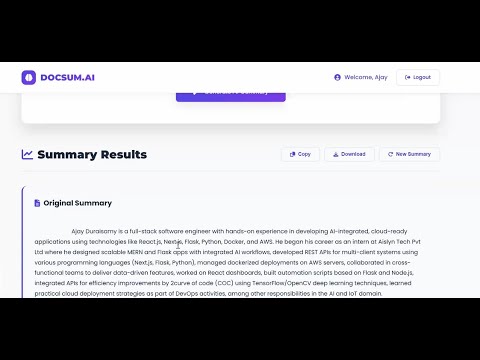
The Smart Document Summarizer & Translator is an intelligent web-based application designed to address this challenge by providing automated document summarization and multilingual translation capabilities. The system allows users to upload PDF documents, extract textual content from them, generate concise summaries using a locally deployed Large Language Model (LLM), and translate the summarized output into multiple languages based on user preference. The application aims to improve productivity, reduce manual effort, and enhance accessibility to information.
One of the key highlights of this project is the use of a local LLM powered by Ollama, rather than relying on cloud-based AI services. Most existing summarization tools depend on external cloud APIs, which raise serious concerns related to data privacy, security, recurring costs, and continuous internet connectivity. In contrast, this system performs all AI inference locally on the user’s machine or server, ensuring complete control over sensitive document data. This makes the solution highly suitable for applications involving confidential or private documents such as academic research, legal files, and internal business reports.
The system is developed using the Flask web framework, which provides a lightweight and flexible backend architecture. Flask handles user authentication, session management, file uploads, request processing, and database interactions. The application uses SQLite as the database to store user information and summarized content. This enables persistent storage and allows users to view or reuse their previously generated summaries.
The document summarization process begins with PDF text extraction, where the system reads the uploaded document and extracts textual content using a PDF processing library. To optimize performance and avoid overloading the language model, the system intelligently limits the number of pages and characters processed. The extracted text is then passed to the summarization engine, which uses prompt-based inference with a carefully configured LLM model to generate a concise and meaningful summary. The summarization process focuses on preserving the core ideas, important points, and overall context of the document while eliminating redundant or less relevant information.
In addition to summarization, the system supports multilingual translation of the generated summaries. This feature is particularly useful in a multilingual country like India, where users may prefer to read content in their native language. The translation module uses natural language processing techniques to convert the summarized text into languages such as Tamil, Hindi, Kannada, Telugu, and others. By translating only the summarized content instead of the entire document, the system ensures faster processing and improved translation accuracy.
The project also incorporates optional Retrieval Augmented Generation (RAG) techniques to enhance summary relevance. RAG combines semantic search and vector similarity methods to retrieve the most important text segments from the document before summarization. This helps the model focus on the most relevant parts of the document, resulting in higher-quality summaries. The use of vector embeddings and similarity search demonstrates the application of advanced AI concepts in real-world systems.
From a user perspective, the application provides a simple and intuitive interface where users can register, log in, upload documents, select their preferred output language, and view the summarized and translated results. Session-based authentication ensures that user data remains secure and accessible only to authorized users. The system architecture is modular, making it easy to extend with additional features such as OCR support for scanned documents, audio summaries, or cloud deployment in the future.
In conclusion, the Smart Document Summarizer & Translator successfully demonstrates how modern artificial intelligence techniques, particularly local large language models, can be integrated into web applications to solve real-world problems. The project highlights the importance of privacy-preserving AI, efficient document processing, and multilingual accessibility. It serves as a practical, scalable, and cost-effective solution for automated document understanding and can be further enhanced to support a wide range of academic and professional use cases.
Objectives
The specific objectives focus on the technical and functional goals of the system.
1) PDF Document Processing
• To allow users to upload PDF documents through a web interface
• To extract readable textual content from PDF files efficiently
• To handle large documents by limiting page count and text length
• To ensure reliable text extraction without data corruption
2) Automated Text Summarization
• To generate concise summaries that preserve the core meaning of the document
• To eliminate redundant and less important information
• To use a locally hosted LLM for summarization to avoid cloud dependency
• To control summarization parameters such as context length, output size, and creativity
Block Diagram
SOFTWARE AND HARDWARE REQUIREMENTS
SOFTWARE REQUIREMENTS
The software requirements define the platforms, frameworks, libraries, and tools necessary for developing and executing the proposed system. The selection of software components focuses on flexibility, open-source availability, ease of integration, and compatibility with artificial intelligence models.
The operating system required for the system can be Windows, Linux, or macOS, as the application is platform-independent. Linux-based systems are preferred for better performance and stability, especially when running local AI models.
The core programming language used in the system is Python, which is widely adopted for web development, artificial intelligence, and natural language processing. Python provides extensive libraries and community support, making it ideal for building intelligent applications.
The backend of the application is developed using the Flask web framework. Flask is a lightweight and flexible framework that simplifies routing, request handling, and session management. It allows easy integration with AI models, databases, and external libraries.
For database management, SQLite is used. SQLite is a lightweight, file-based relational database that is easy to configure and sufficient for handling user data and summary storage in small to medium-scale applications. It supports structured data storage and efficient query execution.
The system uses Ollama as the local AI runtime environment to execute the Large Language Model. Ollama enables running LLMs locally, eliminating the need for cloud-based APIs. This ensures data privacy, reduces dependency on internet connectivity, and avoids recurring costs.
The summarization process utilizes a Large Language Model (such as Phi series) configured within Ollama. The model is responsible for understanding document content and generating concise summaries based on prompt instructions.
For PDF processing, the system uses PyPDF2, which allows efficient extraction of textual content from PDF files. This library enables page-wise text reading and supports handling of text-based documents.
For multilingual translation, the system integrates GoogleTrans, a Python library that supports translation into multiple languages. This module converts summarized content into the user-selected language, improving accessibility.
Optional advanced processing uses Sentence Transformers and FAISS for semantic similarity and retrieval-based enhancement. These tools help improve summary relevance by identifying the most important document segments.
The frontend interface is developed using HTML and CSS, providing a simple and user-friendly web interface accessible through standard web browsers such as Google Chrome or Mozilla Firefox.
________________________________________
HARDWARE REQUIREMENTS
The hardware requirements specify the minimum and recommended system configuration needed to run the application efficiently. Since the system performs AI inference locally, sufficient hardware resources are required for optimal performance.
The minimum hardware configuration includes a system with an Intel i3 or equivalent processor, 8 GB RAM, and at least 10 GB of free disk space. This configuration is sufficient for basic document processing and summarization of small to medium-sized PDFs.
For better performance and faster summarization, a recommended configuration includes an Intel i5/i7 or equivalent processor, 16 GB RAM, and 20 GB or more free disk space. This configuration allows smoother execution of the local LLM and faster response times.
A dedicated GPU is optional but can significantly improve performance if available. While the system can run entirely on CPU, a GPU with sufficient VRAM enhances AI inference speed, especially for larger models.
The system requires a stable power supply and standard input/output devices such as a keyboard, mouse, and display. Internet connectivity is optional and primarily required for initial software installation and optional translation services.