ABSTRACT: -
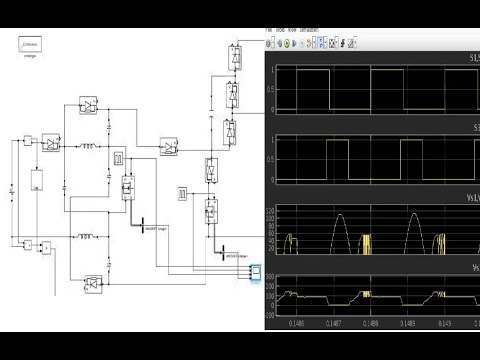
This paper presents a Z-source-based high gain DC-DC converter that benefits from high voltage gain, low voltage stress on the semiconductor devices and the capacitors. The switched-capacitor cells are integrated with the conventional Z-source impedance network resulting in a new high gain DC-DC converter. The proposed converter reduces the voltage stress on the diodes and the power switch to less than half the output voltage and achieves a high-voltage gain without imposing a limitation on the duty cycle and requiring a large number of components. The operating principles and a comparison with other similar high gain DC-DC converters are provided. The simulation is to be carried out in MATLAB/Simulink software.
INTRODUCTION
The technology development for renewable energy sources —such as wind and photovoltaic (PV)—has gotten more attention recently. One of the main drawbacks of PV generation is that the output voltage of the PV panels is low. Therefore, a converter with high-voltage gain is required to boost the PV voltage to levels such as 400 V, for meeting the voltage requirement of the DC MG. Connecting PV panels in a series and employing a conventional DC-DC boost converter are two traditional solutions to step up the PV voltage. The series connection for the PV panels is not reliable because if one of the panels fails, the whole system is affected. The conventional DC-DC boost converter provides high-voltage gain with extremely high duty cycle. However, it generally suffers from high voltage stress across the power switch and output diode, low efficiency, and the severe reverse-recovery problem of output diode. Advanced high step-up DC-DC converters have been explored to boost the PV voltage and overcome the problems offered by the series connection of PV panels and the conventional DC-DC boost converter. These converters employ voltage-boosting approaches, such as switched-capacitor (SC) and switched-inductor (SL) cells, and coupled inductor (CI) or built-in transformer (BIT). The topologies based on SC and SL cells have high complexity and cost due to using a large number of components. A clamping circuitry is required for the converters with CI or BIT to absorb the energy stored in the leakage inductance and to reduce the voltage stress across the power switches. The concept of stepping up the voltage through Z-source (ZS) and quasi-Zsource (qZS) networks has been recently extended to DC-DC converters. However, the voltage gain for conventional ZS and qZS DC-DC converters is not high enough. The SL approach has been integrated into conventional ZS network, resulting in a new high step-up ZS-based DC-DC which was used as the input stage of a three-phase two-stage ZS inverter. Although the voltage gain is increased and the voltage compared to the conventional ZS converter, there is a large number of components and the duty cycle is limited to 0.33, which is less than 0.5 for the conventional ZS topology. The conventional qZS network has been integrated with the SC cells, which yielded a new converter with high-voltage gain and low voltage stress on the semiconductor devices.
PROBLEM STATEMENT
In this paper, a new ZS-based DC-DC converter is developed through integrating the SC cells into the conventional ZS impedance network, which achieves high voltage gain with low voltage stress on the semiconductor devices and a low number of components. Unlike some existing ZS/qZS DC-DC converters that limit the duty cycle to a value lower than 0.5, the proposed topology does not impose limitations on the duty cycle. It is further extended by introducing the switched capacitor cells controlled by an auxiliary switch which further increases the voltage gain without adding to the voltage stress.
• Demo Video
• Complete project
• Full project report
• Source code
• Complete project support by online
• Life time access
• Execution Guidelines
• Immediate (Download)
Software Requirements:
1. Matlab 2014A and Above
2. simpowersystems toolbox
Hardware Requirements:
1. PC or Laptop
2. 500GB HDD with 1 GB above RAM
3. Keyboard and mouse
1. Immediate Download Online
Only logged-in users can leave a review.
No reviews yet. Be the first to review this product!