IEEE Project Ideas for Final Year Engineering Students in Bangalore
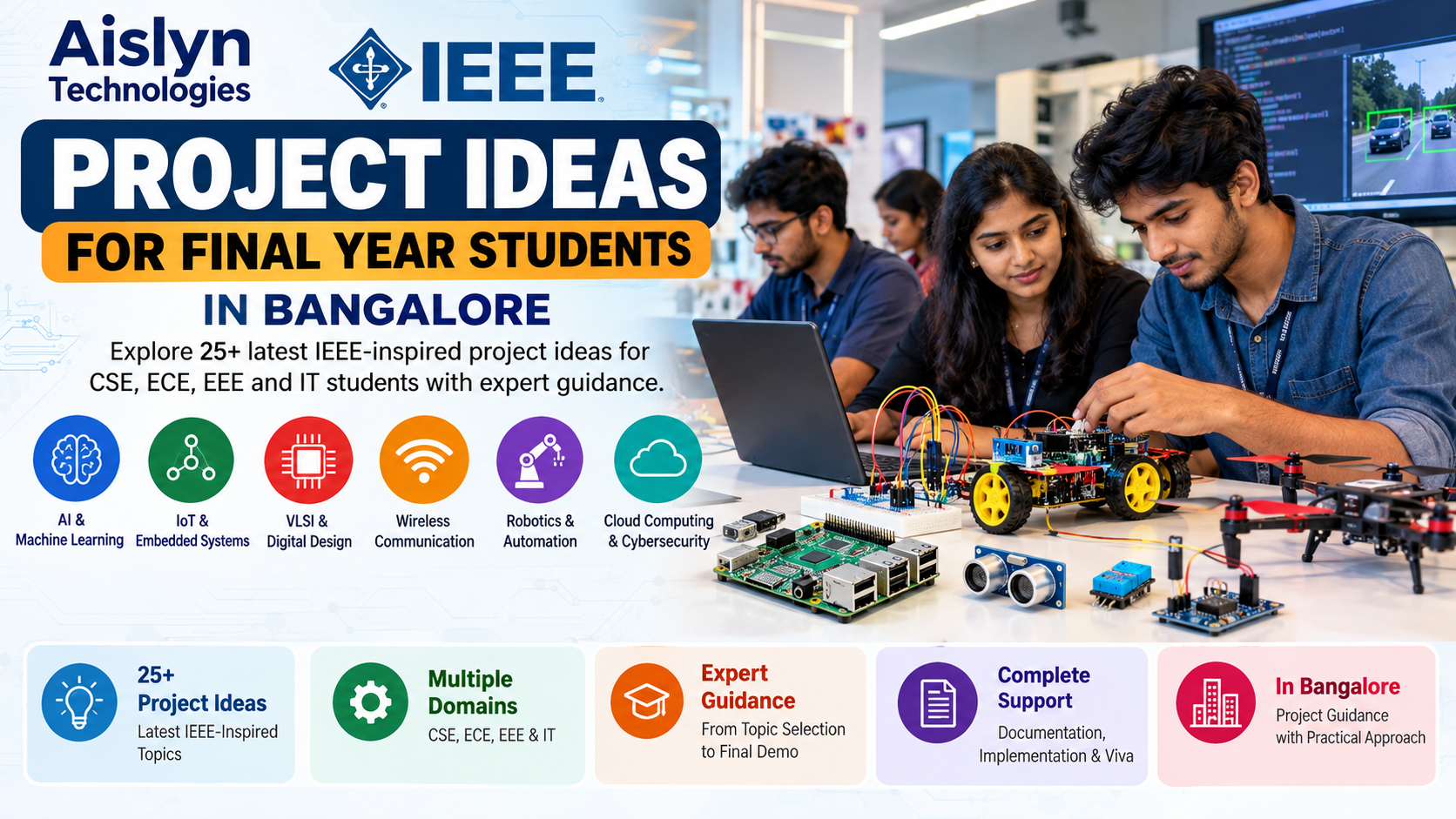
Are you searching for the best IEEE project ideas for your final year engineering project? Aislyn Technologies helps students explore research-oriented project concepts across Computer Science and Engineering, Electronics and Communication Engineering, Electrical and Electronics Engineering, and Information Technology.
IEEE research publications cover emerging technologies such as Artificial Intelligence, Machine Learning, Internet of Things, Cybersecurity, VLSI, Robotics, Wireless Communication, and Cloud Computing. Studying relevant research papers helps students understand existing methods, identify limitations, and develop their own practical implementations.
A successful final year project should solve a clearly defined problem, follow an appropriate methodology, include meaningful testing, and demonstrate measurable results. Students should select a topic that matches their academic requirements, technical interests, available resources, and implementation timeline.
25 Latest IEEE-Inspired Final Year Project Ideas
1. AI-Based Fake News Detection System
Develop a machine learning application that analyses news articles and classifies potentially misleading content using Natural Language Processing and labelled datasets.
2. IoT-Based Smart Agriculture Monitoring
Build a sensor-based system that measures soil moisture, temperature, and humidity and transmits the readings to a connected dashboard.
Analyse network traffic datasets and develop a model that identifies potentially suspicious network activities using classification or anomaly detection techniques.
4. Blockchain-Based Secure Record Management
Develop a prototype that uses blockchain concepts to maintain tamper-evident records and demonstrate transaction traceability.
5. Deep Learning-Based Medical Image Classification
Train a neural network to classify selected medical images and evaluate the model using appropriate metrics and a labelled dataset.
6. FPGA-Based Low-Power VLSI Design
Design and simulate a digital circuit using Verilog or VHDL and evaluate its timing, resource utilisation, and estimated power consumption.
7. AI-Based Traffic Sign Recognition
Create a computer vision model that recognises selected traffic signs from images using suitable deep learning techniques.
8. IoT-Based Air Quality Monitoring
Collect environmental measurements using appropriate sensors and display air quality readings through a connected monitoring interface.
9. Smart Energy Meter with Remote Monitoring
Develop a system that measures electrical parameters using suitable sensing hardware and displays energy consumption through a dashboard.
10. AI-Based Phishing Website Detection
Build a machine learning model that analyses URL or webpage features to classify potentially fraudulent websites.
Develop a question-answering application that retrieves information from documents and generates context-based answers using retrieval-augmented generation.
12. Wireless Sensor Network for Environmental Monitoring
Connect multiple sensor nodes to collect environmental readings and transmit them to a central monitoring system.
13. Software-Defined Radio Communication Prototype
Use suitable SDR hardware to experiment with signal transmission, modulation, reception, and spectrum analysis.
14. Machine Learning-Based Crop Recommendation
Analyse agricultural data, such as soil properties and environmental measurements, to recommend suitable crop candidates using a trained classification model.
15. Smart Helmet with Accident Detection
Integrate motion sensors and location reporting to demonstrate accident detection and emergency alert functionality.
16. AI-Based Object Detection Using Edge Computing
Deploy a compatible lightweight object detection model on embedded hardware and evaluate inference speed, memory usage, and accuracy.
17. Explainable Artificial Intelligence System
Develop a machine learning application that explains model predictions using suitable feature importance or explainability techniques.
Analyse historical electricity consumption and compare forecasting algorithms using appropriate prediction error metrics.
19. IoT-Based Industrial Equipment Monitoring
Collect vibration, temperature, or other sensor measurements to demonstrate equipment condition monitoring and anomaly alerts.
20. Human Activity Recognition Using Deep Learning
Classify selected human activities using labelled sensor data or video datasets and evaluate model performance.
21. Secure Cloud-Based File Storage System
Build a cloud or local prototype that demonstrates encrypted file storage, authenticated access, and controlled file sharing.
22. Intelligent Recommendation System
Develop a recommendation engine that suggests products, books, courses, or movies using collaborative filtering or content-based methods.
23. Digital Image Processing for Noise Reduction
Implement image filtering and enhancement techniques using Python or MATLAB and compare the resulting image quality.
24. Robotics-Based Autonomous Navigation
Develop a robot prototype that uses sensors and control algorithms to navigate a defined environment and avoid obstacles.
25. Federated Learning for Privacy-Preserving AI
Simulate collaborative model training across multiple clients without directly combining their raw training datasets, and evaluate accuracy and communication overhead.
Technologies for IEEE-Inspired Projects
Depending on the selected topic, students can explore Python, Java, TensorFlow, PyTorch, Scikit-learn, OpenCV, Arduino, ESP32, Raspberry Pi, Verilog, VHDL, MATLAB, cloud platforms, and database technologies.
These are research-oriented project concepts inspired by common engineering research areas, not claims that each title is an exact published IEEE paper. For academic work, identify a relevant reference paper, verify its publication details, study its methodology, and define your own implementation objective or research improvement. Follow your institution's citation and academic integrity requirements.
Key Features & Benefits
Applications of IEEE-Inspired Engineering Projects
Research-oriented engineering projects help students apply scientific methods, programming, electronic design, and analytical techniques to practical problems.
Artificial Intelligence and Machine Learning: Develop prediction, classification, recommendation, and decision-support prototypes.
Internet of Things: Connect sensors and embedded devices for remote monitoring, automation, and real-time data collection.
VLSI and Digital Electronics: Design and simulate digital circuits, processors, and hardware-based signal-processing systems.
Wireless Communication: Investigate data transmission, modulation, network performance, and wireless sensor networks.
Healthcare Research: Analyse suitable biomedical datasets and investigate medical image classification or sensor-based monitoring.
Smart Agriculture: Develop connected monitoring systems and data-driven agricultural prototypes.
Industrial Automation: Monitor equipment conditions and demonstrate intelligent control or anomaly detection.
Robotics: Develop autonomous navigation, object detection, and sensor-based control systems.
Cloud and Distributed Computing: Explore secure storage, distributed applications, federated learning, and computing resource management.
These applications help students understand how research methods can be translated into prototypes and evaluated through measurable results.
Implementation Guide
Who Can Benefit from IEEE Project Ideas?
IEEE-inspired project development can benefit engineering students who want to gain practical experience with research methods, programming, hardware development, and technical problem-solving.
BE and BTech Students: Final-year students preparing major projects, prototypes, research reports, and academic demonstrations.
CSE and IT Students: Learners interested in AI, machine learning, cybersecurity, cloud computing, software development, and data science.
ECE Students: Students exploring embedded systems, IoT, VLSI, wireless communication, signal processing, and robotics.
EEE Students: Learners interested in energy monitoring, renewable energy, automation, electrical measurement, and intelligent control.
MTech Students and Research Scholars: Students investigating advanced algorithms, research methodologies, hardware design, and emerging technologies.
Students Preparing for Technical Careers: Learners who want to demonstrate analytical thinking, programming, experimentation, system design, and debugging skills.
Major IEEE Project Domains
Artificial Intelligence and Machine Learning
Deep Learning and Neural Networks
Internet of Things and Embedded Systems
Cybersecurity and Network Security
VLSI Design and FPGA Implementation
Wireless and Mobile Communication
Robotics and Autonomous Systems
Computer Vision and Image Processing
Blockchain and Distributed Systems
Cloud Computing and Edge AI
Data Science and Predictive Analytics
Signal Processing and Biomedical Electronics
Smart Agriculture and Industrial IoT
Renewable Energy and Smart Grids
Federated Learning and Privacy-Preserving AI
Choose a project according to your branch, academic requirements, technical interests, dataset availability, component budget, and implementation timeline. A strong project should explain its objectives, reference literature, methodology, implementation, evaluation results, limitations, and future scope.
Technical Specifications
Why Choose Aislyn Technologies for IEEE Projects in Bangalore?
Aislyn Technologies helps students explore research-oriented engineering project concepts across computer science, electronics, communication, electrical systems, and emerging technologies.
Project Topic Exploration: Identify project ideas based on your academic branch, technical interests, and implementation goals.
Reference Paper Guidance: Learn how to find relevant research publications, understand existing approaches, and identify potential improvements.
Technology Selection: Explore suitable programming languages, hardware platforms, frameworks, development boards, and simulation tools.
Project Planning: Define the problem statement, objectives, methodology, components, datasets, testing process, and expected outcomes.
Implementation Guidance: Understand how software, electronic hardware, sensors, databases, and communication technologies can be integrated into a working prototype.
Documentation Assistance: Prepare abstracts, literature reviews, block diagrams, methodology sections, reports, and presentations according to institutional requirements.
Testing and Evaluation: Learn to measure system performance, compare results against suitable baselines, and explain limitations.
Viva Preparation: Develop a clear understanding of the project architecture, algorithms, components, results, and possible future enhancements.
Before beginning, discuss the project scope, deliverables, implementation support, estimated cost, and timeline. Students should actively participate in coding, hardware development, experimentation, documentation, and project demonstrations.
Aislyn Technologies aims to help students build practical knowledge and develop projects aligned with their academic goals.
Conclusion & Next Steps
Contact Aislyn Technologies for IEEE Project Ideas in Bangalore
Looking for IEEE-inspired final year engineering projects in Bangalore? Contact Aislyn Technologies to explore project ideas across Artificial Intelligence, Machine Learning, IoT, Embedded Systems, VLSI, Cybersecurity, Robotics, Wireless Communication, and Cloud Computing.
Whether you are preparing a BE or BTech final-year project, an MTech research prototype, or an innovative engineering application, selecting the right project topic is an important first step.
Discuss your academic requirements, reference paper selection, preferred technologies, implementation scope, hardware or dataset needs, and project timeline with our team.
Company: Aislyn Technologies, Bangalore
Phone: +91 97395 94609
Email: info@aislyntech.com
Website: https://aislyn.in
Explore innovative engineering project ideas and develop practical skills in programming, hardware integration, research methodology, experimentation, and technical documentation.
Contact Aislyn Technologies today to discuss your IEEE-inspired final year project in Bangalore and get started with suitable project guidance for your engineering goals.












.jpeg)
.jpeg)