ABSTRACT
Credit fraud has emerged as a critical challenge in the financial sector, especially with the exponential increase in digital transactions and online credit processing. Traditional fraud detection methods, which typically rely on static rules and threshold-based decision systems, are no longer adequate to identify evolving fraud strategies and complex behavioral patterns. To address these limitations, this project proposes an intelligent and data-driven credit fraud detection framework using modern machine learning techniques. The system utilizes a structured dataset containing essential customer information and credit-related attributes such as gender, contract type, income levels, credit amount, and annuity values. Comprehensive preprocessing steps—including categorical encoding, missing-value imputation, and feature normalization—are performed to enhance model performance. Two supervised learning algorithms, K-Nearest Neighbors (KNN) and Random Forest Classifier, are trained and evaluated using accuracy, precision, and recall as benchmark metrics. While both models demonstrate effective learning behavior, the Random Forest algorithm exhibits superior accuracy, robustness, and generalization capability, making it the preferred model for deployment. To ensure practical usability, the trained model is integrated into a Flask-based web application supported by a lightweight SQLite database. The interface allows secure user registration, authentication, and real-time fraud prediction by processing user-submitted financial inputs through the deployed model. The end-to-end system delivers rapid and reliable classification of credit transactions into fraudulent or non-fraudulent categories, providing a scalable and efficient solution for financial institutions. Overall, the project demonstrates how machine learning, combined with a modern web framework, can significantly strengthen automated fraud detection and enhance decision-making in credit risk environments.
INTRODUCTION
The rapid digital transformation of the global financial ecosystem has fundamentally reshaped the way credit transactions are processed, evaluated, and monitored, bringing both unprecedented convenience and significant security challenges. As financial institutions, fintech companies, and banking systems increasingly adopt online credit facilities and automated processing pipelines, the risk of fraudulent activities has risen sharply. Fraudulent credit applications, identity manipulation, and unauthorized transactional behaviors impose severe financial losses, degrade institutional trust, and compromise customer security. Traditional fraud detection systems have historically relied on manually designed rules, linear scoring mechanisms, and threshold-based decision models. While these systems were effective for predictable and well-defined fraud patterns, they fail to keep pace with the complexity and dynamism of contemporary fraud schemes. Fraudsters continuously evolve their strategies, exploiting system vulnerabilities, generating synthetic identities, and manipulating credit attributes to bypass conventional security barriers. Consequently, modern financial institutions require intelligent, adaptive, and high-performance fraud detection mechanisms capable of analyzing large-scale data and capturing subtle irregularities that conventional systems overlook. Machine learning has emerged as a transformative solution in this context, offering the ability to model nonlinear relationships, automatically learn patterns from historical data, and detect anomalies with high accuracy and minimal manual intervention. Machine learning–based fraud detection fundamentally shifts the paradigm from predefined rule sets to data-driven inference, enabling more flexible and accurate classification across diverse transaction categories. By leveraging historical customer data, demographic attributes, credit-related financial metrics, and behavioral indicators, machine learning algorithms can distinguish legitimate patterns from suspicious ones and provide probabilistic assessments of fraudulent likelihood. Classification models such as K-Nearest Neighbors (KNN) and Random Forest have gained substantial prominence due to their interpretability, robustness, and ability to handle heterogeneous datasets. In fraud detection, where features may include numerical, categorical, and irregularly distributed variables, these models particularly excel. KNN offers a simple instance-based learning strategy that classifies a record based on local neighborhood proximity, effectively capturing similarity relationships in the dataset.
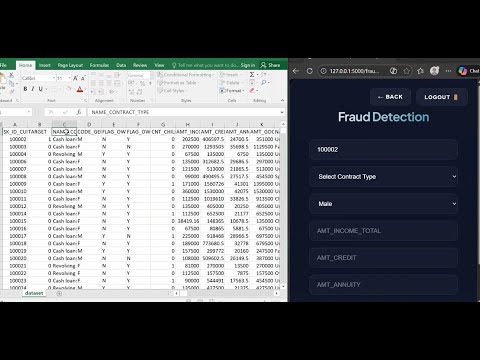
To bridge the gap between algorithmic development and practical financial operations, deploying the trained model into a user-accessible application is essential. Modern fraud detection systems must be interactive, real-time, and easily accessible to analysts, credit managers, and automated decision engines. The integration of the machine learning model into a Flask-based web application provides a lightweight and highly efficient deployment environment. Flask, a widely used Python micro-framework, supports rapid API development, seamless integration with backend machine learning pipelines, and straightforward interaction with front-end forms. In this project, the fraud detection web application incorporates multiple modules including user registration, login authentication, session management, and a fraud prediction interface. Using an SQLite database ensures secure and structured storage of user credentials, offering a reliable authentication mechanism for controlled access to the prediction module. The prediction workflow processes user-submitted credit attributes, applies the same encoding transformations used during model training, and passes the processed input to the deployed Random Forest model. The result—classified as either “Fraudulent Transaction” or “Non-Fraudulent Transaction”—is displayed instantaneously on the user dashboard. This seamless integration creates an end-to-end fraud detection ecosystem that connects data preprocessing, machine learning modeling, model evaluation, and practical deployment into a unified and scalable solution.
The significance of this project extends beyond academic experimentation, addressing real-world challenges faced by financial institutions in managing credit risk. By automating fraud detection and leveraging data-driven decision-making, the system reduces operational delays, enhances security, and improves customer trust. Furthermore, the modular design allows continuous model updates, retraining with new datasets, and integration with advanced techniques such as gradient boosting, neural networks, or anomaly detection algorithms. As fraud strategies evolve, machine learning models can be retrained to maintain high accuracy and adapt to emerging threats. Thus, the proposed credit fraud detection system represents a foundational solution with strong potential for future expansion and integration into large-scale financial infrastructures. By combining the strengths of machine learning, efficient preprocessing, and interactive web deployment, this project demonstrates the powerful synergy of modern data science techniques in solving critical financial fraud challenges.
Block Diagram