Abstract
This project presents a Graphical User Interface (GUI)–based Steganography System that combines encryption, error correction, and spectrum visualization within a unified framework. The system integrates data hiding and extraction modules using the Spread Spectrum Image Steganography (SSIS) approach, designed for robust, secure, and imperceptible communication through digital images. The encoding process encrypts a secret message using AES-GCM symmetric cryptography, generating a random 5-digit password for key derivation. The encrypted payload is optionally protected by Reed–Solomon error correction codes, followed by embedding through Frequency Hopping Spread Spectrum (FHSS) across all color channels. The embedding pattern is randomized using a user-defined or auto-generated seed, enhancing unpredictability and resistance to statistical or visual attacks. The decoding process reverses these steps, recovering the hidden data either directly or via restoration mode using Wiener filtering to counter mild distortions. To ensure high fidelity, the system computes quality metrics such as Mean Squared Error (MSE), Peak Signal-to-Noise Ratio (PSNR), Structural Similarity Index (SSIM), spatial correlation, and mean invariance between cover and stego images.
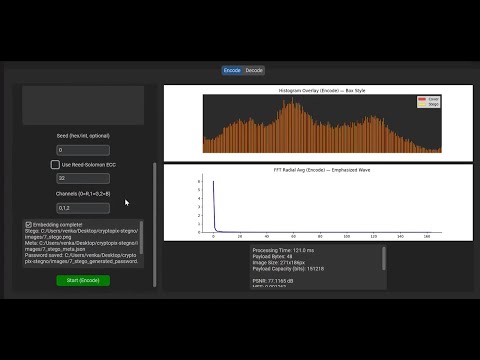
The GUI is implemented in CustomTkinter, featuring an intuitive dual-tab design for Encode and Decode operations. Users can view real-time histogram overlays and FFT radial spectrum plots, which visually demonstrate pixel intensity and frequency-domain variations between cover and stego images. These visuals are enhanced with bolder, box-style histograms and amplified FFT waveforms to improve interpretability. The application supports multi-channel LSB modification, automatic password generation, and meta-data file creation for reproducible decoding. Its modular Python design ensures compatibility with optional scientific libraries such as reedsolo, scipy, and skimage. By combining cryptographic security, error resilience, and visual analytics, this system demonstrates a complete, user-friendly steganographic tool suitable for educational, research, and secure communication purposes. It effectively bridges information hiding, signal processing, and data visualization in a single, interactive application.
INTRODUCTION
In the digital era, the secure exchange of sensitive information has become a critical necessity due to the exponential growth of online communication and data transmission. Traditional cryptographic methods primarily focus on encrypting information, which ensures data confidentiality but often attracts the attention of attackers by signaling the presence of hidden content. To overcome this limitation, steganography — the art and science of concealing information within innocuous digital media — has emerged as a complementary security technique that emphasizes secrecy through invisibility. By embedding secret data into cover media such as images, audio, or video files, steganography provides a covert channel for communication without altering the perceptual quality of the carrier. Among various steganographic techniques, image-based steganography is particularly popular because of its vast redundancy and widespread use in digital communication. The proposed project leverages this concept to design a graphical user interface (GUI)–based system that enables both encryption and decryption of hidden messages within digital images. The system enhances usability through an interactive visual environment built using CustomTkinter, providing users with a simple yet powerful tool for secure data hiding.
This project integrates advanced visualization mechanisms such as histogram analysis and Fast Fourier Transform (FFT) representations to illustrate changes in image frequency and pixel intensity before and after embedding. These visual analytics help users understand the effect of data hiding on the cover image, ensuring transparency and educational insight into the steganographic process. The encryption module converts the secret message into binary or encoded form, disperses it across the pixel matrix, and maintains high peak signal-to-noise ratio (PSNR) and minimal mean squared error (MSE) to preserve image integrity. Conversely, the decryption module extracts the hidden data seamlessly while validating the accuracy of recovery. The GUI includes robust file-handling options, performance metrics, and visual feedback, making it ideal for both academic and practical use in cybersecurity and digital forensics. Overall, this dual-function steganography system bridges the gap between theoretical cryptographic principles and real-time secure communication, demonstrating how graphical interfaces and signal analysis can elevate the reliability, interpretability, and accessibility of modern information-hiding techniques.
The implementation of this steganographic system follows a structured approach that combines data preprocessing, embedding, extraction, and visual validation within a unified GUI environment. During the embedding phase, the system allows users to select any standard image format such as .png, .jpg, or .bmp, and then securely hide textual information within the least significant bits (LSB) of the pixel data. This technique ensures that the modifications are imperceptible to the human eye, maintaining the original image’s appearance and quality. The integrated encryption layer further enhances security by transforming the user’s input message into a cipher-like binary sequence before embedding, preventing direct retrieval even if the steganographic method is discovered. The corresponding decryption phase reverses this process — scanning pixel values, reconstructing the hidden bit stream, and converting it back into readable text — ensuring end-to-end message confidentiality and integrity. In addition to functionality, this system focuses strongly on usability and visualization. The inclusion of histograms and FFT-based image representations helps users comprehend the subtle variations in image structure and frequency domains caused by data embedding. Histograms display pixel intensity distribution before and after encryption, while FFT visuals reveal frequency-domain differences that are typically invisible in the spatial domain. These analyses serve both an educational and diagnostic purpose — helping researchers, students, and practitioners understand the behavior of steganographic transformations in real time. The GUI framework, developed with CustomTkinter, enhances user experience through an organized interface, intuitive buttons, dynamic message boxes, and real-time updates of images and metrics. Additionally, the system computes evaluation parameters such as PSNR, MSE, and data embedding rate, which quantitatively measure the quality and reliability of hidden message retrieval.
Block Diagram