ABSTRACT:
Autonomous mobile robots require efficient and intelligent obstacle avoidance mechanisms to operate safely in dynamic environments. Traditional obstacle avoidance systems rely mainly on distance-based sensors, which can detect obstacles but are unable to identify the type of object present. This limitation can lead to inefficient navigation and safety risks, especially in environments involving humans and furniture.
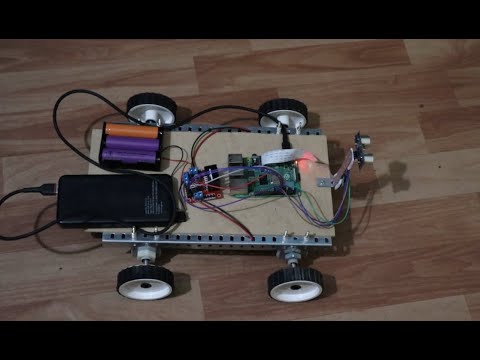
This project presents an AI-based obstacle avoidance robot that integrates YOLO-based object detection with an ultrasonic sensor to achieve intelligent and safe navigation. A Raspberry Pi is used as the central processing unit to perform real-time video processing using a Pi Camera. The trained YOLO model is capable of detecting specific objects such as persons, chairs, dining tables, couches, and suitcases. When any of these objects are detected, the robot intelligently avoids them by making directional movement decisions.
The ultrasonic sensor is employed as a safety mechanism to measure the distance of nearby obstacles and prevent collisions with walls or unseen objects. A priority-based control logic is implemented, where camera-based object detection takes precedence over distance sensing, ensuring correct decision-making. The proposed system enhances navigation accuracy, improves safety, and demonstrates the effectiveness of combining computer vision with sensor-based techniques for autonomous robotic applications.
INTRODUCTION:
Autonomous robots are increasingly being adopted in various fields such as smart homes, healthcare, industries, surveillance, and transportation. One of the most important challenges in autonomous robotic systems is safe and intelligent navigation in environments that contain humans, furniture, and other obstacles. For a robot to operate independently, it must be capable of detecting obstacles, understanding their nature, and making appropriate movement decisions in real time.
Traditional obstacle avoidance robots mainly rely on distance-measuring sensors such as ultrasonic or infrared sensors. While these sensors are effective in detecting nearby obstacles, they cannot identify or classify the type of object present. As a result, all obstacles are treated the same, which may lead to inefficient navigation and unsafe behavior, especially in environments where interaction with humans is required.
Recent advancements in Artificial Intelligence (AI) and computer vision have enabled robots to perceive and understand their surroundings more intelligently. Deep learning-based object detection models such as YOLO (You Only Look Once) allow real-time identification of objects using camera input. By integrating such vision-based intelligence with traditional sensors, robots can make smarter navigation decisions.
This project focuses on the design and development of an AI-based obstacle avoidance robot using a Raspberry Pi, YOLO object detection, and an ultrasonic sensor. The robot is capable of detecting specific objects such as persons, chairs, dining tables, couches, and suitcases using a camera. When these objects are detected, the robot intelligently avoids them by changing direction. The ultrasonic sensor is used as a safety mechanism to detect walls or close obstacles and prevent collisions.
The proposed system implements a priority-based decision-making approach, where camera-based object detection takes precedence over distance sensing. This ensures both intelligent navigation and operational safety. The project demonstrates how the combination of artificial intelligence and sensor-based techniques can significantly enhance the performance and reliability of autonomous robotic systems.
OBJECTIVE:
The main objectives of the AI-Based Obstacle Avoidance Robot Using YOLO and Ultrasonic Sensor are as follows:
1. To design and develop an autonomous mobile robot capable of intelligent obstacle avoidance.
2. To implement real-time object detection using a YOLO-based deep learning model and a camera.
3. To detect and identify specific objects such as persons, chairs, dining tables, couches, and suitcases.
4. To integrate computer vision-based object detection with ultrasonic sensor-based distance measurement.
5. To implement a priority-based control logic where camera detection takes precedence over ultrasonic sensing.
6. To enable the robot to avoid detected objects by making appropriate directional movements such as turning left or right.
7. To use an ultrasonic sensor as a safety mechanism to prevent collisions with walls and unseen obstacles.
8. To control the robot’s movement using a Raspberry Pi and motor driver module.
9. To ensure safe and smooth navigation in indoor environments.
10. To demonstrate the practical application of artificial intelligence and robotics in autonomous navigation systems.
Block Diagram
HARDWARE COMPONENTS:
• Raspberry Pi 4 Model B
• Raspberry Pi Camera Module
• L298N Motor Driver
• DC Motors (4 units for wheels)
• Robot Chassis with Wheels
• 12V Battery / Power Supply
SOFTWARE COMPONENTS:
• Python Programming Language
• YOLOv5 Trained Model (best.pt)
• OpenCV Library
• Raspberry Pi OS
Immediate Download:
1. Synopsis
2. Rough Report
3. Software code
4. Technical support
Hardware Kit Delivery:
1. Hardware kit will deliver 4-10 working days (based on state and city)
2. Packing and shipping changes applicable (based on kit size, state ,city)