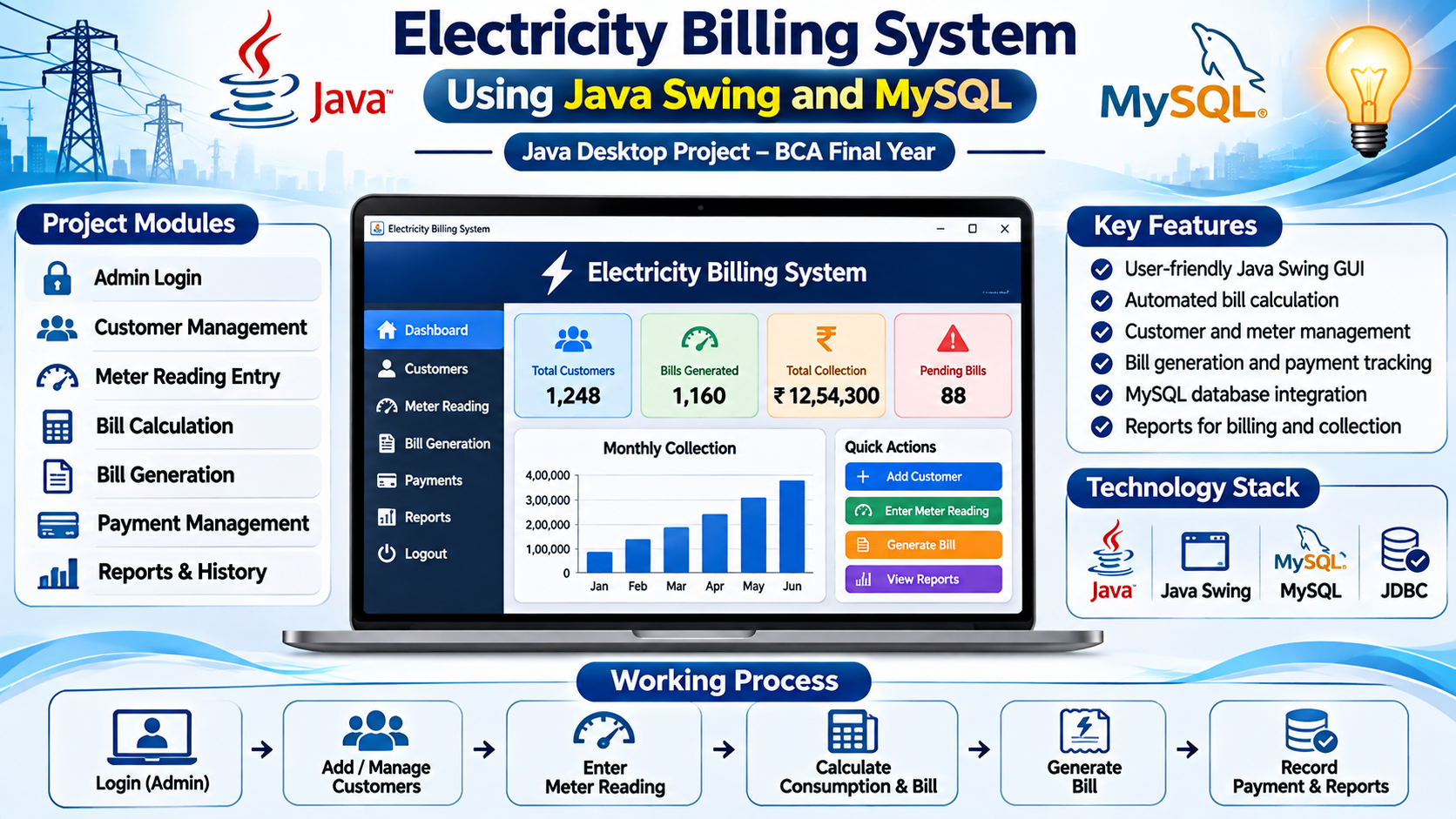
Introduction to Electricity Billing System Using Java
Electricity billing management is an important process for utility service providers. Recording customer information, calculating electricity consumption and maintaining payment details manually can be time-consuming and may lead to calculation errors.
A computerized billing application helps simplify these activities through automated data processing and centralized record management.
Electricity Billing System Using Java Swing and MySQL is a desktop-based software project designed to manage customer information, electricity meter readings, bill generation and payment records.
The application uses Java Swing to create an interactive graphical user interface and MySQL to store customer and billing information. It provides a structured way to manage electricity billing operations while reducing manual paperwork.
Key Features & Benefits
Objectives of the Proposed System
The main objective is to develop a simple and efficient electricity billing management application.
Register and manage electricity customers.
Store customer and meter information.
Record monthly electricity meter readings.
Calculate bills based on consumption and configured tariff rates.
Generate customer electricity bills.
Maintain payment and billing history.
Provide administrators with easy access to customer records.
Reduce manual billing calculations and paperwork.
Implementation Guide
Technologies Used in the Electricity Billing Project
Java: Handles application logic, billing calculations and database operations.
MySQL: Stores customer details, meter readings, electricity bills and payment information.
JDBC: Connects the Java application with the MySQL database.
NetBeans or Eclipse: Provides an integrated development environment for building and testing the application.
Main Modules
Admin Login: Provides authorized access to billing management functions.
Customer Management: Adds, updates, searches and maintains customer information.
Meter Reading Management: Records electricity consumption details for billing periods.
Bill Calculation: Calculates charges using configured consumption slabs, tariff rates and applicable additional charges.
Bill Generation: Creates a detailed bill containing customer information, units consumed, billing period and total payable amount.
Payment Management: Records payments and tracks outstanding bills.
Technical Specifications
Working Process of the Electricity Billing System
Step 1: Administrator Login
The administrator enters valid login credentials to access the application.
Step 2: Customer Registration
Customer information such as name, address, contact details and meter number is registered.
Step 3: Meter Reading Entry
The previous and current meter readings are entered for the selected billing period.
Step 4: Electricity Consumption Calculation
The system calculates consumed units by subtracting the previous reading from the current reading.
Step 5: Automatic Bill Calculation
The application applies the configured tariff slabs, fixed charges and other applicable fees to calculate the bill amount.
Step 6: Bill Generation
A detailed electricity bill is generated and displayed for the customer.
Step 7: Payment Tracking
The administrator records payment details and updates the bill payment status.
Step 8: Database Storage
All customer records, meter readings, billing information and payment transactions are stored in MySQL for future reference.
Conclusion & Next Steps
Applications and Advantages
Applications
Electricity distribution companies.
Residential electricity billing management.
Commercial electricity consumption tracking.
Utility billing administration.
Educational Java desktop application projects.
Advantages
Reduces manual billing work.
Automates electricity consumption calculations.
Organizes customer and meter records.
Provides centralized MySQL database storage.
Simplifies bill generation and payment tracking.
Makes customer information easier to retrieve.
Improves billing record management.
Future Enhancements
The application can be enhanced with online payment integration, PDF bill downloads, email and SMS notifications, customer login portals, graphical consumption reports and smart meter integration for automated meter reading.
Conclusion
The Electricity Billing System using Java Swing and MySQL demonstrates how desktop application development and database management can simplify utility billing operations. By combining customer management, meter reading, automated bill calculation and payment tracking, the project provides a practical solution for learning Java-based software development.
The system can be further expanded into a web-based or cloud-connected electricity management platform with online payments and smart meter integration.
Contact Details
Aislyn Technologies, Bangalore
Phone: +91 97395 94609
Email: info@aislyntech.com
Website: https://aislyn.in
Contact us today to start building your Embedded project in Bangalore with our expert support!