Your Cart

Your Wishlist

EXPLORE

Project Categories

9:30 AM - 6:30 PM | Call Us | WhatsApp

Chat with us Download App Arduino Based Automatic Hole Punch Device Using Servo Motor

Missing People Identification System Using Face Recognition and Deep Learning

Category: AI Projects

Price: ₹ 3600 ₹ 8000 55% OFF

YouTube Video
Product Image

ABSTRACT
Missing people identification is a critical social and security challenge that requires efficient and accurate solutions. Traditional methods of identifying missing individuals rely on manual processes such as physical searches, posters, and public announcements, which are time-consuming and prone to errors. With advancements in machine learning and computer vision, automated facial recognition systems can significantly improve the identification process.
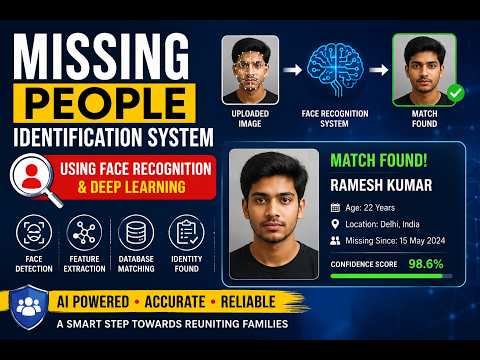
This project presents an image-based Missing People Identification System that uses facial feature extraction and similarity matching techniques to identify missing individuals. Images of missing persons are collected and processed to extract distinctive facial features using a pretrained deep learning model. These features are stored in a centralized database. When an image of a found person is uploaded, the system extracts facial features and compares them with the stored data using similarity metrics. If a matching face is identified, the system displays the corresponding personal details along with a confidence score.
The proposed system is designed as an offline, non-real-time academic prototype and aims to reduce manual effort while improving identification accuracy. This approach provides a practical and efficient solution that can assist authorities and social organizations in identifying missing individuals.
Keywords
Missing People Identification, Face Recognition, Machine Learning, Facial Feature Extraction, Image-Based Identification, Computer Vision


Introduction
Missing people cases pose significant emotional, social, and administrative challenges for families and authorities. The inability to quickly locate and identify missing individuals often leads to prolonged uncertainty and increased risk to the person involved. Existing identification practices largely depend on human observation and manual record verification, which become ineffective when the number of cases increases.
In recent years, the availability of digital images and the widespread use of information systems have created new opportunities for automated identity management. Facial characteristics serve as one of the most reliable biometric traits due to their uniqueness and ease of acquisition. However, efficiently analyzing and comparing facial data from multiple sources requires computational intelligence and systematic processing.
The development of an image-based identification system allows missing person records to be digitally organized and processed in a structured manner. By maintaining a centralized repository of facial information, authorities and organizations can perform faster searches and comparisons. Such systems also help in maintaining consistency and reducing dependency on manual verification.
This project focuses on designing an academic prototype that demonstrates how facial information can be digitally processed, stored, and compared for identification purposes. The system emphasizes simplicity, reliability, and usability while remaining independent of real-time surveillance infrastructure. The proposed approach highlights the practical application of machine learning techniques in addressing societal challenges related to missing people identification.
Objectives
• To design and develop an image-based system for identifying missing people.
• To collect and maintain a centralized database of missing person images and details.
• To perform face detection and preprocessing on uploaded images.
• To extract distinctive facial features using machine learning techniques.
• To store extracted facial features securely for efficient comparison.
• To compare facial features of uploaded images with stored data for identification.
• To display identification results along with a confidence score.
• To reduce manual effort and minimize human errors in the identification process.

Block Diagram

block-diagram