Your cart

Your Wishlist

Categories

YouTube Video
Product Image
Product Preview

Analysis and Design of a Single Phase Multilevel Inverter Using Symmetrical and Asymmetrical Voltage Sources

Category: Electrical Projects

Price: ₹ 5600 ₹ 8000 0% OFF

Abstract:

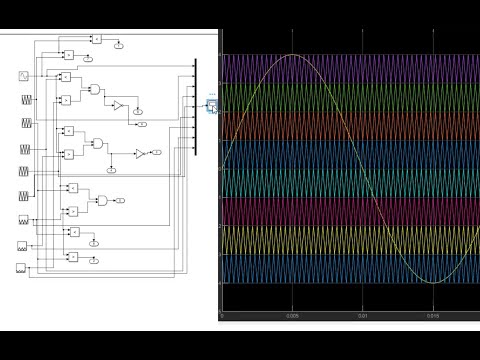
A single-phase multilevel inverter (MLI) with less number of power electronic switches and DC sources is proposed. It can also be extended to any number of levels and also as three phase inverter. The capacitors are balanced by the switching strategy itself and additional voltage control circuits are eliminated. The Switching sequences for nine and thirteen levels is formulated and provided for the proposed MLI. The harmonic reduction is performed and the %THD (Total Harmonic Distortion) is compared for nine and thirteen levels. The proposed system is simulated in MATLAB/Simulink software.
Key words—Multi Level Inverter, Symmetric voltage sources, Reduced number of switches, Generalized inverter structure PWM Modulation strategy.

I. INTRODUCTION:

Traditional energy Numerous drawbacks such as higher distortion in the output voltage, higher switching stress are witnessed in classical or conventional two-level inverters. However, the appearance of Multilevel inverter (MLI) offers several advantages such as low harmonic distortion, lower voltage stress, lower switching losses along with some of the eye-catching features like healthier electromagnetic compatibility, higher efficiency, applications in high voltage, high power. The first configuration of MLI that capable to amalgamate higher output voltage levels for medium voltage applications was none other than Neutral point clamped (NPC) among the three of classical topologies of MLIs. To overcome the drawbacks of increased number of clamping diodes in NPC-MLI, the Flying Capacitor (FC)MLI topology was introduced. Anyway, major drawback lies with FC-MLI about the capacitor voltage balancing technique. However, demerits of aforesaid classical MLIs are overcome by the cascaded H-Bridge configuration that does not requires any surplus components like diodes and capacitors in the circuit with simple structure. It can be simply observed that with the symmetric CHB inverter i.e. with same value of the DC links, the number of power switches and DC sources rise with rise in the output voltage level whereas asymmetrical CHB multilevel inverter consumes different value of DC links voltage having same number of overall components. Therefore, the need strikes to develop a MLI with reduced number of components and DC voltage sources for both symmetrical and the asymmetrical MLI.. The aim of the present researchers is to design and develop reduced switch MLI configurations having minimal number of IGBTs, gate drivers, DC voltage sources, TSV and losses. Recent discovered topology of MLIs is compared with the proposed one and it was found better among them. The MLI proposed is evolved from the existing source-based cross connected multilevel inverter (CCS-MLI) for interfacing renewable energy sources with low/medium- and high voltage grids. The basic block and generalized structure of proposed MLI for HVA and L/M VA are presented. Proposed block (fundamental) includes 6 uni-directional and1 bi-directional switch along with a voltage divider and 2 DC sources. The new structure configured produces all odd and even voltage levels under symmetric as well as in asymmetric mode of operation. A new structure comprises semi-half-bridge cells connected in series with criss-crossed power switches. A new MLI topology presented a new named Square T-Type (ST-Type) module that can generate17 levels with reduced components that can be used in highvoltage/power applications with unequal DC sources. A square T-type module produces 17 levels by 12 switches and4 unequal DC sources. A nearest level control method as a switching technique is used to produce high quality output voltage with lower harmonic contents. Two novel compact modules were presented for CCM-MLI. The proposed 7LCM and 13LCM topologies not only realize a low number of conducting switch count for all voltage levels, but also guarantee smooth transition between voltage levels during dead-time. The letter proposed a basic cell i.e.4-level symmetrical sub-module or a hybrid cascaded multilevel inverter (HCMLI) topology is formed by the combination of n sub-modules and a full-bridge. A two-stage switched-capacitor based multilevel inverter possesses a drawback such that switches in the second stage (i.e. Hbridge) endure higher voltage stress. To resolve this problem, this letter in proposes a single-stage switched-capacitor module (S3CM) topology for cascaded multilevel inverter which ensures the peak inverse voltage across all switches within the dc source voltage.

II. PROBLEM STATEMENT:

In this, a single phase nine and thirteen level MLI topology with equal voltage sources is proposed. Also, this topology is slightly modified to get a new generalized configuration for optimum load sharing. Proposed nine-level inverter is perfect for equal load sharing among DC sources and capacitors. The switching sequences are tabulated for the proposed inverter. The %THD of nine and thirteen level topologies are measured and compared.

block-diagram

• Demo Video
• Complete project
• Full project report
• Source code
• Complete project support by online
• Life time access
• Execution Guidelines
• Immediate (Download)

1. Matlab 2014A to Matlab 2018B
2. Sim power systems toolbox

Hardware Requirements:

1. PC or Laptop
2. 500GB HDD with 1 GB above RAM
3. Keyboard and mouse

1. Immediate Download Online
2. Installation (Monday- Saturday 10 am to 6 pm)

Leave a Review

Only logged-in users can leave a review.

Customer Reviews