ABSTRACT:
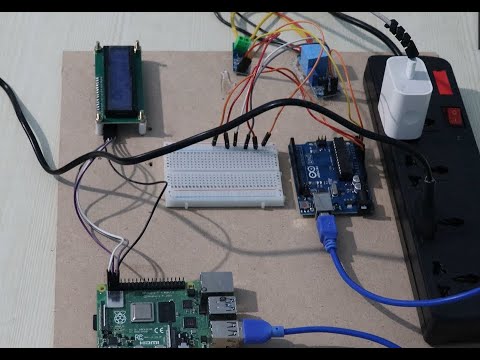
This project presents a comprehensive intelligent energy monitoring and forecasting framework that leverages computational intelligence techniques to estimate electricity consumption and analyze system performance with high accuracy. The proposed system integrates real-time sensor data acquisition, embedded processing, data logging, and machine learning–based predictive analytics to provide a complete solution for smart energy management. An Arduino-based sensing unit equipped with a ZMPT101B voltage sensor and an ACS712 current sensor is used to continuously measure the instantaneous electrical parameters of connected household loads such as chargers, monitors, and soldering equipment. Using these measurements, the Arduino computes the real-time power consumption and transmits the voltage, current, and power values to a Raspberry Pi every 30 seconds through serial communication.
On the Raspberry Pi, the incoming data is systematically recorded in a CSV file, which serves as both a real-time log and the primary dataset for model inference. The system simultaneously generates live graphical visualizations of voltage, current, and power, allowing immediate observation of load behavior. To prevent data accumulation and ensure optimal system performance, the CSV file is automatically reset every 24 hours, enabling a fresh cycle of data collection each day.
A trained machine learning model is deployed on the Raspberry Pi to analyze recent consumption patterns extracted from the CSV file. By processing the latest data every 2 minutes, the model generates both short-term (next 2 minutes) and long-term (next 24 hours) predictions of electricity consumption. These predictive insights are displayed in real time on the Raspberry Pi terminal and mirrored on a 16×2 LCD module for ease of monitoring. Additionally, the system generates a 24-hour prediction graph that illustrates expected consumption trends and provides a visual representation of load performance analysis over the upcoming day.
The integration of hardware sensing, data-driven prediction, and visualization demonstrates the effectiveness of computational intelligence in managing and optimizing electrical energy usage. By offering accurate real-time monitoring, predictive analytics, and performance evaluation, the system highlights its potential for application in households, industries, and smart grid environments. This work ultimately showcases how intelligent energy estimation techniques can support proactive decision-making, reduce wastage, and enhance overall energy efficiency.
INTRODUCTION:
Electricity has become an essential component of daily life, powering residential homes, industries, commercial systems, and a wide array of modern technologies. With the increasing dependence on electrical appliances and equipment, monitoring and managing energy consumption has emerged as a significant challenge. Traditional methods of energy estimation rely mostly on monthly electricity bills or manual meter readings, which provide only cumulative values and lack real-time insights. These conventional approaches fail to detect abnormal usage patterns, cannot perform predictive analysis, and offer no mechanism for understanding future energy demands. As a result, consumers and industries often experience unexpected energy costs, inefficient resource utilization, and difficulty in optimizing load behavior.
Advancements in Internet of Things (IoT), embedded systems, and computational intelligence have created new opportunities for smart and automated energy monitoring. By combining real-time sensing technologies with machine learning algorithms, it is now possible to measure electricity usage continuously, analyze consumption trends, and forecast future energy requirements with improved accuracy. Machine learning models are particularly effective in energy analytics because they can learn complex nonlinear relationships between time, load characteristics, voltage fluctuations, and user behavior patterns. These capabilities support proactive decision-making, enabling users to adjust consumption before overloads, inefficiencies, or high bills occur.
In this project, a complete intelligent energy estimation system is designed and implemented using both hardware and software technologies. The system begins with an Arduino-based sensing module that uses a ZMPT101B voltage sensor and an ACS712 current sensor to capture real-time electrical parameters such as voltage, current, and power. These values are transmitted to a Raspberry Pi, which functions as the core processing unit. The Raspberry Pi logs all sensor readings in a CSV file at 30-second intervals, generates real-time graphs, and hosts a pre-trained machine learning model for forecasting. To ensure reliable and efficient data handling, the CSV file is automatically cleared and recreated every 24 hours, enabling both daily analysis and long-term operational stability.
The machine learning model operates on updated CSV data every 2 minutes to predict the immediate short-term consumption (next 2 minutes) as well as long-term usage patterns for the next 24 hours. These predictions are displayed on the Raspberry Pi terminal and a 16×2 LCD module, providing instant visual feedback to the user. Additionally, detailed graphical representations of future consumption trends are generated to support performance evaluation and energy planning.
The combination of real-time monitoring, computational intelligence, predictive analytics, and visualization highlights the significance of this work in modern energy management. Such systems can be applied in domestic environments, industrial settings, commercial buildings, and smart grid infrastructures. By leveraging the power of embedded systems and machine learning, the project demonstrates a scalable and practical solution for efficient electricity consumption management and performance analysis.
OBJECTIVES
1. To measure real-time electrical parameters
The system aims to accurately capture voltage, current, and power consumption using ZMPT101B and ACS712 sensors connected to an Arduino, ensuring continuous and reliable energy monitoring.
2. To collect and store data systematically
Electrical readings will be logged into a CSV file at 30-second intervals, creating an organized dataset for analysis and machine learning prediction.
3. To integrate machine learning for consumption forecasting
A trained ML model deployed on Raspberry Pi will analyze the real-time data and generate short-term (2-minute) and long-term (24-hour) predictions of electricity usage.
4. To visualize real-time load behavior
The system will produce live graphs that update every 30 seconds, helping users observe changes in voltage, current, and power instantly.
5. To generate future consumption trends
A prediction graph for the next 24 hours will be created every 2 minutes, giving users a clear understanding of expected energy usage and enabling better planning.
6. To maintain efficient data management
The CSV file storing real-time values will automatically reset after 24 hours to prevent memory buildup and keep the system functioning smoothly.
7. To provide user-friendly display outputs
Both the Raspberry Pi terminal and a 16×2 LCD module will show real-time values and predicted consumption, ensuring easy access to information.
8. To develop a low-cost intelligent embedded solution
The project aims to create a compact, economical system capable of real-time monitoring, prediction, and analysis without depending on external servers or cloud services.
Block Diagram