ABSTRACT:
The increasing amount of urban waste generated every day has created a major challenge for efficient waste management and timely garbage collection. Traditional waste collection methods often rely on fixed schedules without considering the actual fill level of garbage bins, which leads to unnecessary collection trips, increased operational costs, overflowing bins, and unhygienic environmental conditions. To overcome these limitations, this project presents the design and implementation of an IoT-based Smart Bin Monitoring System capable of monitoring garbage levels in real time and transmitting the collected data to a remote server for continuous observation and management.
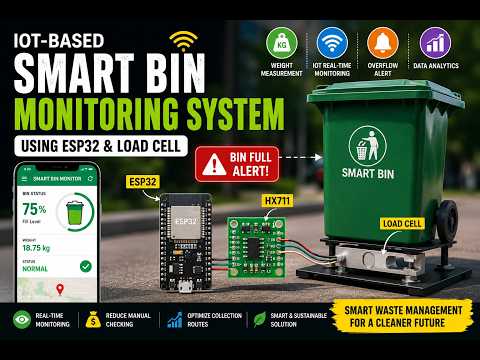
The proposed smart bin system is developed using an ESP32 microcontroller as the central processing unit, integrated with a load cell sensor and HX711 amplifier module to measure the weight of waste deposited inside the bin accurately. The measured weight data is continuously processed by the ESP32 to determine the fill status of the garbage bin. Based on predefined threshold values, the system classifies the bin condition into different levels such as Less, Medium, and Heavy. Visual indications are provided using LED indicators, while a 16x2 I2C LCD display shows the real-time weight and current status of the bin for local monitoring purposes.
To ensure reliable measurements, the system incorporates averaging techniques, noise filtering, and spike elimination mechanisms to remove unstable sensor readings and improve accuracy. The smart bin is also equipped with Wi-Fi connectivity, enabling the ESP32 to send real-time bin weight information to a web server or cloud-based API using HTTP communication protocols. This allows municipal authorities or waste management personnel to remotely monitor the status of multiple bins and make informed decisions regarding garbage collection scheduling.
The proposed system offers several advantages including reduced manpower requirements, optimized waste collection routes, improved environmental cleanliness, prevention of bin overflow, and efficient utilization of waste management resources. The integration of IoT technology enables continuous remote monitoring and supports the development of smart city infrastructure. The project demonstrates a low-cost, scalable, and energy-efficient solution for modern waste management applications and can be further enhanced with additional features such as GPS tracking, automatic lid control, gas detection sensors, and mobile application support for real-time notifications and analytics.
Overall, the Smart Bin Monitoring System provides an intelligent and automated approach to waste management by combining embedded systems, sensor technology, wireless communication, and IoT-based monitoring to improve the efficiency and effectiveness of garbage collection processes.
INTRODUCTION:
Rapid urbanization and population growth have significantly increased the amount of solid waste generated in cities, institutions, industries, and residential areas. Efficient waste management has therefore become an essential requirement for maintaining environmental cleanliness, public health, and sustainable urban development. Traditional waste collection systems mainly depend on routine manual inspection and fixed collection schedules, which often result in inefficient operations such as overflowing garbage bins, unnecessary collection trips, increased fuel consumption, and poor utilization of manpower. These limitations highlight the need for an intelligent and automated waste monitoring solution capable of improving the overall efficiency of garbage management systems.
Recent advancements in the Internet of Things (IoT), embedded systems, and wireless communication technologies have enabled the development of smart waste management systems that can monitor garbage bins in real time and provide accurate information regarding their fill status. IoT-based monitoring systems help municipal authorities and waste management organizations optimize collection schedules, reduce operational costs, and maintain cleaner surroundings. Smart bins equipped with sensors and wireless connectivity can continuously track the condition of garbage bins and transmit data to remote monitoring platforms for analysis and decision-making.
This project presents the design and implementation of an IoT-Based Smart Bin Monitoring System using an ESP32 microcontroller, load cell sensor, HX711 amplifier module, LCD display, LED indicators, and Wi-Fi communication technology. The system measures the weight of garbage inside the bin using a load cell sensor and processes the data through the ESP32 microcontroller. Based on predefined weight threshold values, the system categorizes the bin status into different levels such as Less, Medium, and Heavy. The current weight and status are displayed locally on an LCD screen, while LED indicators provide visual alerts regarding the bin condition.
In addition to local monitoring, the system utilizes the built-in Wi-Fi capability of the ESP32 to transmit real-time weight information to a remote server or cloud platform using HTTP communication protocols. This enables remote monitoring of garbage bins from any location and supports efficient waste collection planning. The system also incorporates filtering techniques to remove sensor noise and unstable readings, thereby improving measurement reliability and overall system performance.
The proposed smart bin system offers several advantages including automated waste monitoring, reduced manual inspection, prevention of garbage overflow, improved environmental hygiene, optimized waste collection operations, and support for smart city infrastructure. The project demonstrates how IoT and sensor-based technologies can be effectively integrated to develop an intelligent, low-cost, and scalable waste management solution suitable for modern urban environments.
OBJECTIVES:
The main objective of this project is to design and develop an IoT-Based Smart Bin Monitoring System that can monitor garbage levels in real time using weight measurement technology and transmit the collected data to a remote server for efficient waste management and monitoring.
1. To develop an automated garbage monitoring system using the ESP32 microcontroller.
2. To measure the weight of waste inside the bin accurately using a load cell sensor and HX711 amplifier module.
3. To classify the garbage level into different categories such as Less, Medium, and Heavy based on predefined threshold values.
4. To display the real-time garbage weight and bin status on a 16x2 I2C LCD display for local monitoring.
5. To provide visual indications using LED indicators for different garbage fill levels.
6. To establish Wi-Fi connectivity using ESP32 for wireless data transmission.
7. To send real-time garbage weight data to a remote server or cloud platform using HTTP communication protocols.
8. To reduce manual inspection and improve the efficiency of waste collection management.
9. To prevent garbage overflow and maintain environmental cleanliness through continuous monitoring.
10. To develop a low-cost, scalable, and energy-efficient smart waste management solution suitable for smart city applications.
11. To improve the reliability of sensor readings using filtering and noise reduction techniques.
12. To demonstrate the practical implementation of IoT technology in modern waste management systems.
Block Diagram