Abstract
Road accidents caused by hazardous environmental conditions, gas leakage, unexpected obstacles, and abnormal sensor readings remain a major safety concern in modern transportation systems. This project presents a real-time Accident Detection and Monitoring System that integrates IoT sensor data with a Machine Learning model to predict accident conditions and display live monitoring results through a Flask-based web application. The system collects real-time sensor data including temperature, humidity, gas concentration, vibration, ultrasonic distance, and GPS coordinates from an external API.
A Multi-Output Random Forest Classifier is trained using labeled historical sensor data to simultaneously predict temperature level, humidity level, gas leakage status, object detection, and accident occurrence. Feature scaling is applied using StandardScaler to ensure optimal model performance. The trained model is deployed within the Flask application to provide real-time predictions whenever live sensor data is fetched.
The system stores sensor records and accident history using SQLite database management, enabling persistent monitoring and statistical tracking of accident-prone locations. The web interface displays latest readings, machine learning predictions, historical data, and frequent accident zones. This integrated approach combines IoT data acquisition, supervised machine learning, and web-based deployment to create a scalable and intelligent accident monitoring solution aimed at improving road safety and emergency response efficiency.
Keywords
Accident Detection, Internet of Things (IoT), Machine Learning, Multi-Output Classification, Random Forest, Flask Web Application, Real-Time Monitoring, Sensor Data Analysis, Road Safety, SQLite Database.
Introduction
Road safety has become one of the most critical challenges in modern transportation systems. With the rapid increase in the number of vehicles and expanding urban infrastructure, the probability of road accidents has significantly increased. Accidents not only result in loss of human lives but also cause severe economic damage and long-term social impact. Traditional accident monitoring systems largely depend on manual reporting, eyewitness communication, or delayed emergency response mechanisms. Such approaches often result in increased response time, which can worsen the consequences of accidents. Therefore, there is a growing need for intelligent, automated, and real-time accident detection systems capable of identifying hazardous conditions and alerting concerned authorities without human intervention.
Recent advancements in Internet of Things (IoT) technology have enabled the deployment of multiple sensors capable of continuously monitoring environmental and vehicle-related parameters. Sensors such as temperature sensors, humidity sensors, gas detectors, vibration sensors, and ultrasonic distance sensors provide valuable real-time information about road and environmental conditions. When integrated with location data using GPS coordinates, these sensors create a comprehensive dataset that can be analyzed to determine potential accident situations. However, raw sensor data alone is insufficient to make reliable decisions. Intelligent processing using Machine Learning (ML) techniques is required to interpret patterns and classify conditions accurately.
Machine Learning has emerged as a powerful tool for predictive analysis and classification tasks. In accident detection systems, ML models can learn patterns from historical sensor data and classify whether a particular combination of readings indicates normal conditions or a potential accident. Unlike rule-based systems, machine learning models adapt to data patterns and improve prediction reliability. Multi-output classification models are particularly useful in such scenarios, as they allow simultaneous prediction of multiple related conditions. For example, temperature level, humidity level, gas leakage status, object detection, and accident occurrence can all be predicted together from the same input data.
This project presents the design and implementation of an IoT-based real-time Accident Detection and Monitoring System using a Multi-Output Random Forest Classifier integrated with a Flask web application. The system collects live sensor data from an external API source, processes it, stores it in a local SQLite database, and uses a trained machine learning model to generate predictive labels. The predictive outputs include environmental condition classification (low, normal, high), gas leakage detection, obstacle detection using ultrasonic sensor readings, and final accident prediction.
The machine learning model is trained using historical sensor data stored in a CSV file. During preprocessing, numerical sensor readings are transformed into categorical labels based on predefined threshold ranges. For instance, temperature and humidity values are categorized into low, normal, or high levels, while gas and ultrasonic values are converted into binary classifications. The dataset is scaled using StandardScaler to normalize feature values and improve model performance. A Random Forest classifier is employed due to its robustness, ability to handle non-linear relationships, and reduced risk of overfitting. The MultiOutputClassifier wrapper enables simultaneous prediction of multiple target variables.
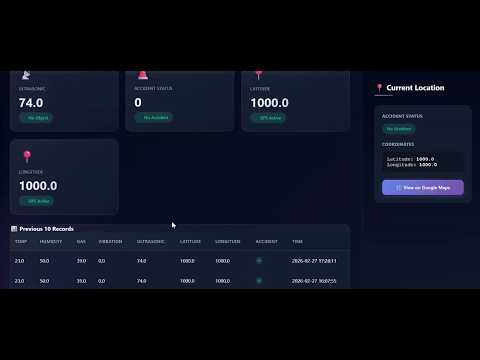
After training, the model and scaler are saved using joblib and integrated into the Flask application. Whenever live data is fetched through the API, the system automatically applies scaling and generates predictions in real time. The web application displays the latest sensor values, predicted classifications, and accident status in an organized dashboard interface. Additionally, the system maintains two database tables: one for storing all live sensor records and another for tracking persistent accident locations along with their frequency counts. This enables identification of accident-prone zones over time.
The integration of IoT data acquisition, machine learning prediction, and web-based visualization creates a complete end-to-end intelligent monitoring system. Unlike traditional accident detection approaches that rely solely on impact sensors or manual alerts, this system evaluates multiple environmental factors before determining accident conditions. The use of GPS coordinates further enhances the system’s ability to map and analyze accident hotspots.
Another important advantage of this system is scalability. Since the web application is built using Flask, it can be deployed on local servers or cloud platforms. The modular architecture allows easy integration of additional sensors, more advanced machine learning algorithms, or real-time alert systems such as SMS and email notifications. The database-driven design ensures persistent storage and efficient retrieval of historical records for analysis and reporting purposes.
In summary, this project addresses the limitations of conventional accident monitoring systems by introducing an intelligent, data-driven solution that combines IoT sensing, supervised machine learning, and web-based deployment. By enabling real-time detection and historical accident tracking, the system contributes toward improving road safety, reducing response time, and supporting data-driven decision-making for transportation authorities
Objectives
The primary objectives of the IoT-Based Real-Time Accident Detection and Monitoring System are:
1. To design and develop an IoT-based data acquisition system
To collect real-time environmental and sensor data including temperature, humidity, gas concentration, vibration, ultrasonic distance, and GPS location.
2. To create a structured dataset for machine learning training
To preprocess historical sensor data and generate meaningful classification labels for temperature level, humidity level, gas leakage, object detection, and accident occurrence.
3. To implement a Multi-Output Machine Learning model
To train a Random Forest-based MultiOutputClassifier capable of simultaneously predicting multiple related conditions from sensor inputs.
4. To apply feature scaling for improved model performance
To use StandardScaler for normalizing input features before training and prediction to enhance accuracy and stability.
5. To integrate the trained model into a Flask web application
To deploy the trained machine learning model for real-time accident prediction within a web-based monitoring system.
6. To store and manage sensor records using a database system
To design and implement SQLite tables for storing live sensor data and persistent accident history.
7. To track and analyze accident-prone locations
To maintain accident frequency counts based on GPS coordinates for identifying high-risk zones.
8. To develop a real-time monitoring dashboard
To display latest sensor readings, machine learning predictions, historical data, and accident statistics in a user-friendly interface.
9. To reduce response time in accident detection scenarios
To enable automated and intelligent accident identification without relying on manual reporting.
10. To build a scalable and extendable system architecture
To design the system in a modular way so that additional sensors, alert mechanisms, or advanced algorithms can be integrated in the future.
Block Diagram