Abstract
The rapid increase in substance abuse has emerged as a critical challenge affecting public safety, healthcare services, and workplace productivity. Conventional drug detection techniques primarily rely on biochemical tests such as blood, urine, or saliva analysis. Although these methods are clinically reliable, they are invasive, time-consuming, costly, and unsuitable for real-time or large-scale screening environments. Consequently, there is a growing need for a non-invasive, automated, and efficient drug detection mechanism capable of delivering fast and reliable results.
Drug consumption often induces noticeable physiological changes in the human eye, including abnormal pupil dilation, irregular eye movements, redness, and altered blinking patterns. These ocular manifestations serve as important visual biomarkers that can be exploited for automated drug detection. In this context, the present work proposes an intelligent drugged eye detection system that integrates classical image processing techniques with deep learning models to accurately classify eye images as drug-affected or normal.
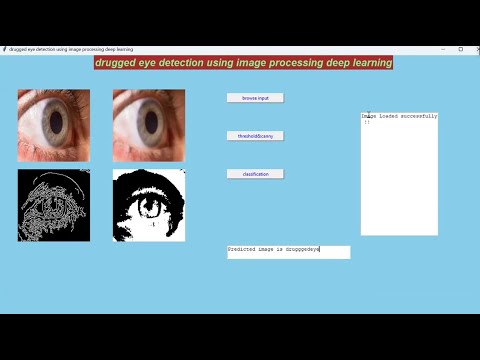
The proposed framework begins with the acquisition of eye images, which are subjected to preprocessing operations such as resizing, normalization, thresholding, and Canny edge detection. These techniques enhance critical ocular features while reducing noise and irrelevant visual information. The preprocessed images are then fed into a Convolutional Neural Network (CNN), which automatically extracts hierarchical features and learns complex visual patterns associated with drug-induced eye conditions. The CNN model is trained using labeled datasets and optimized to achieve high classification accuracy and generalization performance.
Experimental evaluation demonstrates that the integration of image processing with deep learning significantly improves detection reliability while minimizing human intervention and subjectivity. The system is non-invasive, scalable, and suitable for real-time deployment in law enforcement checkpoints, clinical diagnostics, workplace safety monitoring, and transportation systems. Overall, the proposed approach offers a practical and effective solution for automated drug detection using ocular image analysis, contributing to enhanced public safety and improved decision-making processes.
Keywords
Drugged Eye Detection, Image Processing, Deep Learning, Convolutional Neural Network, Canny Edge Detection, Thresholding, Ocular Biometrics, Non-Invasive Drug Detection.
Introduction
Substance abuse has become a pervasive global problem, significantly affecting public safety, healthcare systems, and socio-economic stability. The consumption of narcotic and psychotropic substances impairs cognitive ability, motor coordination, and sensory perception, often leading to accidents, criminal activities, and severe health complications. According to global health statistics, a substantial proportion of road accidents, workplace incidents, and violent offenses are directly or indirectly associated with drug influence. Consequently, there is an urgent need for effective, rapid, and reliable drug detection mechanisms that can be deployed in real-time environments.
Traditional drug detection techniques primarily depend on biochemical analysis methods such as blood tests, urine screening, saliva analysis, and hair follicle examination. Although these methods are considered accurate and legally accepted, they suffer from several limitations. These approaches are invasive, time-consuming, expensive, and require specialized laboratory infrastructure and trained personnel. Moreover, they are impractical for immediate decision-making scenarios such as roadside inspections, workplace safety checks, and emergency medical assessments. As a result, law enforcement agencies and healthcare professionals often rely on preliminary observational assessments before laboratory confirmation.
One of the most prominent indicators of drug influence manifests through the human eye. Drug consumption can induce noticeable ocular changes such as abnormal pupil dilation or constriction, increased redness, irregular blinking patterns, impaired eye movements, and altered gaze behavior. These physiological responses are widely used in field sobriety tests and clinical examinations. However, such assessments are largely subjective and depend heavily on the experience and judgment of the observer. Factors such as lighting conditions, environmental distractions, fatigue, and subtle symptom presentation can significantly affect the accuracy and consistency of manual eye inspections.
With the rapid advancement of computer vision and artificial intelligence technologies, automated image-based analysis has emerged as a promising alternative to traditional drug detection methods. Image processing techniques enable the enhancement and extraction of salient visual features from images, while deep learning models are capable of learning complex patterns from large datasets. Among various deep learning architectures, Convolutional Neural Networks (CNNs) have demonstrated remarkable performance in image classification and pattern recognition tasks, particularly in medical imaging and biometric analysis.
Objectives
The main objectives of the project are:
• To design an automated drug detection system using eye images.
• To apply image preprocessing techniques to enhance ocular features.
• To implement a CNN-based deep learning model for classification.
• To improve accuracy and consistency in drug detection.
• To reduce reliance on invasive and manual testing methods.
• To enable real-time detection capability.
• To ensure scalability and robustness of the system.
Block Diagram
System Requirements
Software
The system is developed using Python programming language, specifically Python version 3.8, which provides a stable and widely supported development environment. Image processing tasks are performed using the OpenCV library, while numerical operations are handled using NumPy. The deep learning components, including the Convolutional Neural Network, are implemented using TensorFlow and Keras frameworks. A graphical user interface is designed using the Tkinter library to enable user-friendly interaction and result visualization. The software environment is compatible with Windows and Linux operating systems, and all required tools and libraries are open-source, ensuring ease of installation, portability, and maintenance.
Hardware
The proposed drugged eye detection system can be implemented on a standard personal computer without the need for specialized hardware. A system equipped with a minimum of 4 GB RAM and a multi-core processor is sufficient to support image processing operations and deep learning inference. Since the model is optimized for efficiency, the use of high-performance GPUs is not mandatory for basic execution. Standard input and output devices such as a keyboard, mouse, and display unit are required for user interaction. Additionally, a digital camera or imaging device may be utilized for capturing eye images when real-time data acquisition is needed.