ABSTRACT
In recent years, the rapid digitalization of recruitment platforms and job portals has resulted in an overwhelming number of job postings across multiple domains. While this expansion has increased opportunities, it has also created significant challenges for job seekers in identifying roles that genuinely align with their skills, experience, and career objectives. Traditional job recommendation systems primarily rely on keyword-based matching techniques, which often fail to capture the semantic meaning and contextual relevance of resume content. As a result, job seekers frequently receive irrelevant or low-quality job recommendations. To address these limitations, this project presents an AI Job Recommendation System that leverages modern Natural Language Processing (NLP) techniques and semantic similarity models to provide accurate and intelligent job recommendations based on resume analysis.
The proposed system is designed to automatically analyze a candidate’s resume and recommend suitable job roles by comparing the semantic similarity between resume content and job descriptions. The system accepts resumes in Portable Document Format (PDF) and extracts textual content using reliable document parsing techniques. This extracted text undergoes preprocessing steps such as normalization, punctuation removal, and text cleaning to improve the quality of semantic representation. Job data is sourced from a structured dataset containing job roles, workplace details, working modes, responsibilities, and required skills. These fields are consolidated into a unified textual representation to enable effective semantic comparison.
At the core of the system lies an LLM-based embedding approach using a pre-trained Sentence Transformer model, specifically the paraphrase-MiniLM-L6-v2 architecture. This lightweight yet powerful model is capable of converting both resume text and job descriptions into dense numerical vector embeddings that capture contextual meaning rather than surface-level keyword similarity. Unlike traditional machine learning models that require extensive task-specific training, this system utilizes transfer learning, where a pre-trained language model is directly applied to a new domain without fine-tuning. This approach significantly reduces computational complexity while maintaining high semantic accuracy, making the system suitable for deployment on CPU-based environments.
To enhance performance and scalability, the system integrates a two-stage job filtering and matching mechanism. In the first stage, a Term Frequency–Inverse Document Frequency (TF-IDF) based filtering method is applied to identify the most relevant job postings based on lexical similarity. This step reduces the search space by selecting a subset of potentially relevant jobs, thereby minimizing unnecessary computation. In the second stage, a dense vector similarity search is performed using FAISS (Facebook AI Similarity Search), a high-performance library designed for efficient similarity search over large vector datasets. FAISS computes cosine similarity between resume embeddings and job embeddings to retrieve the top matching job recommendations in real time.
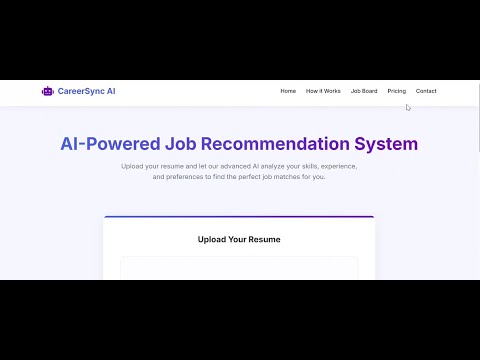
The system is implemented as a Flask-based web application, providing an intuitive and user-friendly interface for job seekers. Users can upload their resumes through the web interface and receive a ranked list of recommended job roles based on semantic relevance. The application architecture ensures modularity, allowing independent handling of resume processing, embedding generation, similarity computation, and result presentation. Additionally, dynamic model quantization techniques are applied to optimize memory usage and inference speed, further improving system efficiency without compromising recommendation quality.
From an artificial intelligence perspective, the system demonstrates the practical application of Large Language Models (LLMs) in real-world recommendation systems. Although the model used is not fine-tuned on domain-specific job data, its pre-trained semantic capabilities enable effective understanding of resumes across diverse domains. The decision to avoid fine-tuning in the current implementation is intentional, as it ensures faster development, lower hardware requirements, and reduced risk of overfitting due to limited labeled data. The system design, however, allows future enhancements such as supervised fine-tuning using curated resume–job datasets to further improve recommendation accuracy and personalization.
Experimental evaluation of the system shows that semantic-based job matching significantly outperforms traditional keyword-based approaches in terms of relevance and contextual accuracy. The use of FAISS ensures low-latency retrieval even when the job dataset scales to thousands of entries. The system is particularly suitable for small to medium-scale recruitment platforms, educational institutions, and career guidance portals seeking intelligent job matching solutions without high infrastructure costs.
In conclusion, the AI Job Recommendation System effectively addresses the shortcomings of conventional job recommendation techniques by combining NLP, LLM-based embeddings, and efficient similarity search. The project highlights the potential of semantic understanding in improving recruitment processes and demonstrates a scalable, efficient, and practical approach to intelligent job recommendation. This system serves as a strong foundation for future research and development in AI-driven recruitment platforms, with scope for enhancements such as skill extraction, personalization, fine-tuned models, and cloud-based deployment.
Block Diagram