Data security has become increasingly important as digital information is exchanged through web applications, cloud platforms, communication networks and distributed systems. Sensitive information requires protection against unauthorized access, modification and disclosure. Cryptography and steganography are two important research areas that explore different approaches to information security.
Cryptography transforms readable information into an encrypted representation using algorithms and secret keys. Steganography focuses on concealing the existence of information within another digital medium. Combining these concepts with biological sequence representations has created opportunities for exploring alternative data encoding and key generation techniques.
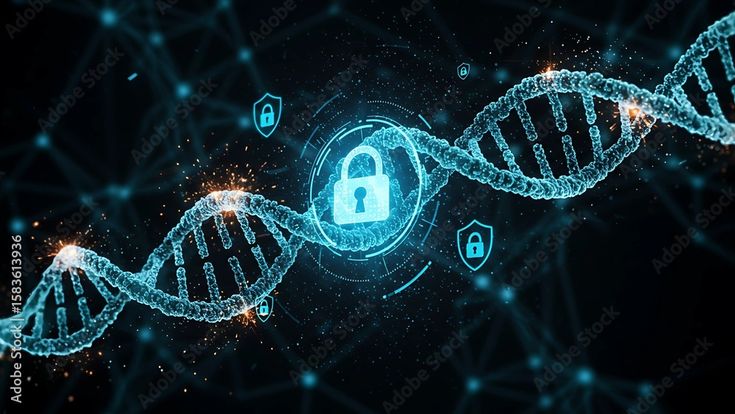
The Key Generation for Zero Steganography Using DNA Sequences project explores the use of DNA-inspired encoding and cryptographic techniques to develop a secure key generation framework. DNA contains four basic nucleotide symbols: Adenine (A), Thymine (T), Guanine (G) and Cytosine (C). These symbols can be represented digitally and mapped to binary values for computational processing.
The proposed approach uses DNA sequence representation to generate or transform key material for a zero-steganography workflow. The project aims to demonstrate how sequence encoding, cryptographic processing and secure key management can be integrated into an experimental information security application.
Key Features & Benefits
Existing System and Its Challenges
Traditional data protection systems commonly use encryption algorithms, secret keys and authentication mechanisms to protect sensitive information. Conventional steganography systems may also hide information within images, audio files or other digital media.
Although these methods provide useful security capabilities, they present several research and implementation challenges.
1. Key Management: Securely generating, distributing, storing and updating cryptographic keys is an important part of any security system.
2. Unauthorized Access: Weak keys, poor authentication and insecure storage can expose sensitive information.
3. Predictable Key Generation: Poorly designed random number generation can produce predictable keys and weaken security.
4. Data Representation: Converting information between binary, nucleotide and other encoding formats requires accurate mapping and validation.
5. Steganographic Detection: Conventional hidden-data techniques may be detected through statistical analysis or specialized steganalysis methods.
6. Computational Complexity: Combining multiple encoding and cryptographic operations may increase processing time and implementation complexity.
DNA-inspired encoding provides an interesting alternative representation for information processing. However, using DNA symbols does not automatically make a cryptographic key secure. Security must come from a properly designed cryptographic algorithm and a cryptographically secure source of randomness.
Implementation Guide
Proposed System and Methodology
The proposed system combines DNA sequence encoding with cryptographic key generation and a zero-steganography processing workflow. Its implementation can be divided into the following stages.
1. Input Data Collection
The application receives the data or parameters required for the security process. Input validation is performed to ensure that the information follows the expected format.
2. DNA Sequence Mapping
Binary data can be represented using the four DNA nucleotide symbols. One possible illustrative mapping is:
00 → A (Adenine)
01 → C (Cytosine)
10 → G (Guanine)
11 → T (Thymine)
This mapping converts binary information into a nucleotide-based representation. The mapping must remain consistent during encoding and decoding.
3. Cryptographic Key Generation
The system generates key material using a cryptographically secure random number generator. The resulting key material can be represented through DNA sequence encoding for the project's processing workflow.
For security, the DNA representation should be treated as an encoding of key material rather than a substitute for secure randomness.
4. DNA-Based Sequence Processing
The generated nucleotide sequence can undergo predefined transformations, such as sequence mapping, segmentation or controlled rearrangement. These operations must be reversible where required and clearly documented.
5. Encryption and Data Protection
A standard, well-reviewed cryptographic algorithm can be used to encrypt the input data. The generated key is supplied to the encryption process according to the selected algorithm's requirements.
6. Zero-Steganography Workflow
The project can implement its defined zero-steganography approach using DNA-based key material without assuming that ordinary DNA encoding itself conceals information. The exact workflow should specify whether it avoids a traditional cover medium, performs direct encoded-data protection or uses another defined mechanism.
7. Decoding and Key Verification
During retrieval, the application reverses the DNA mapping and reconstructs the corresponding key material. The key is then used in the decryption or verification process. Integrity checks can help identify incorrect or modified data.
8. Result Display
The application displays the generated sequence representation, encryption status and verification result. Sensitive keys should never be exposed in logs or publicly accessible output.
Technical Specifications
Technologies, Features and Applications
The project can be developed using Python or Java along with cryptographic libraries and sequence-processing modules.
Technologies Used
Python – Main programming language.
Java – Alternative implementation language.
Cryptography library – Secure encryption and key handling.
NumPy – Binary and sequence data processing.
Biopython – DNA sequence representation and manipulation.
Hashing algorithms – Data integrity verification.
Secure random number generator – Cryptographic key material generation.
Flask or Streamlit – Optional application interface.
MySQL – Optional storage of user records and non-sensitive metadata.
Key Features
DNA nucleotide sequence representation.
Binary-to-DNA and DNA-to-binary conversion.
Cryptographic key generation.
DNA-based key material processing.
Encryption and decryption workflow.
Data integrity verification.
Sequence validation and error handling.
User-friendly interface for security operations.
Secure handling of sensitive key information.
Potential Applications
Academic research in DNA-inspired cryptography.
Experimental secure data encoding.
Cryptographic key representation studies.
Information security education.
DNA computing and sequence-processing research.
Development of secure data communication prototypes.
The project should use established cryptographic algorithms rather than custom DNA transformations as its sole security mechanism. DNA encoding is a representation technique; it does not independently provide confidentiality, authentication or protection against cryptanalysis.
Conclusion & Next Steps
Conclusion
Key Generation for Zero Steganography Using DNA Sequences explores the combination of DNA-inspired sequence representation and cryptographic techniques for secure information processing. By integrating nucleotide mapping, key generation, encryption and verification, the project provides an educational framework for studying alternative data representation methods in information security.
This project is suitable for MCA students interested in cryptography, Python or Java programming, DNA computing, secure communication and information security research. It also provides a foundation for further experimentation with DNA-inspired encoding and modern cryptographic technologies.
Contact Details
Aislyn Technologies, Bangalore
Phone: +91 97395 94609
Email: info@aislyntech.com
Website: https://aislyn.in
Contact Aislyn Technologies for project development, implementation guidance and technical support. Our team can help you develop your MCA final-year project with expert support.






















.jpeg)
