Abstract
Emotion recognition from facial expressions is an important research area in human–computer interaction, mental health analysis, and intelligent surveillance systems. This project presents a Convolutional Neural Network (CNN)-based facial emotion detection system capable of identifying human emotions from facial images accurately. The proposed system classifies facial expressions into five categories: Angry, Fear, Happy, Neutral, and Sad.
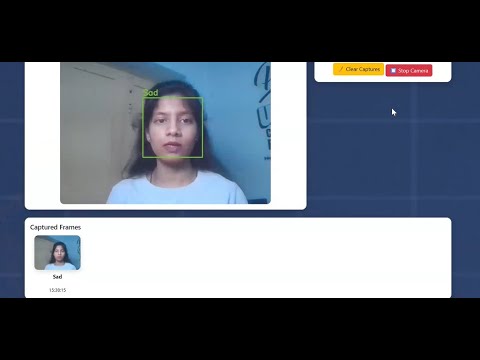
Facial images are preprocessed by converting them into grayscale, resizing to a fixed resolution of 48×48 pixels, and normalizing pixel values to improve learning efficiency. A CNN model is trained using these processed images to automatically extract facial features and perform emotion classification. The trained model is then integrated into a Flask-based web application that supports user authentication, real-time webcam emotion detection, image capture, and emotion-based song recommendations.
The system uses OpenCV for face detection and real-time video processing, while SQLite is used for secure user data management. Experimental results demonstrate that the proposed system effectively detects emotions in real time and provides an interactive and user-friendly experience. This project highlights the effectiveness of deep learning techniques in real-world emotion recognition applications.
Keywords
Facial Emotion Detection, Convolutional Neural Network, Deep Learning, Image Processing, Flask Web Application, OpenCV, Real-Time Emotion Recognition
Introduction
Human emotions play a vital role in communication, decision-making, and social interaction. Facial expressions are one of the most natural and powerful ways through which humans convey emotions. Automatic recognition of emotions from facial expressions has become an important research area in computer vision and artificial intelligence due to its wide range of applications in fields such as human–computer interaction, mental health analysis, surveillance systems, smart classrooms, driver monitoring systems, and entertainment platforms.
Traditionally, emotion recognition was performed through manual observation or psychological evaluation. These methods are subjective, time-consuming, and highly dependent on human expertise. In real-time environments, such approaches are not practical and may lead to incorrect interpretation of emotions. Hence, there is a strong need for automated systems that can accurately detect and classify human emotions in real time with minimal human intervention.
With the rapid development of machine learning and deep learning technologies, automated emotion recognition systems have gained significant attention. Among various deep learning techniques, Convolutional Neural Networks (CNNs) have proven to be highly effective for image-based tasks. CNNs can automatically learn meaningful features such as edges, textures, and shapes directly from raw image data, eliminating the need for manual feature extraction. This makes CNNs particularly suitable for facial emotion recognition.
In this project, a CNN-based facial emotion detection system is developed to classify human emotions from facial images. The system focuses on recognizing five basic emotions: Angry, Fear, Happy, Neutral, and Sad. These emotions are commonly used in facial expression research and provide a balanced representation of positive, negative, and neutral emotional states. The emotion classification is performed using grayscale facial images of size 48×48 pixels, which reduces computational complexity while preserving essential facial features.
The facial images undergo a series of preprocessing steps before being fed into the CNN model. These steps include grayscale conversion, image resizing, and normalization. Grayscale conversion reduces unnecessary color information, resizing ensures uniform input dimensions, and normalization improves the learning efficiency of the model. After preprocessing, the images are used to train the CNN model using supervised learning techniques.
The CNN architecture used in this project consists of multiple convolutional layers followed by max-pooling layers, fully connected layers, and a softmax output layer. The convolutional layers extract spatial features from facial images, while max-pooling layers reduce dimensionality and prevent overfitting. The fully connected layers learn high-level representations, and the softmax layer produces probability scores for each emotion class. The model is trained using categorical cross-entropy loss and the Adam optimizer to achieve optimal performance.
Once trained, the CNN model is saved and integrated into a Flask-based web application for real-time usage. Flask is a lightweight and flexible web framework that allows easy deployment of machine learning models into web-based environments. The web application provides features such as user registration, login authentication, real-time webcam emotion detection, image capture, and emotion-based song recommendation.
Real-time emotion detection is achieved using a webcam connected to the system. OpenCV is used to capture video frames and detect faces using the Haar Cascade classifier. The detected face region is extracted and resized to match the input requirements of the CNN model. The trained model then predicts the emotion associated with the detected face in real time. This allows the system to continuously monitor and classify emotions from live video streams.
To enhance user interaction, the system includes an emotion-based recommendation module. Based on the detected emotion, a suitable song is recommended using predefined YouTube links. This feature demonstrates how emotion recognition can be used to personalize user experiences and improve engagement in entertainment and wellness applications.
In addition to emotion detection, the system incorporates user authentication and data management using SQLite. This ensures secure access to the application and enables personalized usage. The integration of deep learning, image processing, and web technologies makes the system practical, interactive, and suitable for real-world deployment.
Overall, this project demonstrates the effectiveness of CNN-based deep learning models for facial emotion recognition and highlights the importance of integrating artificial intelligence techniques into user-friendly web applications. The proposed system provides an efficient, scalable, and real-time solution for emotion detection and can be extended to various real-world applications such as mental health monitoring, smart surveillance, and adaptive human–computer interfaces.
Objectives
The main objectives of the proposed Facial Emotion Detection System are as follows:
1. To design and develop an automated system for detecting human emotions from facial expressions using deep learning techniques.
2. To build a Convolutional Neural Network (CNN) model capable of accurately classifying facial images into different emotional categories.
3. To recognize and classify facial emotions into five predefined classes: Angry, Fear, Happy, Neutral, and Sad.
4. To implement effective image preprocessing techniques such as grayscale conversion, image resizing to 48×48 pixels, and normalization to improve model performance.
5. To reduce dependency on manual feature extraction by enabling the CNN model to automatically learn relevant facial features.
6. To train the CNN model using a labeled facial emotion dataset and evaluate its performance using training and testing data.
7. To integrate the trained emotion recognition model into a real-time application environment.
8. To develop a Flask-based web application for real-time facial emotion detection using webcam input.
9. To implement face detection using OpenCV to accurately extract facial regions before emotion classification.
10. To provide real-time emotion prediction results with minimal delay for practical usability.
11. To incorporate secure user authentication and session management using a database system.
12. To enable image capture functionality and allow emotion prediction on captured facial images.
Block Diagram
Requirements
Software Requirements
The proposed facial emotion detection system is developed using a combination of programming languages, libraries, frameworks, and tools. Each software component plays a critical role in building, training, deploying, and testing the system.
8.1.1 Operating System
The system can be implemented on Windows, Linux, or macOS platforms. Windows OS is preferred for development due to its ease of configuration and compatibility with OpenCV, TensorFlow, and Flask.
8.1.2 Programming Language – Python
Python is used as the primary programming language for this project. It offers simplicity, readability, and extensive support for scientific computing and deep learning. Python enables easy integration of machine learning models with web applications and supports a wide range of libraries required for image processing, deep learning, and database management.
8.1.3 TensorFlow
TensorFlow is an open-source deep learning framework used to build and train the Convolutional Neural Network (CNN). It provides efficient computation, automatic differentiation, and GPU acceleration support. TensorFlow allows easy construction of deep neural networks and supports model saving and loading, which is essential for deploying the trained emotion detection model.
8.1.4 Keras
Keras is a high-level deep learning API built on top of TensorFlow. It simplifies the process of designing CNN architectures using an intuitive and modular approach. In this project, Keras is used to define convolutional layers, pooling layers, dense layers, dropout layers, and activation functions. Keras also supports fast experimentation and easy model training.
8.1.5 OpenCV
OpenCV (Open Source Computer Vision Library) is used for image processing and real-time computer vision tasks. It plays a crucial role in capturing webcam frames, converting images to grayscale, resizing images, and performing face detection using Haar Cascade classifiers. OpenCV enables efficient real-time video processing, which is essential for live emotion detection.
8.1.6 NumPy
NumPy is a fundamental library for numerical computation in Python. It is used to handle multi-dimensional arrays and perform mathematical operations efficiently. In this project, NumPy is used for storing image data, preprocessing operations, normalization, and preparing data for CNN input.
8.1.7 scikit-learn
Scikit-learn is used for data handling and preprocessing tasks such as splitting the dataset into training and testing sets. It provides reliable tools for data manipulation and ensures balanced dataset distribution, which helps in evaluating the performance of the CNN model.
8.1.8 Flask
Flask is a lightweight Python web framework used to deploy the emotion detection model into a web-based application. It handles routing, session management, user authentication, and integration of the CNN model with the frontend. Flask enables real-time emotion detection through webcam streaming and provides an interactive user interface.
8.1.9 SQLite
SQLite is a lightweight relational database used to store user registration details such as name, email, phone number, and encrypted passwords. It provides secure and efficient data storage without requiring a separate database server, making it suitable for small-scale and academic projects.
8.1.10 HTML, CSS, and Bootstrap
HTML is used to structure the web pages, CSS is used for styling, and Bootstrap is used to create a responsive and user-friendly interface. These technologies ensure a clean and intuitive design for the emotion detection web application.
8.1.11 Development Tools
• Anaconda / Python IDLE / VS Code – Used for writing and executing Python code
• Jupyter Notebook – Used for experimentation and testing during model development
• Web Browser (Chrome / Edge) – Used for accessing the Flask web application
8.2 Hardware Requirements
The hardware requirements for the proposed system are minimal and suitable for standard computing environments.
The system requires a computer with a minimum Intel i3 processor, 4 GB RAM, and at least 10 GB of free storage for dataset storage and model files. A webcam is required for real-time facial emotion detection. A higher configuration such as an Intel i5 processor with 8 GB RAM is recommended for faster model training and smoother real-time performance.