Image captioning is an Artificial Intelligence technique that automatically generates natural language descriptions for images.
It combines computer vision and natural language processing to identify visual objects and communicate their information through readable sentences.
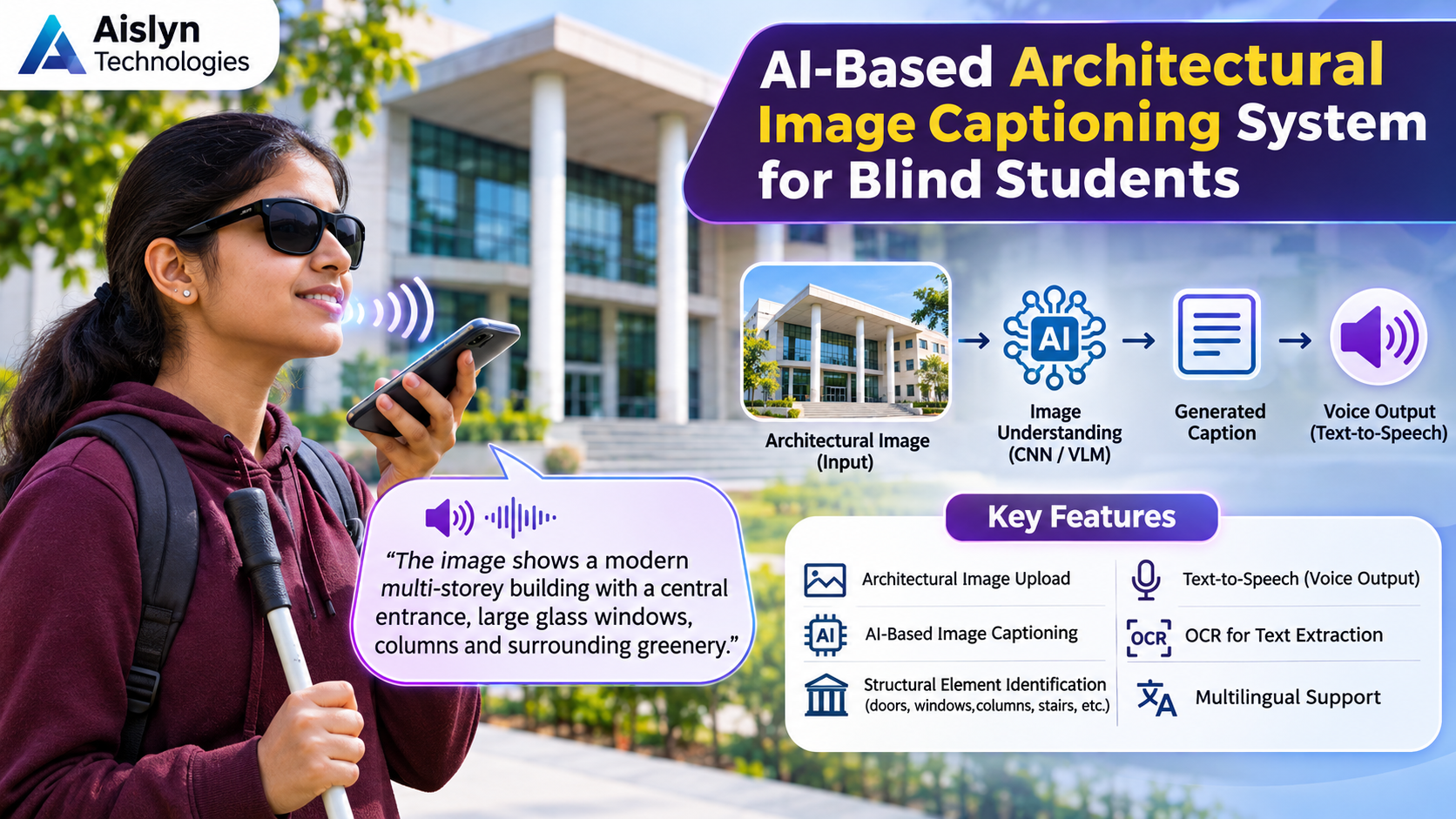
In the proposed system, a user uploads an architectural image through a web or mobile application. The AI model analyzes the image and generates a description of the visible architectural elements.
For example, when a user uploads an image of a building, the system may generate a description such as:
"The image shows a multi-storey building with several rectangular windows, a central entrance, supporting columns, and a symmetrical architectural design."
The generated description is then presented as text or converted into speech.
Main Objectives
Develop an AI-powered architectural image captioning application.
Make architectural images more accessible to blind students.
Identify important objects and structural elements in images.
Generate meaningful natural language descriptions.
Convert generated captions into speech.
Support accessible learning through assistive technology.
Improve interaction between visually impaired students and digital educational materials.
The main objective is to transform architectural visual information into understandable audio descriptions.
Key Features & Benefits
AI Technologies Used for Image Understanding
The proposed system combines computer vision, deep learning, and language generation to understand architectural images and produce meaningful descriptions.
1. Computer Vision
Computer vision enables computers to interpret visual information from digital images.
The system processes architectural images and identifies important visual patterns, objects, and structural components.
Image preprocessing techniques can improve input quality before passing the image to the AI model.
2. Convolutional Neural Networks (CNN)
CNN architectures are widely used for image classification and feature extraction.
They learn visual characteristics such as edges, shapes, textures, and object patterns.
CNN-based feature extraction can be integrated into an image captioning architecture to help identify architectural elements.
3. Vision-Language Models
Modern Vision-Language Models can understand images and generate natural language descriptions.
These models connect visual information with language understanding, allowing the application to describe objects, structures, and relationships within an image.
Depending on the implementation, pretrained vision-language models can be integrated to generate captions without training a complete image captioning architecture from scratch.
4. Natural Language Processing
Natural Language Processing helps convert visual understanding into readable descriptions.
The language generation component organizes identified information into meaningful sentences that users can understand.
5. Optical Character Recognition
OCR technology can be integrated to extract visible text from architectural drawings, building labels, room numbers, and signboards.
This provides additional information that may not be captured by image captioning alone.
6. Text-to-Speech Technology
Text-to-Speech converts generated captions into spoken audio.
This feature allows blind students to listen to architectural image descriptions using speakers or headphones.
Implementation Guide
Key Features of the Proposed System
The proposed AI-based application provides several functionalities to support accessible architectural learning.
1. Architectural Image Upload
Users can upload architectural photographs, building images, structural diagrams, and other supported visual materials.
2. AI-Based Image Understanding
The system analyzes uploaded images using computer vision or pretrained Vision-Language Models to identify important visual elements.
3. Automatic Image Caption Generation
The application generates natural language descriptions explaining the visible contents of architectural images.
4. Architectural Object Identification
The system can identify relevant structural components such as buildings, doors, windows, columns, stairs, roofs, and other visible architectural elements, depending on the selected model.
5. Voice-Based Description
Generated captions can be converted into spoken audio using Text-to-Speech technology.
6. Screen Reader Compatibility
The application can provide accessible page structures, keyboard navigation, descriptive labels, and screen reader-friendly content.
7. OCR-Based Text Extraction
An integrated OCR module can extract visible text from architectural drawings, building signs, and labels.
8. User-Friendly Interface
A simple and accessible interface allows students to upload images, generate descriptions, listen to captions, and access previously processed results.
9. Caption History
The system can optionally store previously generated descriptions so users can review them later.
10. Multilingual Audio Support
The application can be extended to translate generated captions into supported languages and provide audio output for different linguistic requirements.
Technical Specifications
Technologies and Implementation Methodology
The project can be developed using Python, deep learning frameworks, computer vision libraries, and accessible web technologies.
Software Requirements
Python: Main programming language for AI development and backend processing.
TensorFlow/Keras: Used to develop or integrate deep learning image processing models.
PyTorch: Can be used for implementing advanced vision-language models.
Hugging Face Transformers: Provides access to pretrained image captioning and vision-language models.
OpenCV: Used for image preprocessing and visual analysis.
Pillow (PIL): Used for image loading, resizing, and conversion.
OCR Technology: Used to extract text from architectural images and drawings.
Flask or Streamlit: Used to develop the interactive web application.
HTML, CSS, and JavaScript: Used to create the accessible user interface.
Text-to-Speech Library: Converts generated descriptions into spoken audio.
MySQL or MongoDB: Can store user information, image metadata, and caption history.
Hardware Requirements
Computer or laptop.
Minimum 8 GB RAM recommended for basic development.
16 GB RAM or higher recommended for larger local AI models.
Webcam or smartphone camera for image capture.
Internet connection when using cloud-based AI models.
Headphones or speakers for audio descriptions.
GPU recommended for faster local model inference.
System Implementation Process
Step 1: Image Collection
Collect architectural images containing different building structures, interior spaces, exterior designs, and architectural components.
Step 2: Image Preprocessing
Resize and normalize uploaded images into the required input format. Apply suitable preprocessing techniques depending on the selected AI model.
Step 3: Model Integration
Select a suitable pretrained image captioning model or Vision-Language Model capable of understanding architectural visual content.
Step 4: Architectural Image Analysis
Pass the uploaded image into the model to identify visible objects, structures, and important visual relationships.
Step 5: Caption Generation
Generate a meaningful natural language description based on the visual information identified by the AI model.
Step 6: Optional OCR Processing
Apply OCR to extract additional textual information from visible labels, architectural drawings, and signboards.
Step 7: Text-to-Speech Conversion
Convert the generated description into audio using a suitable speech synthesis engine.
Step 8: Accessible Result Presentation
Display the generated caption and provide audio playback through an accessible interface.
Step 9: Testing and Evaluation
Evaluate the system using different architectural images. Assess caption relevance, object identification, description quality, speech clarity, and accessibility.
Conclusion & Next Steps
Conclusion
The AI-Based Architectural Image Captioning System for Blind Students demonstrates how Artificial Intelligence, Computer Vision, and Natural Language Processing can be used to improve accessibility to visual educational information.
By analyzing architectural images and converting their contents into meaningful text and spoken descriptions, the proposed application provides an alternative way for blind students to understand visual learning materials.
The integration of Vision-Language Models, image processing, OCR, and Text-to-Speech technology creates a flexible foundation for intelligent assistive learning applications.
This project provides practical experience in Python programming, deep learning, image processing, and accessible application development. With further improvements in spatial understanding, multilingual interaction, and real-time image analysis, it can become a more advanced accessibility solution.
Contact Aislyn Technologies
Aislyn Technologies, Bangalore
Phone: +91 97395 94609
Email: info@aislyntech.com
Website: https://aislyn.in
Contact us today to start building your AI, Image Processing, Machine Learning, and assistive technology projects with our expert support!