Abstract
The rapid advancement of technology and the increasing popularity of the Internet have revolutionized the way people shop. Traditional shopping methods often require physical presence, time, and effort, which can be inconvenient for many consumers. With the growing demand for online shopping, e-commerce platforms have become essential for businesses to reach customers efficiently and for users to purchase products conveniently from anywhere at any time.
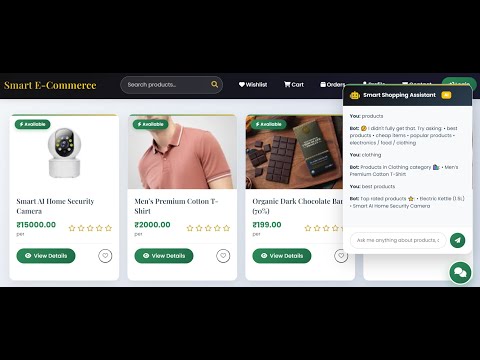
The Smart E-Commerce Web Application Using Flask is designed to address these needs by providing a user-friendly, secure, and intelligent online shopping platform. The project leverages Python Flask, a lightweight yet powerful web framework, for developing the backend, while MySQL is used as the database to manage products, users, orders, and reviews. The frontend is designed to be responsive and intuitive, ensuring a seamless user experience across devices.
Key Objectives
The main objectives of this project are:
1. User Management: Enable users to register, log in, and manage their profiles securely.
2. Product Management: Allow users to browse, search, and filter products by category, price, or popularity.
3. Cart and Wishlist Management: Facilitate adding products to the shopping cart or wishlist for future purchases.
4. Order Management: Enable users to place orders, track their status, and cancel them if required.
5. Review and Rating System: Allow users to provide feedback on products through reviews and ratings, helping other users make informed decisions.
6. Admin Dashboard: Provide administrators with tools to manage users, inventory, and orders efficiently, and to generate sales reports.
7. Chatbot Assistance: Implement a basic AI-powered chatbot to assist users in finding products and answering queries in real-time.
Introduction
Block Diagram
Technology Stack
The Technology Stack refers to the collection of technologies, frameworks, libraries, and tools used to develop the Smart E-Commerce Web Application. The stack is chosen based on performance, scalability, maintainability, and ease of development.
1. Front-End Technologies
The front-end is responsible for the user interface and user experience, ensuring smooth interaction between users and the system.
1.1 HTML5
• Purpose: Structure of web pages.
• Features:
o Semantic tags for better readability and SEO
o Forms for user input (registration, login, checkout)
o Multimedia support (images, videos)
1.2 CSS3
• Purpose: Styling and layout of web pages.
• Features:
o Flexbox and Grid for responsive design
o Animations and transitions for visual effects (e.g., product cards, wishlist pulse effect)
o Media queries for mobile and tablet compatibility
1.3 JavaScript
• Purpose: Client-side scripting for interactive features.
• Features:
o Dynamic updates of product listings, cart, and wishlist
o Smooth scrolling and animation effects
o Validation of forms before submission
1.4 Bootstrap
• Purpose: Rapid UI development with responsive design.
• Features:
o Predefined UI components (buttons, cards, modals)
o Consistent design across the application
2. Back-End Technologies
The back-end handles server-side logic, database interactions, and business rules.
2.1 Python & Flask
• Purpose: Backend development and web server framework.
• Features:
o Lightweight and easy-to-use micro-framework
o Handles routing, sessions, and template rendering
o Supports integration with databases and APIs
2.2 MySQL
• Purpose: Relational database management system (RDBMS).
• Features:
o Stores structured data like users, orders, products, reviews
o Supports complex queries and joins
o Provides transactional support for order processing
2.3 Flask-Mail
• Purpose: Sending emails from the application.
• Use Cases:
o Order confirmation notifications
o Password reset and verification emails
o Admin notifications
2.4 Flask-CORS
• Purpose: Cross-Origin Resource Sharing support.
• Use Cases:
o Allows API requests from different domains
o Enables chatbot integration and external API calls
2.5 Werkzeug & Passlib
• Purpose: Security and password management.
• Features:
o Hashing passwords for secure storage
o Verifying hashed passwords during login
3. AI & Chatbot Integration
3.1 Chatbot Implementation
• Purpose: Provide interactive assistance to users.
• Features:
o Predefined intents for greetings, help, product recommendations
o Fetches real-time product data from database
o Responds to queries like “best products”, “cheap items”, or specific categories
3.2 NLP Concepts (Basic)
• Purpose: Understand user queries in natural language.
• Implementation:
o Convert user input to lowercase
o Match keywords to predefined intents
o Generate responses dynamically from the database
4. Tools & Utilities
4.1 Git & GitHub
• Purpose: Version control and collaborative development.
• Features:
o Track code changes
o Branching for feature development
o Issue tracking
4.2 Visual Studio Code / PyCharm
• Purpose: Integrated Development Environment (IDE) for coding.
• Features:
o Syntax highlighting
o Debugging tools
o Integrated terminal for running Flask
4.3 dotenv
• Purpose: Manage environment variables.
• Use Cases:
o Store sensitive information like database credentials, API keys, and secret keys
4.4 Postman
• Purpose: Test API endpoints.
• Features:
o Send GET, POST, PUT, DELETE requests
o Test backend routes without frontend
5. Hardware and Deployment
5.1 Server Requirements
• Processor: Minimum Intel i5 or equivalent
• RAM: 8 GB minimum
• Storage: 256 GB SSD recommended