Artificial Intelligence, robotics, and automation are transforming the way organizations manage their daily activities. Modern offices, educational institutions, hospitals, hotels, and business centers are increasingly exploring intelligent systems to improve visitor management and customer interaction.
A smart receptionist robot is an innovative solution that combines robotics, computer vision, speech processing, and artificial intelligence to automate basic receptionist activities. Instead of depending entirely on manual assistance, visitors can interact with a robotic system that identifies faces, understands voice commands, and provides relevant responses.
The Smart Receptionist Robot with Face Identification and Voice-Based Chat System Using Raspberry Pi is designed to create an intelligent robotic assistant capable of recognizing visitors and communicating with them through voice interaction.
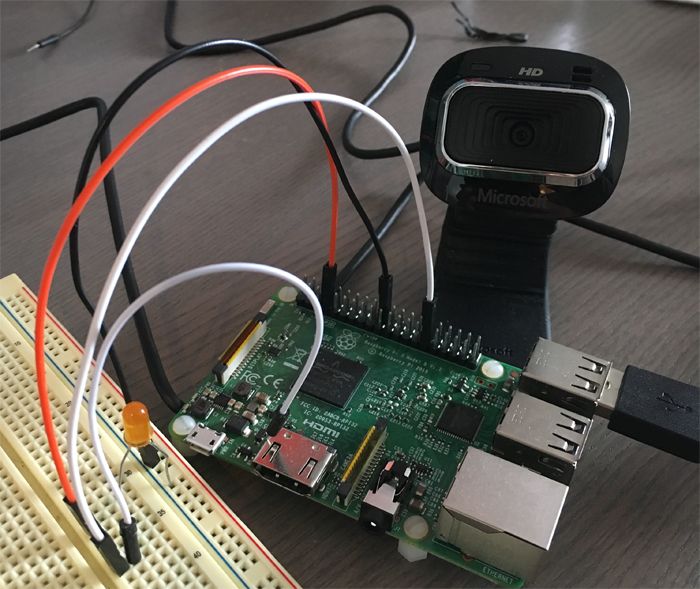
The system uses Raspberry Pi as its primary computing platform and integrates a camera module, microphone, speaker, and face recognition technology. By combining these components, the robot can identify registered individuals, respond to spoken queries, and provide basic information about the organization.
This project demonstrates how affordable embedded computing platforms and AI technologies can be integrated to develop practical human-robot interaction systems.
Understanding the Smart Receptionist Robot
A smart receptionist robot is an automated robotic assistant developed to perform basic front-desk responsibilities. It uses artificial intelligence and embedded hardware to interact with visitors and provide information without requiring continuous human involvement.
The proposed system uses Raspberry Pi to coordinate its hardware components and execute the required software applications.
A camera captures the visitor's face, and the face identification module processes the captured image to determine whether the person matches a registered user. Based on the recognition result, the robot can provide a personalized greeting or request additional information.
The voice-based communication module allows visitors to interact naturally with the robot. Speech recognition converts spoken questions into text, while a chatbot processes the queries and generates appropriate responses. Text-to-speech technology converts the responses into audio.
Main Objectives
Develop an intelligent receptionist robot using Raspberry Pi.
Identify registered visitors through face recognition.
Enable voice-based communication between visitors and the robot.
Provide automated greetings and basic information.
Reduce repetitive receptionist activities.
Demonstrate practical applications of artificial intelligence and robotics.
The system aims to improve visitor interaction while providing a foundation for intelligent reception automation.
Key Features & Benefits
Face Identification and Voice-Based Chat Technology
The combination of face recognition and voice interaction makes the receptionist robot more intelligent and interactive.
Face Identification System
Face identification is a computer vision technique used to recognize individuals based on their facial characteristics.
The robot uses a camera module to capture visitor images. The captured frames are processed using a suitable face detection and recognition algorithm.
The general face identification process includes:
Capturing the visitor's image using the camera.
Detecting the face within the captured frame.
Extracting important facial features.
Comparing the extracted features with registered face records.
Identifying a matching registered person or marking the visitor as unknown.
Providing an appropriate greeting or response.
Depending on the implementation, technologies such as OpenCV and face embedding models can be used for face identification.
Voice-Based Chat System
The voice interaction module allows visitors to communicate with the robot using natural speech.
The system uses speech-to-text technology to convert spoken questions into text. The chatbot processes the text and generates a relevant response. Finally, text-to-speech technology converts the response into audio.
For example, a visitor may ask:
Where is the manager's office?
What are the office working hours?
How can I contact customer support?
Where is the meeting room?
Can you provide information about the organization?
The robot processes these questions and responds through its speaker.
Combining face identification with voice-based communication creates a more personalized and interactive visitor experience.
Implementation Guide
Key Features of the Proposed System
The smart receptionist robot integrates several features to provide automated visitor assistance.
1. Real-Time Face Detection
The camera captures visitor images and detects faces in real time. This enables the robot to begin the identification process when someone approaches.
2. Registered Visitor Identification
The face recognition module compares detected facial features with previously registered records to identify known visitors.
3. Automated Greetings
When a registered visitor is identified, the robot can provide a personalized greeting using its voice output system.
4. Voice-Based Communication
Visitors can ask questions through a microphone and receive spoken responses from the robot.
5. AI Chatbot Integration
An intelligent chatbot can process user queries and generate meaningful responses based on configured information or an integrated language model.
6. Text-to-Speech Conversion
The generated responses are converted into audio, allowing the robot to communicate without requiring visitors to read text on a display.
7. Raspberry Pi-Based Control
Raspberry Pi acts as the main processing unit and coordinates the camera, microphone, speaker, and other connected hardware components.
8. Automated Reception Assistance
The system can provide basic information about departments, employees, office locations, and visitor instructions.
Technical Specifications
Technologies and Implementation Methodology
The project combines embedded computing, computer vision, speech processing, and artificial intelligence to create an intelligent robotic receptionist.
Hardware Requirements
Raspberry Pi 4 or Raspberry Pi 5.
Raspberry Pi camera module or USB webcam.
USB microphone or microphone module.
Speaker or audio output module.
Display module (optional).
Robot chassis and mechanical components.
Power supply and connecting accessories.
Software Requirements
Python programming language.
Raspberry Pi OS.
OpenCV for image processing and face detection.
Face recognition or face embedding model for visitor identification.
Speech recognition for converting voice into text.
Natural language processing for understanding visitor queries.
Chatbot or LLM integration for response generation.
Text-to-speech library for voice output.
System Implementation Process
Step 1: Raspberry Pi Configuration
Install Raspberry Pi OS and configure the required Python environment, camera, microphone, and speaker connections.
Step 2: Camera Integration
Connect the camera module and configure image capture to continuously monitor the reception area when the system is active.
Step 3: Face Detection
Use computer vision techniques to detect human faces from camera frames.
Step 4: Face Identification
Extract facial features and compare them against registered visitor records. The system identifies known visitors or handles unknown visitors according to the configured workflow.
Step 5: Voice Input Processing
Capture the visitor's voice through the microphone and convert the audio into text using a speech recognition engine.
Step 6: Chatbot Response Generation
Process the recognized text using a chatbot or language model to generate relevant answers to visitor questions.
Step 7: Voice Output
Convert the chatbot response into speech using a text-to-speech engine and play it through the connected speaker.
Step 8: Complete Robot Integration
Integrate face identification, speech recognition, chatbot processing, and voice output into one application running on Raspberry Pi.
Conclusion & Next Steps
Applications, Advantages, and Future Enhancements
Real-World Applications
The smart receptionist robot can be adapted for different environments where automated visitor assistance is useful.
Corporate Offices: Provides visitor greetings and basic information about employees and departments.
Educational Institutions: Helps students, parents, and visitors locate administrative offices and departments.
Hospitals: Provides directions to departments, reception counters, and patient service areas.
Hotels: Supports guest interaction and provides information about hotel facilities.
Business Centers: Helps visitors access basic organizational information.
Exhibition Centers: Provides automated information about events, exhibits, and available facilities.
Advantages
Reduces repetitive front-desk activities.
Provides interactive voice-based communication.
Supports automated visitor identification.
Combines robotics and artificial intelligence in one system.
Can be developed using affordable embedded hardware.
Provides a flexible platform for future AI integration.
Supports personalized greetings for registered visitors.
Future Enhancements
The project can be extended with advanced AI capabilities and additional robotic functionalities.
Future improvements may include multilingual voice communication, emotion-aware interaction, cloud-based visitor management, appointment scheduling, QR-based visitor registration, and integration with organizational databases.
The robot can also be enhanced with autonomous navigation, obstacle avoidance, and motor control to move between different locations within a building.
Additional security improvements should include encrypted facial records, secure access controls, visitor consent, and automatic deletion policies for stored biometric information.
Conclusion
The Smart Receptionist Robot with Face Identification and Voice-Based Chat System Using Raspberry Pi demonstrates the practical integration of embedded systems, artificial intelligence, computer vision, and speech technologies.
By combining facial recognition with voice-based chatbot interaction, the system provides an intelligent approach to automated visitor assistance. Raspberry Pi serves as the central processing platform, connecting the camera, microphone, speaker, and AI-based software modules.
This project offers an excellent opportunity to explore real-world applications of robotics, face recognition, speech processing, and human-robot interaction. With additional improvements in autonomous navigation, multilingual communication, and intelligent visitor management, the proposed system can be developed into a more advanced reception automation solution.
Contact Aislyn Technologies
Aislyn Technologies, Bangalore
Phone: +91 97395 94609
Email: info@aislyntech.com
Website: https://aislyn.in
Contact us today to start building your Raspberry Pi, Embedded Systems, Robotics, and AI projects with our expert support!