ABSTRACT
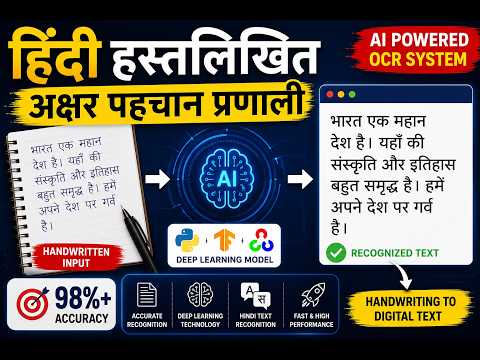
Handwritten character recognition is an important application of computer vision and artificial intelligence that focuses on identifying and converting handwritten symbols into machine-readable formats. Recognition of handwritten characters is a challenging task due to variations in individual writing styles, character shapes, sizes, orientations, and noise present in handwritten images. This project presents a deep learning-based Hindi handwritten character recognition system using a ResNet50 Convolutional Neural Network (CNN) architecture integrated with a Flask-based web application for real-time character prediction. The proposed system utilizes the Devanagari handwritten character dataset consisting of multiple Hindi alphabet classes and numerical digits. The input images are preprocessed through resizing, normalization, and augmentation techniques to improve model learning capability and enhance recognition accuracy. Data augmentation methods such as rotation, zooming, width shifting, and height shifting are applied to increase dataset diversity and reduce overfitting. The system employs a transfer learning approach using the ResNet50 architecture, which is a powerful deep convolutional neural network capable of extracting complex image features through residual learning.
In this project, the pretrained ResNet50 model is customized by removing its original classification layers and adding new layers including Global Average Pooling, Dense layers, Dropout regularization, and Softmax classification to accurately classify Hindi characters. The base layers of ResNet50 are frozen to preserve previously learned image features, while the newly added layers are trained according to the handwritten character dataset. The model is trained using categorical cross-entropy loss and the Adam optimizer to achieve efficient multiclass classification performance. The performance of the developed model is evaluated using different metrics such as training accuracy, validation accuracy, loss analysis, confusion matrix, and classification report. The generated accuracy and loss graphs provide detailed insights into model learning behavior, while the confusion matrix helps analyze classification performance among different Hindi character categories. The trained model is saved and integrated into a Flask web framework to provide a user-friendly interface for real-time handwritten character prediction.
INTRODUCTION
In recent years, Artificial Intelligence (AI) and Deep Learning (DL) technologies have significantly transformed the field of computer vision by enabling machines to understand, analyze, and interpret visual information with high accuracy. One of the major applications of computer vision is handwritten character recognition, which involves identifying handwritten symbols, letters, and numbers from digital images and converting them into a machine-understandable format. Handwritten character recognition plays an important role in several real-world applications such as automatic document processing, postal automation, bank cheque verification, digital libraries, educational systems, and Optical Character Recognition (OCR) applications. Although recognition systems for English handwritten characters have achieved remarkable progress, handwritten recognition of regional languages such as Hindi still remains a challenging research area because of the complex structure and large variation in writing patterns. Hindi is one of the most widely used languages in India and is written using the Devanagari script. The Devanagari script consists of a large number of characters, including vowels, consonants, compound characters, and numerical digits. Compared to English alphabets, Hindi characters have more complex shapes, curves, strokes, and similarities between different characters. Different individuals write the same character in various styles depending on handwriting habits, speed, thickness, orientation, and personal writing methods. These variations create difficulties for traditional image processing approaches to achieve reliable recognition accuracy. Therefore, advanced deep learning techniques are required to automatically extract important visual features and classify handwritten Hindi characters effectively.
Traditional handwritten recognition techniques mainly depend on manual feature extraction methods, where features such as edges, shapes, textures, and character structures are extracted using image processing algorithms. These manually designed features are then classified using machine learning techniques such as Support Vector Machines (SVM), Decision Trees, or Artificial Neural Networks (ANN). However, these approaches often require expert knowledge for feature selection and may fail when dealing with large datasets containing complex handwriting variations. The development of deep learning, especially Convolutional Neural Networks (CNNs), has overcome these limitations by automatically learning important image features directly from input data without the need for manual feature extraction. Convolutional Neural Networks have become one of the most effective deep learning techniques for image classification and pattern recognition applications. CNN architectures use convolution layers, pooling layers, and fully connected layers to extract hierarchical features from images. Lower layers learn basic features such as edges and lines, while deeper layers identify complex patterns and structures. This ability makes CNN highly suitable for handwritten character recognition tasks. Among different CNN architectures, ResNet (Residual Network) has achieved excellent performance due to its deep architecture and residual learning mechanism, which helps solve the vanishing gradient problem commonly found in very deep neural networks.
To make the system interactive and accessible, the trained ResNet50 model is integrated with a Flask-based web application. Flask provides a lightweight and efficient framework for deploying machine learning models through a web interface. The application includes user authentication features such as registration and login using an SQLite database. After successful login, users can upload handwritten Hindi character images, and the system processes the image to predict the corresponding character. The predicted output is displayed in the original Devanagari script along with the confidence score, making the system user-friendly and easy to understand. The integration of deep learning with web technology provides a complete end-to-end solution for Hindi handwritten character recognition. This project demonstrates the capability of ResNet50-based transfer learning in accurately recognizing complex handwritten patterns. The proposed system can be useful in various applications such as converting handwritten documents into digital formats, automatic data entry systems, educational learning platforms, and intelligent OCR applications. Further improvements can include expanding the dataset, supporting complete handwritten words and sentences, and optimizing the model for deployment on mobile and real-time applications.
OBJECTIVES
• To develop an efficient Hindi handwritten character recognition system using deep learning techniques for accurate identification of Devanagari characters and digits.
• To implement the ResNet50 Convolutional Neural Network (CNN) architecture using transfer learning for automatic feature extraction and character classification.
• To preprocess handwritten character images through techniques such as image resizing, normalization, and data preparation to improve model performance.
• To apply data augmentation techniques including rotation, zooming, width shifting, and height shifting to increase dataset variations and reduce model overfitting.
• To train the deep learning model using the Hindi handwritten character dataset and optimize it for improved recognition accuracy.
• To customize the pretrained ResNet50 model by adding Global Average Pooling, Dense, Dropout, and Softmax layers for multiclass character classification.
• To evaluate the trained model performance using accuracy, loss analysis, confusion matrix, and classification report.
• To develop a Flask-based web application that allows users to upload handwritten Hindi character images for real-time prediction.
• To integrate the trained deep learning model with the web application for automatic recognition and classification of uploaded character images.
• To implement user authentication functionality using an SQLite database for secure registration and login access.
Block Diagram