ABSTRACT
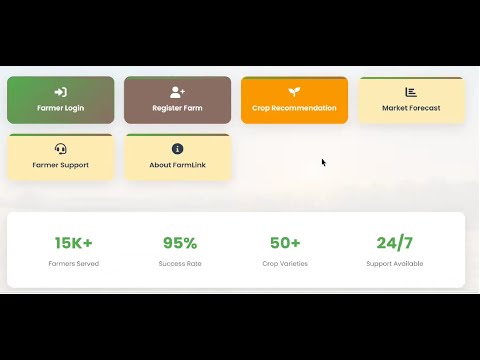
The integration of Artificial Intelligence (AI) and Data Science into agriculture is transforming traditional farming into a data-driven, intelligent process. This project, titled “AI-Powered Agricultural Decision Support System using Flask,” is designed to assist farmers, traders, and agricultural planners by providing smart recommendations and predictions based on real-world data. The system integrates three key intelligent modules — crop recommendation, buyer–farmer matching, and market demand forecasting — all unified under a single Flask web application. The Crop Recommendation Module utilizes a Random Forest model to predict the most suitable crop based on environmental parameters such as nitrogen, phosphorus, potassium, temperature, humidity, pH, rainfall, and moisture levels. It also predicts the possible market price of the selected crop. The Buyer–Farmer Matching Module employs cosine similarity and feature scaling techniques to connect buyers with suitable farmers based on crop type, location, price, and quantity, thereby improving trade efficiency and transparency. The Market Forecasting Module leverages Long Short-Term Memory (LSTM) neural networks to forecast future demand trends for specific crops in given regions, helping farmers plan production and supply chain decisions effectively. The system ensures secure user management through an SQLite database with hashed passwords, enabling farmers and buyers to register and log in safely. All predictions and visual outputs are displayed through an interactive and user-friendly web interface, making it easily accessible for non-technical users. Flask serves as the backend framework to link machine learning models, datasets, and visualization components, while Matplotlib is used to generate real-time graphical insights for predicted results. The integration of these technologies enables accurate, real-time decision support, promoting efficient resource utilization and profit maximization. The project demonstrates the potential of combining machine learning, deep learning, and web technology to solve key agricultural challenges, reduce risks, and support sustainable farming practices. In conclusion, the system contributes toward building a smart agricultural ecosystem that empowers farmers with data-driven insights and bridges the gap between production and market demand.
OBJECTIVES
01. To Develop an AI-Based Integrated Agricultural Decision Support System
The primary objective of this project is to design and implement a fully integrated web-based system that combines multiple intelligent modules to assist farmers, traders, and agricultural analysts. The system aims to consolidate crop recommendation, market forecasting, and buyer–farmer matchmaking into one platform powered by artificial intelligence and machine learning. It bridges the gap between data science and agriculture by transforming raw data into actionable insights. The goal is to make agriculture more predictive, data-driven, and economically efficient by using modern computational techniques. Through this system, users can make informed decisions regarding crop selection, expected yield, price prediction, and market strategies. The integration of all these features within a Flask web application ensures accessibility, scalability, and user-friendliness. This objective also focuses on real-time interactivity and deployment feasibility, making AI technology usable even for non-technical users in rural regions.
02️. To Recommend the Most Suitable Crop Based on Soil and Climate Parameters
This objective focuses on helping farmers identify the most appropriate crop for cultivation based on soil nutrient composition and environmental conditions. The model considers parameters such as nitrogen (N), phosphorus (P), potassium (K), temperature, humidity, pH value, rainfall, and soil moisture. By processing these parameters, the system predicts the optimal crop using a pre-trained Random Forest model. The recommendation is generated after feature scaling and normalization through MinMaxScaler and StandardScaler, ensuring model stability. The ultimate goal is to assist farmers in maximizing yield, minimizing losses, and optimizing the use of natural resources. This recommendation engine not only enhances productivity but also promotes sustainable farming practices by reducing soil degradation and resource wastage.
Block Diagram