Abstract:
Artistic image creation, facilitated by Neural Style Transfer (NST), represents a dynamic frontier in the realm of convolutional neural networks (CNNs). This project is dedicated to the exploration and implementation of NST, with a focus on evaluating outcomes through a dual lens of qualitative and quantitative analysis. The efficacy of the trained neural network is scrutinized by assessing resultant image styles and measuring performance through visual
analysis and loss calculations, given the absence of a direct accuracy metric for this intricate task. Exploring the complexities of picture-style transmission, this study examines six different approaches in the context of neural networks. model yields the highest Structural Similarity Index (SSIM) score out of all of them, also indicating an image that is closer to the content. which used CNN with five relu layers in the style and content images. These performers are distinguished for their exceptional versatility in capturing and translating a wide range of artistic styles. This thorough methodology offers insightful information about the efficiency and possible uses of neural style transfer methods.
KEYWORDS: dataset of images, Convolutional neural network(CNN)
Introduction:
For centuries, art has held a mesmerizing sway over humanity, captivating our minds and emotions with its diverse expressions. This project delves into the captivating intersection of art and technology, driven by a singular quest: Can we transfer the distinctive style of one image onto another, using the magic of artificial intelligence? Style transfer is the answer. While the world cherishes the legacy of countless artistic styles, replicating them often requires years of dedicated practice, confining the process to a select few skilled artists. This project proposes a revolutionary approach: neural style transfer, a technique that seamlessly imbues one image with the stylistic essence of another, capturing its texture and character without the laborious effort of traditional methods.
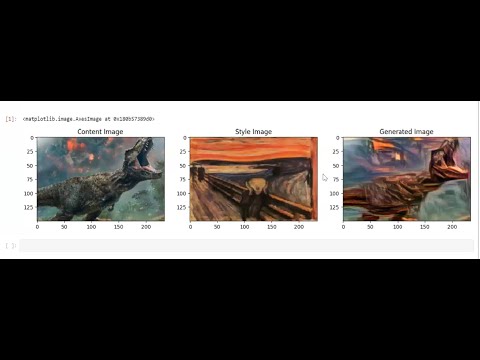
Neural style transfer holds immense commercial potential, offering a unique bridge between art and a wider audience. This technology has the power to democratize artistic appreciation, allowing anyone to experience the beauty and depth of diverse artistic expressions through the lens of their digital creations. Style transfer, a computer vision method, is the process of taking two images- a content image and a style reference image- and blending them to create an output image that keeps the main components of the content image but gives the impression that it has been ”painted” in the style of the style reference image . When using a typical supervised learning strategy to solve this job, we need two input images: the original image and an artistic rendition of the original image. This is known as learned style transfer. A machine learning model can then use the transformed photos to create new ones after learning about the process. Unfortunately, this method is practically unfeasible because some types of image combinations are not common.
In recent years, a breakthrough approach known as neural style transfer (NST) has changed the possibilities. NST uses deep neural networks to power these modifications. Neural networks are employed to extract statistical factors related
to both content and style from photos to assess the effectiveness of style transfer in the absence of explicit image pairs. Using only one style reference image, the neural network can now apply a style to original content photos thanks to this improved technique. The task of transferring the style to the content image was handled as an optimization issue in earlier versions of NST, which resulted in time-consuming and inefficient iterations.
Fast NST, which is more effective, was introduced to address this problem. While fast style transfer also makes use of deep neural networks, it does so by training an independent model that can alter any image in a single feed forward pass. Instead of requiring thousands of network iterations, trained models can stylize each image with just one. We witness the commercial art world’s manifestation of the significance of style transfer. Additionally, style transfer is now possible for both recorded and live video because of the ongoing advancements in AI-accelerated hardware on the edge and in the cloud. This new capacity offers countless
opportunities in the fields of design, content creation, and tool development for creativity. We can see how style transfer can be used in a variety of ways given this evolution: editors for images and videos, artist-community engagement, virtual reality, gaming, and commercial art. Let’s discover the secret language of style, transforming ordinary images to extraordinary artistic worlds.
Objective :
The objective of neural style transfer using Convolutional Neural Networks (CNNs) is to combine the content of one image with the style of another image to generate a new image that preserves the semantic content of the original content image while adopting the visual style of the style reference image. Neural Style Transfer (NST) using CNNs can be applied to both images and video.
Block Diagram