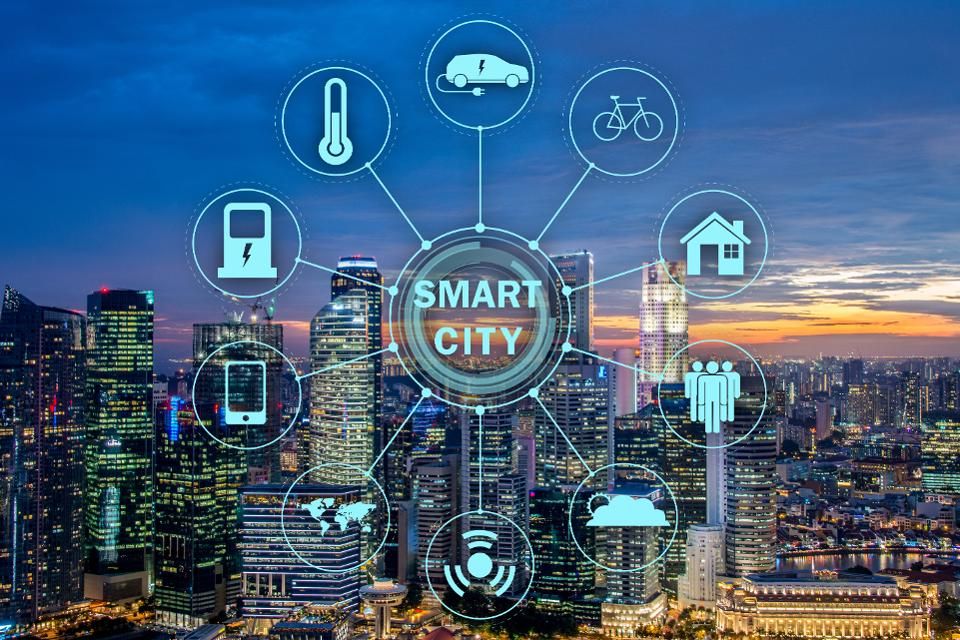
A Smart City is an urban environment that uses digital technologies, connected devices, and intelligent automation to improve public services and infrastructure.
The main objective of smart city development is to use real-time information to make urban services more efficient, reduce resource wastage, and improve the quality of life for citizens.
The Internet of Things plays an important role in this process. Sensors installed at different locations collect information about traffic movement, air quality, water levels, lighting conditions, and other environmental parameters.
Embedded controllers such as ESP32, Arduino, and Raspberry Pi can process sensor information and communicate with centralized monitoring applications.
Main Objectives
Develop an IoT-based smart city monitoring system.
Monitor environmental conditions using connected sensors.
Improve street lighting through intelligent automation.
Support traffic monitoring and congestion management.
Monitor waste collection and public infrastructure.
Provide centralized monitoring through a web dashboard.
Promote efficient resource utilization and sustainable urban development.
A smart city system can be developed as an integrated platform or as multiple independent modules connected through a common monitoring application.
Key Features & Benefits
Major Technologies Used in Smart Cities
Modern smart city infrastructure combines several technologies to improve the management of urban services.
1. Smart Traffic Management
Traffic congestion is one of the major problems in growing cities. Smart traffic management systems use sensors, cameras, and intelligent controllers to monitor vehicle movement and traffic density.
The collected information can help identify congested roads and support adaptive traffic signal management.
2. Smart Street Lighting
Traditional streetlights generally operate according to fixed schedules. Smart street lighting uses light sensors and motion detection to control lighting based on surrounding conditions.
The system can automatically adjust streetlight operation depending on ambient brightness and detected movement, helping reduce unnecessary electricity consumption.
3. Environmental Monitoring
Environmental monitoring is important for maintaining healthy urban conditions.
IoT-based monitoring systems can measure:
Temperature and humidity.
Air quality.
Carbon monoxide and other selected gases.
Particulate matter such as PM2.5 and PM10.
Noise levels.
Other environmental parameters using suitable sensors.
The collected readings can be displayed through a centralized dashboard to support environmental monitoring.
4. Smart Waste Management
Smart waste management systems use ultrasonic sensors or other suitable sensing technologies to estimate waste-bin fill levels.
When a bin reaches a configured threshold, the system can generate an alert for waste collection personnel.
This approach can help improve collection planning and reduce unnecessary collection trips.
5. Smart Water Management
Water monitoring systems use flow sensors, water-level sensors, and quality-monitoring devices to observe water usage and storage conditions.
These systems can support water tank monitoring, leakage detection, and water resource management.
6. Smart Energy Management
Smart energy systems monitor electricity consumption and support efficient energy utilization.
Connected energy meters and controllers can provide information about power usage, equipment performance, and energy consumption patterns.
Implementation Guide
Key Features of the Proposed Smart City System
The proposed Smart City project integrates multiple IoT-based functionalities into a centralized monitoring and automation platform.
1. Real-Time Sensor Monitoring
Connected sensors collect environmental and infrastructure information and transmit readings to the monitoring system.
2. Intelligent Streetlight Control
Light sensors and motion detection modules help automate streetlight operation based on surrounding brightness and activity.
3. Traffic Monitoring
Traffic sensors and camera-based monitoring can be used to observe vehicle movement and identify congested areas.
4. Air Quality Monitoring
Gas sensors and particulate matter sensors provide environmental readings that help monitor urban air quality.
5. Smart Waste Bin Monitoring
Ultrasonic sensors measure the approximate fill level of waste containers and generate alerts when collection is required.
6. Water Level Monitoring
Water-level sensors monitor storage tanks and can activate alerts when water levels become too high or too low.
7. Centralized IoT Dashboard
A web-based dashboard displays sensor information, device status, alerts, and monitoring history in one location.
8. Automated Alerts and Notifications
The system can generate notifications when sensor values cross predefined thresholds or when an abnormal condition is detected.
9. Historical Data Analysis
Sensor readings can be stored in a database to analyze environmental changes, energy consumption, and infrastructure performance over time.
Technical Specifications
Technologies and Implementation Methodology
The Smart City project can be developed using embedded controllers, IoT communication technologies, sensor modules, and web-based monitoring applications.
Hardware Requirements
ESP32 or Arduino microcontroller.
Raspberry Pi for advanced processing and gateway applications.
Temperature and humidity sensors.
Gas and air quality sensors.
PM2.5 and PM10 sensors.
Ultrasonic sensors for waste-bin and water-level monitoring.
LDR and motion sensors for smart lighting.
Traffic monitoring sensors or cameras.
Relay modules for controlling compatible electrical devices.
Wi-Fi or other suitable wireless communication modules.
Power supply and connecting accessories.
Software Requirements
Python for backend development and data processing.
Embedded C/C++ for microcontroller programming.
Arduino IDE for ESP32 and Arduino development.
HTML, CSS, and JavaScript for dashboard development.
Flask or PHP for backend API development.
MySQL for sensor data storage.
MQTT or HTTP for IoT communication.
Chart.js for sensor visualization and historical analytics.
System Implementation Process
Step 1: Sensor Integration
Connect the required sensors to ESP32, Arduino, or Raspberry Pi according to the selected smart city modules.
Step 2: Data Collection
Program the microcontroller to collect readings from the connected sensors at predefined intervals.
Step 3: Data Processing
Process the sensor readings and identify conditions that require alerts or automated actions.
Step 4: IoT Communication
Transmit the collected information to the backend server using Wi-Fi, MQTT, or HTTP communication protocols.
Step 5: Database Integration
Store the incoming sensor readings, timestamps, device information, and system status in a database.
Step 6: Dashboard Development
Create a web-based monitoring dashboard that displays live sensor readings, device status, historical information, and alerts.
Step 7: Automation and Control
Implement suitable automation rules for street lighting, water management, and other connected infrastructure modules.
Step 8: Testing and Performance Evaluation
Test individual sensors, communication modules, automation functions, and dashboard operations to verify the reliability of the complete system.
Conclusion & Next Steps
Future Enhancements
The Smart City project can be enhanced with advanced AI and predictive analytics to improve urban infrastructure management.
Future development may include AI-powered traffic prediction, automatic number plate recognition, intelligent parking management, predictive maintenance, smart public transportation monitoring, and advanced environmental forecasting.
Integration with 5G connectivity, edge computing, cloud platforms, and digital twin technologies can further improve data processing and connected infrastructure management.
Machine learning algorithms can also analyze historical sensor readings to identify traffic patterns, predict energy demand, and detect unusual environmental conditions.
Additional improvements may include mobile applications for citizens, multilingual alert systems, secure device authentication, and advanced cybersecurity mechanisms for protecting connected infrastructure.
Conclusion
The Smart City project demonstrates how IoT, embedded systems, wireless communication, and intelligent automation can be integrated to improve modern urban infrastructure.
By combining environmental monitoring, smart traffic management, intelligent lighting, waste monitoring, and water management, the proposed system provides a foundation for connected and efficient city services.
The integration of ESP32, Raspberry Pi, sensors, communication technologies, databases, and web-based dashboards makes this project a practical application of embedded systems and IoT development.
With further enhancements using Artificial Intelligence, machine learning, cloud computing, and predictive analytics, smart city solutions can contribute to more sustainable, efficient, and technology-driven urban environments.
Contact Aislyn Technologies
Aislyn Technologies, Bangalore
Phone: +91 97395 94609
Email: info@aislyntech.com
Website: https://aislyn.in
Contact us today to start building your Embedded Systems, IoT, Smart City, and automation projects with our expert support!