ABSTRACT
The rapid growth of the automobile industry has resulted in a wide variety of car models with diverse specifications, making the car selection process complex and time-consuming for users. Traditional decision-making approaches rely heavily on manual comparison, which often fails to consider multiple criteria simultaneously and lacks personalization. This project presents a Smart Car Recommendation and Ranking System that integrates machine learning, multi-criteria decision-making (MCDM) techniques, and a web-based interface to provide intelligent and data-driven car recommendations. The system utilizes a real-world car dataset containing technical, performance, safety, and comfort-related attributes. Cars are first categorized into different segments, and a Decision Tree Regressor is trained separately for each segment to learn feature importance and normalize comparisons. To enhance decision accuracy, the system applies TOPSIS, VIKOR, and SAW algorithms, which evaluate and rank selected car models based on multiple weighted criteria. The final ranking is obtained by aggregating the results of all three MCDM methods, ensuring robustness and fairness in recommendations.
INTRODUCTION
The automobile industry has experienced rapid growth over the past decade, leading to the availability of a wide range of car models with diverse specifications, features, and performance metrics. While this growth provides consumers with more choices, it also introduces significant complexity in the decision-making process, as selecting the most suitable car requires evaluating multiple technical, economic, and safety-related factors simultaneously. Buyers often struggle to compare vehicles effectively due to the sheer volume of information available, including engine capacity, mileage, fuel efficiency, safety ratings, comfort features, acceleration, and pricing-related constraints. Traditional methods of car selection, such as manual comparison, expert reviews, or dealer recommendations, are often subjective, time-consuming, and prone to bias, making them inadequate for modern data-driven decision environments. As a result, there is a growing demand for intelligent decision-support systems that can analyze large datasets and provide accurate, transparent, and personalized recommendations to users. Advances in machine learning and data analytics have enabled the development of automated systems capable of learning patterns from historical data and making informed predictions and rankings. Machine learning techniques can effectively model complex relationships between vehicle attributes and user preferences, enabling more accurate evaluations compared to rule-based systems. However, relying solely on machine learning predictions may not always provide explainable or balanced outcomes when multiple conflicting criteria are involved. To address this challenge, multi-criteria decision-making methods have gained importance as they allow systematic evaluation of alternatives based on multiple weighted criteria. Techniques such as TOPSIS, VIKOR, and SAW are widely used in decision-support systems to rank alternatives by measuring their relative closeness to ideal solutions. These methods help convert multi-dimensional data into meaningful rankings that are easier for users to interpret. Integrating machine learning models with multi-criteria decision-making techniques provides a hybrid approach that enhances both predictive capability and decision transparency. In the context of automobile selection, this integration allows the system to leverage historical data patterns while also ensuring fair and balanced comparison across multiple attributes. Additionally, segment-wise analysis of cars plays a crucial role in improving recommendation accuracy, as different car segments such as hatchbacks, sedans, SUVs, and luxury vehicles are designed with distinct priorities and performance expectations. Treating all car models uniformly without considering their segment can lead to misleading comparisons and inaccurate rankings. Segment-wise modeling enables the system to evaluate cars within comparable groups, thereby improving relevance and user satisfaction. With the increasing adoption of web technologies, deploying such intelligent systems as web-based applications has become essential to ensure accessibility and ease of use. Web frameworks like Flask enable rapid development of interactive applications that allow users to explore data, select preferences, and visualize results in real time. Secure user authentication and session management further enhance the reliability and personalization of the system.
OBJECTIVES
To design and develop an intelligent car recommendation system that analyzes multiple vehicle attributes and assists users in selecting suitable car models based on data-driven evaluation rather than manual comparison.
To implement segment-wise machine learning models using decision tree regression in order to accurately capture feature relationships and ensure fair comparison among cars belonging to the same category.
To apply multi-criteria decision-making techniques such as TOPSIS, VIKOR, and SAW to rank shortlisted car models by considering multiple conflicting criteria simultaneously.
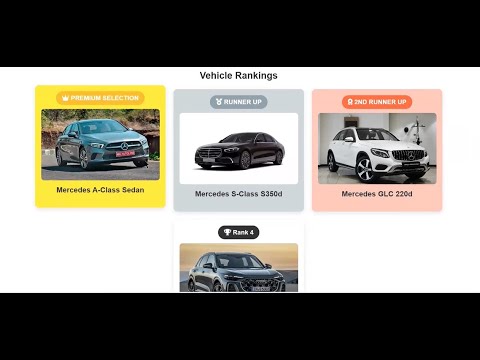
To integrate the recommendation and ranking logic into a secure, user-friendly web application using Flask and SQLite, enabling authenticated users to explore, compare, and evaluate car models interactively.
Block Diagram