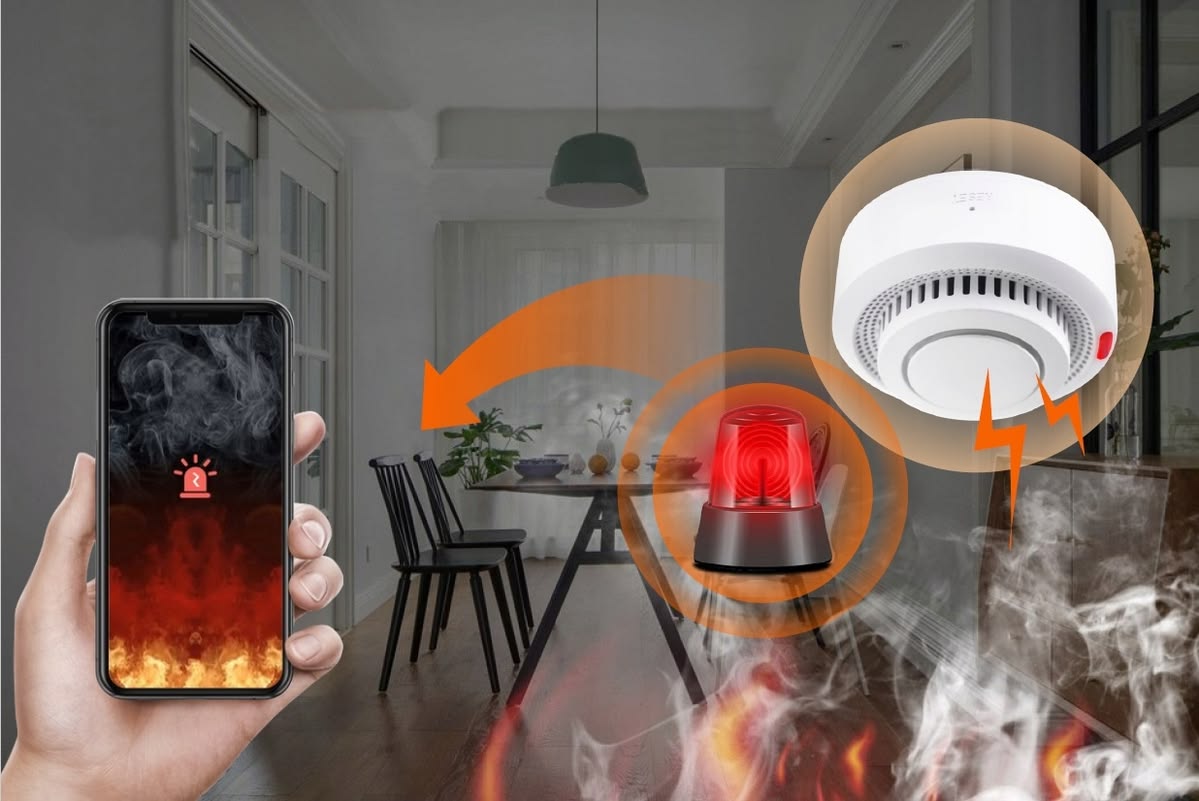
Fire accidents can cause serious damage to buildings, electrical equipment, industrial facilities and human life. Detecting fire-related conditions at an early stage is important for improving safety and reducing potential losses. Traditional fire alarm systems generally use local sensors and alarm devices to identify smoke or heat and notify people in the surrounding area.
With the development of the Internet of Things (IoT), fire detection systems can be enhanced with connected sensors, microcontrollers and remote monitoring platforms. These technologies allow sensor readings to be collected continuously and shared with a monitoring dashboard or alert application.
The IoT-Based Fire Detection System is an embedded and IoT project designed to identify potential fire-related conditions using sensors such as flame, smoke and temperature detectors. A microcontroller processes the sensor readings and activates an alarm when predefined conditions indicate a possible fire risk.
The system can also connect to the internet through Wi-Fi or another communication technology to send alerts to authorized users. A web-based dashboard can display sensor readings, system status and alert history.
The main objective of this project is to demonstrate how IoT technology can support continuous fire-risk monitoring and faster notification in residential, commercial and industrial environments.
Key Features & Benefits
Existing System and Its Challenges
Traditional fire detection systems commonly use smoke detectors, heat sensors and local alarm devices. When a sensor detects a condition above its configured threshold, the system activates an audible or visual alarm.
Although these systems are important safety devices, basic implementations may have certain limitations:
1. Limited Remote Monitoring: Conventional local alarms may not provide remote access to sensor information.
2. Delayed Notification: People who are away from the protected location may not immediately know that an alarm has been triggered.
3. Limited Data History: Basic alarm systems may not maintain detailed sensor readings or historical event records.
4. Sensor Limitations: Individual sensors detect specific conditions and may not identify every type of fire-related event.
5. Environmental Interference: Dust, steam, cooking smoke and other environmental factors can cause false alarms in unsuitable sensor configurations.
6. Manual Inspection: Systems without connected monitoring may require people to physically inspect the alarm or equipment.
IoT connectivity can improve monitoring and notification capabilities. However, connected systems must be designed with reliable sensors, secure communication and backup power. Internet connectivity should not be the only method of raising a local fire alarm.
Implementation Guide
Proposed System and Methodology
The proposed system combines fire-related sensors, a microcontroller, an alarm device and an IoT communication platform to monitor environmental conditions.
The implementation can include the following stages:
1. Sensor Data Collection
Sensors are installed in the area being monitored. Depending on the project design, these may include:
An ESP32, NodeMCU or Arduino-based controller collects the sensor readings. The microcontroller checks the input values against configured thresholds and evaluates the detection conditions.
3. Fire Condition Analysis
The system analyses the readings to identify possible fire-related conditions. Multiple sensor inputs can be combined to reduce dependence on a single sensor. Thresholds should be selected and validated according to the sensor specifications and intended environment.
4. Local Alarm Activation
When the detection logic identifies a possible fire condition, the controller activates a buzzer, LED indicator or other local warning device.
5. IoT Communication
The controller sends sensor readings and event information to a server using Wi-Fi, MQTT or HTTP communication. A backend application receives and processes the data.
6. Real-Time Dashboard
A web or mobile dashboard displays temperature, smoke-related readings, flame detection status and alert information. Users can view the current monitoring status remotely when network connectivity is available.
7. Alert Notification and History
The application can send notifications through supported channels such as email or a mobile notification service. It can also store timestamped alert records for later review.
The local alarm should continue operating even if the internet connection fails. The prototype should not replace certified fire detection equipment or approved fire protection systems.
Technical Specifications
Technologies, Features and Applications
The project can be developed using IoT hardware, sensor modules, embedded programming and web application technologies.
Hardware Components
ESP32 or NodeMCU – Main IoT controller.
Flame Sensor – Detecting flame-related signals.
MQ-2 or suitable smoke/gas sensor – Detecting selected combustible gases and smoke-related changes.
Temperature Sensor – Monitoring environmental temperature.
Buzzer – Providing an audible warning.
LED Indicators – Displaying system status.
Relay Module – Optional control of compatible external devices.
Power Supply – Providing stable power to the circuit.
Software and Technologies
Arduino IDE – Writing and uploading microcontroller programs.
Embedded C/C++ – Sensor interfacing and controller programming.
Python – Optional backend data processing.
Flask – Web application backend.
HTML, CSS and JavaScript – Dashboard development.
MySQL or MongoDB – Storing sensor readings and event history.
MQTT or HTTP – Transmitting IoT sensor data.
Cloud Platform – Optional remote monitoring and data visualization.
Conclusion & Next Steps
Conclusion
The IoT-Based Fire Detection and Real-Time Alert Monitoring System demonstrates the use of embedded systems, sensors and internet connectivity for fire-risk monitoring. By combining flame, smoke-related and temperature sensors with microcontroller processing and remote notifications, the project provides an educational prototype for connected safety applications.
This project is suitable for students interested in IoT, Arduino, ESP32, sensor interfacing, embedded programming and web application development. It also provides a foundation for exploring intelligent building monitoring and connected safety technologies.
Contact Details
Aislyn Technologies, Bangalore
Phone: +91 97395 94609
Email: info@aislyntech.com
Website: https://aislyn.in
Contact Aislyn Technologies for project development, implementation guidance and technical support. Our team can help you develop your IoT final-year project with expert support.