ABSTRACT
In recent years, the health and well-being of domestic animals, especially dogs, have gained significant attention due to their close association with humans. Early detection of diseases in dogs plays a crucial role in preventing severe health complications and ensuring timely medical intervention. Traditional methods of diagnosis often rely on veterinary expertise and manual observation, which can be time-consuming, subjective, and prone to human error. With advancements in artificial intelligence and deep learning, computer vision techniques have emerged as powerful tools for automated disease detection using images. This project presents a deep learning-based approach for dog disease classification using a customized Residual Neural Network (ResNet-like CNN) model. The system is trained to classify dog images into multiple categories such as Dermatitis, Ringworm, Eye Disease, and Healthy based on visual features extracted from skin, fur, and facial regions. The dataset is preprocessed and augmented using advanced image transformations to improve model generalization and robustness. The proposed CNN architecture integrates convolutional layers with residual connections to enhance feature learning and mitigate vanishing gradient issues, thereby improving classification accuracy. The model is trained using Keras with TensorFlow backend, employing Adam optimizer and categorical cross-entropy loss to optimize the learning process. A checkpoint mechanism is implemented to store the best-performing model based on validation accuracy, ensuring reliable prediction outcomes. After rigorous training and evaluation, the model achieves promising accuracy on unseen validation data, demonstrating its capability to distinguish between healthy and diseased dogs effectively. Furthermore, a user-friendly Graphical User Interface (GUI) is developed using Tkinter, enabling users to upload dog images and instantly receive disease predictions without technical expertise. The GUI integrates image visualization and model inference, making the system accessible and interactive for end-users such as veterinarians, dog owners, and animal care centers. This automated diagnostic tool has the potential to assist veterinary professionals by providing preliminary analysis and reducing diagnostic time. The combination of deep learning techniques with a practical desktop application showcases the feasibility of AI-driven disease detection in animals.
Introduction
In the modern world, the role of companion animals, particularly dogs, has extended beyond mere domestication to becoming integral members of families, emotional support systems, and contributors to human well-being. As such, maintaining their health is of utmost importance, not only for animal welfare but also for public health. Dogs are prone to various diseases that manifest externally through visible symptoms such as skin infections, eye disorders, or abnormal patterns on fur and body. Early detection of these conditions can significantly reduce treatment time, prevent disease progression, and improve the overall quality of life for the animal. Traditionally, disease detection in dogs relies heavily on manual examination by veterinarians, which involves visual inspection, clinical tests, and experience-based diagnosis. However, such approaches are often time-consuming, costly, and may not always be feasible, especially in rural or resource-limited settings where veterinary services are scarce. In this context, the integration of Artificial Intelligence (AI) and Deep Learning (DL) into veterinary diagnostics presents a transformative opportunity to automate disease detection, enhance accuracy, and support veterinary professionals in decision-making. Deep Learning, a subset of AI inspired by the structure of the human brain, has achieved groundbreaking success in image recognition, classification, and medical diagnostics. Convolutional Neural Networks (CNNs), in particular, have demonstrated exceptional performance in extracting spatial features from images and classifying them into distinct categories. This project leverages the power of CNNs to build a robust and reliable system capable of identifying diseases in dogs using image-based analysis. The proposed system utilizes a ResNet-like CNN architecture, which incorporates residual connections to overcome the vanishing gradient problem, allowing deeper networks to train effectively and capture complex visual features. The model is trained on a curated dataset consisting of images representing different conditions such as Dermatitis, Ringworm, Eye Disease, and Healthy dogs. Through the use of data augmentation techniques—such as rotation, shifting, flipping, and zooming—the model’s generalization ability is enhanced, reducing overfitting and improving real-world performance.
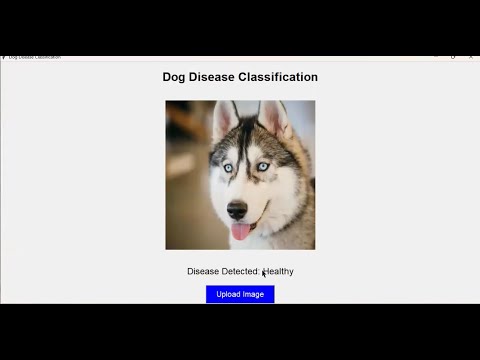
The project workflow begins with dataset preparation, where images are preprocessed, resized, and normalized to a consistent format suitable for neural network input. A deep learning model is then constructed using TensorFlow and Keras frameworks, where convolutional layers perform feature extraction, pooling layers reduce dimensionality, and fully connected layers perform classification. The Adam optimizer and categorical cross-entropy loss function are employed to fine-tune model parameters and minimize prediction error. Training is conducted over multiple epochs with validation monitoring to ensure stable convergence. A ModelCheckpoint callback is integrated to save the best-performing model based on validation accuracy, ensuring optimal performance during inference. After training, the model is evaluated using accuracy and loss metrics, and its learning behavior is visualized using plots for accuracy and loss over epochs. To make the system accessible to non-technical users, a Graphical User Interface (GUI) is developed using Tkinter, a Python-based library for building desktop applications. The GUI provides an intuitive interface where users can upload dog images from their local storage and receive instant predictions of the detected disease along with image visualization. This user-friendly design bridges the gap between complex deep learning models and real-world usability, enabling veterinarians, animal shelters, and pet owners to quickly identify potential health issues. The integration of CNN-based disease classification with a GUI application demonstrates a practical deployment scenario of AI in animal healthcare, making advanced diagnostic tools available at the click of a button.
Block Diagram
SOFTWARE REQUIREMENTS
• Operating System: Windows 10/11, Linux (Ubuntu), or macOS can be used for development and deployment.
• Programming Language: Python 3.8 or higher is required to implement the CNN model and web interface.
• Deep Learning Libraries: TensorFlow/Keras for building and training the ResNet-like CNN.
• Image Processing Libraries: OpenCV, Pillow, and NumPy for image preprocessing and manipulation.
• Web Framework: Flask (or Django) to create the web-based interface for uploading images and displaying predictions.
• Visualization Libraries: Matplotlib or Seaborn for plotting model accuracy and loss curves during training.
• Web Browser: Chrome, Firefox, or Edge for testing and using the web application.
• Additional Tools: pip for installing Python packages, Jupyter Notebook/VS Code for coding and experimentation