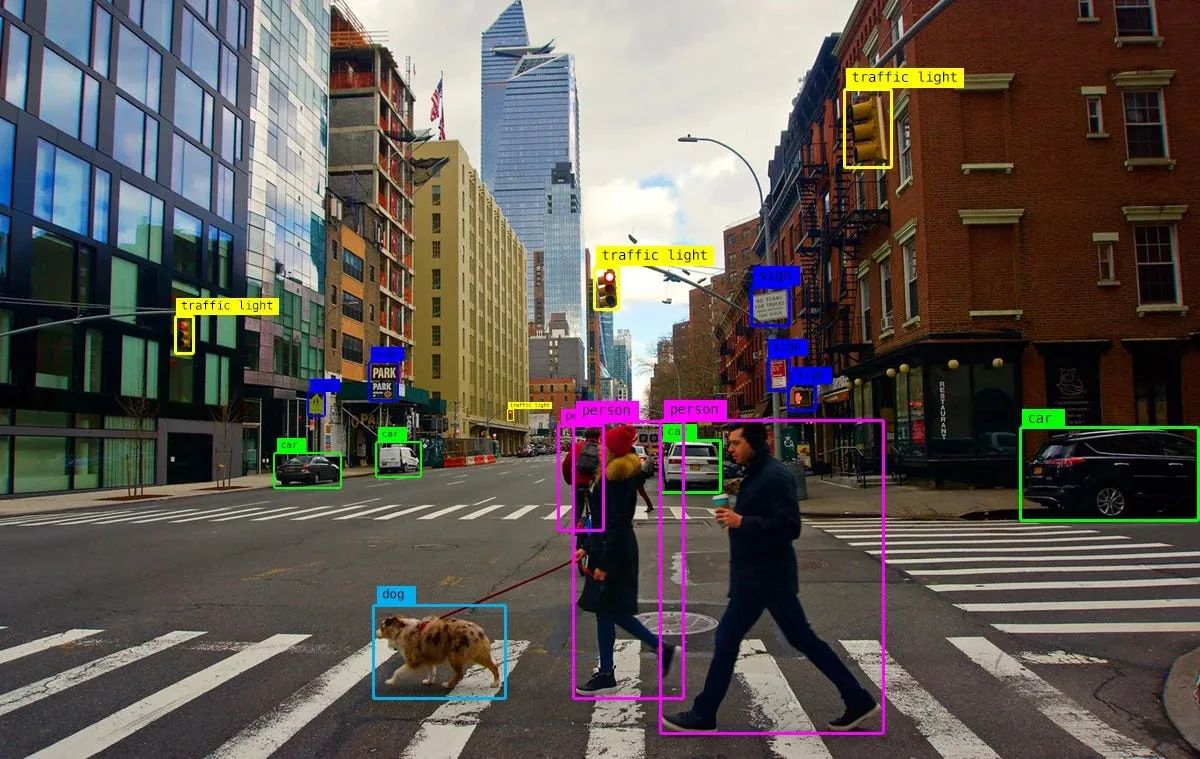
Object tracking is an important application of Artificial Intelligence, Computer Vision, and intelligent sensing technologies. It enables computer systems to identify objects and continuously monitor their movement across video frames or sensor observations.
Traditional object tracking systems often depend on a single data source, such as a camera. However, environmental conditions such as poor lighting, motion blur, object occlusion, and camera limitations can affect tracking performance.
The AI-Based Multi-Sensor Object Tracking System for High Accuracy and Reliability project focuses on combining information from multiple sensors to improve object tracking performance.
The system can integrate visual information from cameras with additional sensor measurements such as LiDAR, radar, ultrasonic sensors, or other supported sensing devices. Artificial Intelligence algorithms process the collected information to detect objects, estimate their positions, and track their movement.
Sensor fusion techniques combine complementary information from different sources to create a more comprehensive representation of the surrounding environment.
This project combines Python programming, Deep Learning, Computer Vision, image processing, and multi-sensor data fusion. It is suitable for students interested in AI, robotics, autonomous systems, surveillance, and intelligent transportation technologies.
Key Features & Benefits
Project Overview and Objectives
The primary objective of this project is to develop an intelligent object tracking framework that combines multiple sensor inputs with AI-based detection and tracking algorithms.
A camera-based detection system can identify objects visually, while other sensors can provide additional information about distance, position, velocity, or environmental conditions.
By combining these inputs, the system aims to improve tracking continuity and reliability under different operating conditions.
Understanding Multi-Sensor Fusion
Multi-sensor fusion is the process of combining measurements from multiple sensing devices to obtain more useful information than may be available from an individual sensor.
For example:
Camera: Provides visual information about objects.
The actual sensors used depend on the project hardware and application requirements.
Key Project Objectives:
Collect data from multiple sensor sources.
Detect objects using computer vision algorithms.
Extract useful object features from video frames.
Combine information from multiple sensors.
Estimate object positions and movement.
Track multiple objects across consecutive frames.
Improve tracking continuity during partial occlusion.
Display tracking information through a real-time interface.
Evaluate detection and tracking performance.
Implementation Guide
Major Features and Modules
The AI-Based Multi-Sensor Object Tracking System consists of multiple modules for data collection, object detection, sensor fusion, tracking, and visualization.
1. Sensor Data Acquisition Module
Collects measurements from connected sensing devices. Depending on the implementation, inputs may include camera frames, LiDAR point clouds, radar measurements, or ultrasonic distance readings.
2. Video Processing Module
Receives video streams from cameras and prepares frames for object detection. Operations may include resizing, color conversion, frame extraction, and preprocessing.
3. AI-Based Object Detection Module
Uses deep learning models to identify objects in video frames. YOLO-based object detection architectures can be explored for detecting people, vehicles, and other supported object categories.
4. Feature Extraction Module
Extracts useful object characteristics such as bounding boxes, appearance features, object locations, and detection confidence values.
5. Multi-Sensor Fusion Module
Combines information from different sensors to improve the representation of detected objects. Fusion can be performed at the data, feature, or decision level depending on the system architecture.
6. Object Tracking Module
Maintains object identities across consecutive video frames. Algorithms such as Kalman Filter, SORT, and DeepSORT can be explored for object tracking.
7. Position and Movement Estimation Module
Estimates object position and movement using available sensor measurements and tracking information.
8. Object Identification Module
Assigns tracking identifiers to detected objects and maintains their identities across frames.
9. Real-Time Monitoring Dashboard
Displays camera output, object bounding boxes, tracking IDs, sensor measurements, and tracking statistics.
10. Data Logging and Report Module
Stores tracking information, timestamps, sensor measurements, and detection results for later analysis.
Technical Specifications
Technologies Used and System Implementation
The project combines Artificial Intelligence, Computer Vision, sensor integration, and real-time data processing.
MySQL or SQLite – Stores sensor readings, object tracking information, and historical records.
System Implementation Workflow
The implementation begins with connecting the required sensors and collecting their measurements. Camera frames are captured and passed to the image processing pipeline.
The selected object detection model processes each frame and identifies objects with their bounding boxes and confidence scores.
Next, the tracking algorithm associates detections across consecutive frames and assigns unique tracking identifiers.
Additional sensor measurements are processed and synchronized with the visual detection information. The sensor fusion module combines relevant measurements using the selected fusion strategy.
The tracking system estimates object positions and updates their movement information. When a new frame arrives, the system repeats the detection, association, and tracking process.
Finally, the Flask dashboard displays detected objects, tracking identifiers, sensor readings, and relevant performance information.
For reliable multi-sensor operation, sensor calibration, timestamp synchronization, coordinate transformation, and measurement uncertainty should be considered during implementation.
Conclusion & Next Steps
Advantages, Applications and Future Enhancements
Advantages of the Project
Combines information from multiple sensors.
Supports intelligent object detection and tracking.
Provides continuous object identity tracking.
Helps reduce dependence on a single sensing source.
Supports tracking under changing environmental conditions.
Provides real-time visualization of detected objects.
Enables historical tracking data analysis.
Demonstrates practical applications of AI and sensor fusion.
Real-World Applications
The proposed concepts can be explored in several industries.
Autonomous vehicle object tracking.
Intelligent traffic monitoring systems.
Smart surveillance applications.
Robotics and autonomous navigation.
Industrial object monitoring.
Pedestrian tracking systems.
Smart transportation infrastructure.
Warehouse automation.
Security and perimeter monitoring.
Intelligent drone navigation.
Future Enhancements
The system can be extended with advanced AI and sensor fusion technologies.
Integrate advanced YOLO models for object detection.
Implement LiDAR-camera fusion.
Introduce radar-camera sensor fusion.
Explore Transformer-based object tracking.
Improve object tracking during long-term occlusion.
Add 3D object tracking capabilities.
Implement edge AI using NVIDIA Jetson devices.
Integrate GPS and IMU measurements for vehicle tracking.
Develop cloud-based tracking analytics.
Introduce multi-camera object tracking.
Conclusion
The AI-Based Multi-Sensor Object Tracking System for High Accuracy and Reliability demonstrates how Artificial Intelligence, Computer Vision, and sensor fusion can be combined to develop intelligent tracking applications.
By integrating object detection, tracking algorithms, and measurements from multiple sensing devices, the system provides a framework for monitoring object movement and analyzing surrounding environments.
The project offers practical experience in Python programming, YOLO object detection, OpenCV, sensor integration, Kalman filtering, and multi-sensor data fusion.
It is a valuable final-year project for students interested in Image Processing, Artificial Intelligence, Robotics, Computer Vision, and autonomous systems.
Frequently Asked Questions
1. What is a multi-sensor object tracking system?
It is an intelligent system that combines information from multiple sensors to detect and track objects over time.
2. What is the role of AI in object tracking?
AI models identify objects in images or video streams, while tracking algorithms maintain their identities across consecutive frames.
3. Which algorithms can be used for object tracking?
YOLO, Kalman Filter, SORT, and DeepSORT are commonly explored in object detection and tracking systems.
4. What is sensor fusion?
Sensor fusion combines measurements from different sensors to produce a more informative representation of the observed environment.
5. Which programming language is used in this project?
Python is commonly used with OpenCV, PyTorch, TensorFlow, and NumPy.
6. Can LiDAR and camera sensors be integrated?
Yes. Camera images and LiDAR point clouds can be combined after appropriate calibration, synchronization, and coordinate transformation.
7. Is this project suitable for final-year students?
Yes. It combines image processing, deep learning, sensor integration, and real-time application development.
Contact Details
Aislyn Technologies, Bangalore
Phone: +91 97395 94609
Email: info@aislyntech.com
Website: https://aislyn.in
Contact us today to start building your Artificial Intelligence, Image Processing, Machine Learning, IoT, and Embedded Projects in Bangalore with our expert support!