Abstract
The AI Voice Companion is an intelligent conversational system designed to enable natural interaction between humans and machines using Artificial Intelligence technologies. The system integrates Natural Language Processing (NLP), Deep Learning, Speech Recognition, and Text-to-Speech technologies to create a voice-enabled chatbot capable of understanding and responding to user queries. The primary objective of this project is to develop an assistant that can accept both text and voice input, analyze the user’s intent, and generate appropriate responses in real time. The system first converts spoken input into text using speech recognition techniques. The text is then processed using NLP methods such as tokenization and lemmatization to standardize the input. After preprocessing, the sentence is transformed into a numerical representation using the bag-of-words technique so that it can be interpreted by the machine learning model. A deep neural network model is trained to classify user input into predefined intent categories based on probability scores. Once the correct intent is identified, the system retrieves a suitable response from the dataset and presents it to the user through the graphical interface. The response is also converted into speech using text-to-speech technology, enabling a more natural conversational experience. The application is implemented with a user-friendly graphical interface that displays conversation history and provides controls for voice interaction. The system also includes fallback mechanisms to handle unknown or unclear queries effectively. By combining NLP preprocessing, deep learning-based intent classification, and speech technologies, the AI Voice Companion provides a scalable and efficient conversational assistant. This project demonstrates the practical implementation of intelligent human–computer interaction systems and highlights how artificial intelligence can enhance communication through smart, voice-enabled applications.
Introduction
Artificial Intelligence has significantly transformed the way humans interact with machines. In recent years, conversational systems such as chatbots and virtual assistants have become increasingly popular in various applications including customer service, education, healthcare, and smart devices. These systems are designed to simulate human conversation and provide automated responses to user queries. With the advancement of technologies like Natural Language Processing (NLP), machine learning, and speech processing, it is now possible to develop intelligent systems that can understand and respond to human language more effectively. One such application of artificial intelligence is the development of a voice-enabled conversational assistant that can interact with users through both text and speech.
The AI Voice Companion project focuses on developing an intelligent chatbot capable of understanding natural language input and generating appropriate responses. The system integrates multiple technologies including NLP, deep learning, speech recognition, and text-to-speech processing to create a complete conversational platform. The goal of this system is to enable smooth communication between humans and computers by allowing users to interact with the application using natural language instead of complex commands or technical interfaces.
Natural Language Processing plays a crucial role in enabling machines to understand human language. NLP techniques allow computers to analyze, interpret, and process textual data in a meaningful way. In this project, NLP methods such as tokenization and lemmatization are used to preprocess user input. Tokenization involves breaking a sentence into individual words or tokens, while lemmatization reduces words to their base or root form. These techniques help in normalizing the input data and improving the efficiency of the machine learning model used for intent classification.
After preprocessing the input text, the system converts the processed sentence into a numerical format using the bag-of-words representation. Machine learning models cannot directly process raw text data, so it must be transformed into numerical vectors that represent the presence or absence of words in a predefined vocabulary. The bag-of-words technique provides a simple and effective way to represent text data for classification tasks. This numerical representation is then used as input to the deep learning model that predicts the user’s intent.
The intent classification component is implemented using a deep neural network model. The model is trained on a structured dataset containing various user queries and corresponding responses organized into different intent categories. During training, the model learns patterns and relationships between words and their associated intents. Once trained, the model can analyze new user inputs and predict the most appropriate intent category based on probability scores. The predicted intent is then used to retrieve the correct response from the predefined dataset.
Another important feature of the system is voice interaction. In addition to text input, the AI Voice Companion allows users to communicate with the system through speech. The system uses speech recognition technology to capture audio input from a microphone and convert it into text. This text is then processed in the same way as typed input, ensuring consistent handling of user queries. Voice interaction makes the system more convenient and accessible, allowing users to interact with the assistant without needing to type.
To further enhance user experience, the system also includes text-to-speech functionality. After generating a response, the system converts the text response into spoken audio using a text-to-speech engine. The generated audio is played through speakers, enabling the system to communicate verbally with the user. This feature creates a more natural and engaging conversational experience and simulates real human-like interaction.
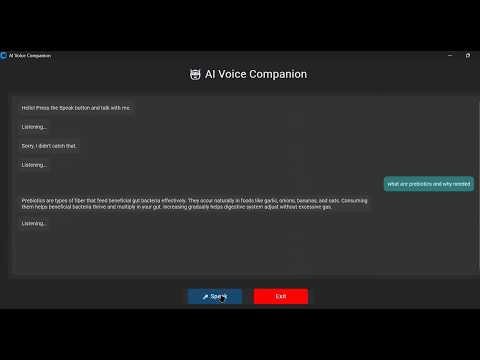
The AI Voice Companion also includes a graphical user interface (GUI) that allows users to interact with the system easily. The interface provides a chat window that displays both user queries and chatbot responses. It also includes buttons for voice input and system controls, making the application simple and user-friendly. The GUI ensures that users can communicate with the system without requiring technical knowledge.
One of the major advantages of this system is its ability to handle variations in user input. Unlike traditional rule-based chatbots that rely on exact keyword matching, the AI Voice Companion uses machine learning techniques to understand different ways of expressing the same query. This makes the system more flexible and intelligent when interacting with users. Additionally, the system includes fallback mechanisms to handle unknown or unclear inputs gracefully, preventing system failures and maintaining smooth communication.
The development of this project demonstrates how multiple artificial intelligence technologies can be combined to create a practical and interactive system. By integrating NLP preprocessing, deep learning-based intent classification, speech recognition, and text-to-speech technologies, the AI Voice Companion provides a comprehensive conversational platform. The system highlights the potential of AI in improving human–computer interaction and shows how intelligent assistants can be developed for real-world applications.
Overall, the AI Voice Companion project represents an effective implementation of modern AI techniques for building smart conversational systems. It demonstrates how machines can be trained to understand natural language, identify user intentions, and provide meaningful responses in real time. With further improvements and expansion of the dataset, such systems can be adapted for many domains including virtual assistants, automated customer support systems, and intelligent information retrieval applications.
OBJECTIVES
To develop an intelligent conversational chatbot capable of understanding and responding to user queries using Natural Language Processing (NLP).
To implement NLP preprocessing techniques such as tokenization and lemmatization for efficient processing of user input.
To design and train a deep learning model that can accurately classify user intents and generate appropriate responses.
To integrate speech recognition and text-to-speech technologies to enable both voice input and voice output interaction.
To create a user-friendly graphical interface (GUI) that allows users to interact with the AI Voice Companion easily and efficiently.
Block Diagram
Software Requirements
The AI Voice Companion system requires several software tools and libraries for development, training, and deployment of the chatbot application. These software components help in implementing Natural Language Processing, deep learning models, speech processing, and the graphical user interface.
The primary programming language used for developing the system is Python, which provides extensive libraries for machine learning, NLP, and speech processing. Python version 3.8 or higher is recommended for smooth execution of the application and compatibility with the required libraries.
The deep learning model used for intent classification is developed using TensorFlow and Keras. These frameworks provide powerful tools for designing, training, and deploying neural network models. The trained model is saved in .h5 format, which is later loaded during the system’s runtime for predicting user intents.
The system uses the Natural Language Toolkit (NLTK) library to perform text preprocessing tasks such as tokenization and lemmatization. These NLP techniques help convert user input into a structured format that can be processed by the machine learning model.
For numerical operations and data handling, the system uses NumPy, which provides efficient array operations required for preparing input data for the neural network model.
The project also uses Scikit-learn, which is mainly used for evaluating the model performance through metrics such as classification reports and confusion matrices.
To support voice interaction, the system integrates the SpeechRecognition library, which captures audio input from the microphone and converts it into text. This allows the system to understand spoken commands from the user.
The chatbot’s responses are converted into spoken audio using gTTS (Google Text-to-Speech). The generated speech is then played through the speakers using the playsound library, allowing the system to communicate verbally with the user.
The graphical interface of the application is developed using Tkinter, which is a built-in Python library used to design simple and user-friendly desktop interfaces. The GUI displays conversation history and provides controls for text and voice input.
For development and coding, an Integrated Development Environment (IDE) such as Visual Studio Code or PyCharm can be used. These tools provide features like debugging, code completion, and project management, which help in efficient development.
The system can run on common operating systems such as Windows, Linux, or macOS, as long as Python and the required libraries are properly installed.
Overall, these software components work together to support the development, training, execution, and user interaction of the AI Voice Companion system.