Abstract
Skin diseases are among the most commonly occurring health conditions and often require early and accurate diagnosis to prevent complications. Manual diagnosis methods depend heavily on dermatological expertise and clinical examination, which can be time-consuming, costly, and inaccessible in many regions. To address these challenges, this project proposes an AI-based skin disease detection and cosmetic recommendation system using deep learning and transfer learning techniques. The system employs a pre-trained MobileNetV2 model for multi-class classification of skin images into five categories: Atopic Dermatitis, Eczema, Melanocytic Nevi, Warts Molluscum, and Normal. Image preprocessing and data augmentation techniques are applied to improve model generalization. A two-stage training strategy involving feature extraction and fine-tuning is used to enhance classification performance. The trained model is integrated into both a desktop-based Tkinter application and a web-based Flask application with user authentication. Based on the predicted skin condition, the system provides personalized cosmetic routines, recommended ingredients, and suitable skincare products. The proposed system demonstrates high accuracy, computational efficiency, and practical usability, making it suitable for real-world skin analysis and cosmetic guidance applications.
Keywords
Skin Disease Detection, Deep Learning, MobileNetV2, Transfer Learning, Image Classification, Cosmetic Recommendation, Flask Application
Introduction
Skin diseases constitute one of the most prevalent health concerns worldwide, affecting individuals irrespective of age, gender, or geographic location. The skin, being the largest and most visible organ of the human body, is highly susceptible to environmental factors, allergens, infections, and lifestyle-related conditions. Disorders such as atopic dermatitis, eczema, melanocytic nevi, warts, and other skin abnormalities not only impact physical health but also significantly affect an individual’s psychological well-being and quality of life. Early detection and appropriate skincare management are crucial to prevent disease progression and long-term complications.
Traditionally, skin disease diagnosis relies on clinical examination by dermatologists, dermatoscopic analysis, and in some cases, invasive laboratory tests such as biopsies. While these methods are clinically reliable, they are often expensive, time-consuming, and dependent on the availability of skilled medical professionals. In many rural and resource-limited regions, access to dermatological expertise is limited, resulting in delayed diagnosis and improper treatment. Furthermore, manual diagnosis is subjective in nature and may vary based on practitioner experience, lighting conditions, and visual interpretation, which can lead to inconsistencies.
With the rapid advancement of artificial intelligence (AI) and deep learning technologies, automated medical image analysis has emerged as a promising solution to overcome these challenges. Deep learning models, particularly Convolutional Neural Networks (CNNs), have demonstrated exceptional performance in visual pattern recognition tasks, including medical image classification. By learning hierarchical feature representations directly from image data, CNNs can identify subtle patterns that may not be easily noticeable to the human eye. As a result, AI-based systems are increasingly being adopted in healthcare for disease screening, diagnosis assistance, and decision support.
However, training deep neural networks from scratch requires large-scale annotated datasets and substantial computational resources, which may not always be feasible in practical scenarios. To address this limitation, transfer learning has gained widespread acceptance. Transfer learning leverages knowledge from pre-trained models that have been trained on large benchmark datasets and adapts them to specific tasks with comparatively smaller datasets. Among various pre-trained architectures, MobileNetV2 is particularly well-suited for medical image classification due to its lightweight structure, reduced computational complexity, and high accuracy. Its use of depthwise separable convolutions enables efficient feature extraction while maintaining strong representational capability.
In this project, MobileNetV2 is employed as the backbone network for skin disease classification. The model is fine-tuned using a two-stage training strategy to enhance performance while preventing overfitting. The first stage focuses on feature extraction by freezing the base layers of the network, allowing the newly added classification layers to learn task-specific features. In the second stage, selective fine-tuning of deeper layers is performed using a very low learning rate, enabling the model to adapt more precisely to skin disease characteristics. This approach ensures both stability and improved generalization across multiple skin conditions.
In addition to disease classification, there is a growing need for systems that provide post-diagnosis guidance. Many existing AI-based skin analysis tools focus solely on disease identification and fail to offer practical recommendations for skincare management. Users often remain uncertain about appropriate cosmetic routines, key ingredients to use or avoid, and suitable products for their skin condition. To bridge this gap, the proposed system integrates a cosmetic recommendation module that provides personalized skincare guidance based on the predicted skin condition. This feature enhances the practical usefulness of the system and supports preventive skincare practices.
The proposed system is designed with usability and accessibility in mind. To cater to different user preferences and deployment environments, the trained deep learning model is integrated into two distinct platforms: a desktop-based application and a web-based application. The desktop application is developed using the Tkinter framework, providing a simple graphical user interface for image upload, prediction, and display of recommendations. This mode is suitable for offline usage and local testing scenarios.
The web-based implementation is developed using the Flask framework and includes additional features such as user registration, login authentication, and session management. This ensures secure access to the prediction module and enables multi-user interaction. Users can upload skin images through a web interface, receive disease predictions along with confidence scores, and view personalized cosmetic recommendations. The inclusion of authentication mechanisms improves system reliability and aligns with real-world application requirements.
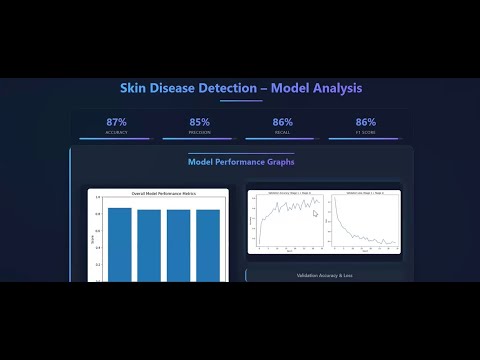
From a technical perspective, the system incorporates robust image preprocessing techniques to improve classification accuracy. Uploaded images are resized, normalized, and preprocessed according to the MobileNetV2 input requirements. Data augmentation techniques such as rotation, zooming, shifting, and brightness adjustment are applied during training to increase dataset diversity and enhance model robustness. Model performance is evaluated using standard metrics such as classification reports and confusion matrices, ensuring reliable assessment of predictive accuracy.
Overall, this project presents a comprehensive AI-based solution for skin disease detection and cosmetic recommendation. By combining deep learning, transfer learning, and user-friendly interfaces, the system addresses the limitations of traditional diagnostic approaches while offering practical skincare guidance. The lightweight nature of MobileNetV2, coupled with efficient training strategies, makes the system suitable for real-time applications and deployment on resource-constrained platforms. The proposed approach demonstrates how artificial intelligence can be effectively utilized to support dermatological analysis and promote accessible, technology-driven healthcare solutions.
Objectives
The primary objective of this project is to design and develop an intelligent system for automated skin disease detection and cosmetic recommendation using deep learning techniques. The specific objectives of the proposed system are as follows:
1. To develop an automated skin disease detection system capable of classifying skin images into multiple categories, including Atopic Dermatitis, Eczema, Melanocytic Nevi, Warts Molluscum, and Normal skin conditions.
2. To utilize a lightweight deep learning architecture, specifically MobileNetV2, to achieve high classification accuracy while maintaining low computational complexity suitable for real-time and resource-constrained environments.
3. To apply transfer learning and fine-tuning strategies in order to enhance model performance when training with a limited dataset and to reduce overfitting.
4. To implement effective image preprocessing and data augmentation techniques to improve robustness and generalization across variations in lighting, skin tone, and image quality.
5. To evaluate the performance of the trained model using standard metrics such as accuracy, classification reports, and confusion matrices.
6. To integrate the trained model into a user-friendly desktop application using Tkinter for offline testing and local deployment.
7. To deploy the model through a web-based application using the Flask framework, enabling secure user access with authentication and session management.
8. To provide personalized cosmetic recommendations based on the predicted skin condition, including skincare routines, key ingredients, and suitable product suggestions.
9. To enhance user experience and accessibility by designing intuitive graphical and web interfaces for image upload, prediction, and result visualization.
10. To create a scalable and extensible system that can be further expanded to include additional skin disease categories, real-time prediction, and mobile application support.
Block Diagram
• Demo Video
• Complete project
• Full project report
• Source code
• Complete project support by online
• Lifetime access
• Execution Guidelines
• Immediate (Download)
Software Requirements
The successful development, training, deployment, and execution of the proposed AI-based skin disease detection and cosmetic recommendation system require a set of software tools, programming languages, libraries, and frameworks. Each software component plays a crucial role in ensuring accurate model performance, efficient data handling, and user-friendly interaction.
1. Operating System
The system is designed to be platform-independent and can be executed on commonly used operating systems such as Windows, Linux, or macOS. In the implementation phase, a Windows operating system is used due to its wide availability and compatibility with deep learning frameworks and development tools. The operating system provides the necessary environment for running Python-based applications, managing dependencies, and executing graphical and web-based interfaces.
2. Programming Language – Python
Python serves as the core programming language for the proposed system due to its simplicity, flexibility, and extensive ecosystem of libraries for artificial intelligence and web development. Python supports rapid prototyping and modular programming, which allows seamless integration of deep learning models, image processing modules, and user interfaces. In this project, Python is used for model training, evaluation, image preprocessing, desktop GUI development using Tkinter, and web application development using Flask. Its interpreted nature and large community support make Python highly suitable for building scalable and maintainable AI-based systems.
3. Deep Learning Framework – TensorFlow and Keras
TensorFlow is an open-source deep learning framework used for building, training, and deploying neural network models. It provides efficient numerical computation using tensors and supports hardware acceleration through GPUs and TPUs. In this project, TensorFlow is used as the underlying engine for implementing convolutional neural networks and managing the training workflow. TensorFlow ensures optimized execution of mathematical operations involved in feature extraction and classification, making it suitable for handling large-scale image data and deep learning models.
Keras is a high-level neural network API that operates on top of TensorFlow, offering a simplified and user-friendly interface for deep learning model development. Keras allows rapid implementation of complex neural network architectures with minimal code. In the proposed system, Keras is used to load the pre-trained MobileNetV2 model, define custom layers, compile the model, and manage training parameters such as loss functions, optimizers, and callbacks. Keras also supports transfer learning, enabling efficient fine-tuning of pre-trained models for skin disease classification.
4. Pre-trained Model – MobileNetV2
The MobileNetV2 architecture is used as the backbone model for feature extraction and classification. MobileNetV2 is selected due to its lightweight design, reduced parameter count, and efficient computation. The model is pre-trained on large-scale image datasets and fine-tuned for skin disease classification. Using a pre-trained model significantly reduces training time and improves performance when working with limited datasets.
5. Image Processing Libraries
Pillow is a Python imaging library used for opening, manipulating, and saving image files. It supports a wide range of image formats and provides functions for resizing, format conversion, and image enhancement. In the proposed system, Pillow is used to load user-uploaded skin images, resize them to the required dimensions, and convert them into suitable formats for further preprocessing. Pillow plays a crucial role in bridging raw image input and numerical representation used by the deep learning model.
NumPy is a fundamental Python library used for numerical computing and array manipulation. It provides support for multi-dimensional arrays and efficient mathematical operations. In this project, NumPy is extensively used for handling image data as numerical arrays, performing normalization, reshaping image tensors, and processing model prediction outputs. NumPy ensures fast computation and seamless integration between image preprocessing steps and deep learning model input requirements.
6. Data Augmentation and Preprocessing – ImageDataGenerator
The ImageDataGenerator module from Keras is used for image preprocessing and data augmentation during training. This tool applies transformations such as rotation, zooming, shifting, flipping, and brightness adjustment in real time. Data augmentation helps improve model generalization, reduce overfitting, and enhance robustness against variations in image quality and lighting conditions.
7. Model Optimization and Training Utilities
The Adam Optimizer is used for training the deep learning model due to its adaptive learning rate and efficient convergence.
Categorical Cross-Entropy is used as the loss function, which is suitable for multi-class classification problems.
EarlyStopping and ModelCheckpoint callbacks are used to monitor validation performance, prevent overfitting, and save the best-performing model during training.
8. Evaluation and Visualization Libraries
Scikit-learn
Scikit-learn is a machine learning library used for model evaluation and performance analysis. Although the deep learning model is implemented using TensorFlow and Keras, Scikit-learn is utilized to compute evaluation metrics such as classification reports, precision, recall, F1-score, and confusion matrices. These metrics provide detailed insights into class-wise performance and model reliability. Scikit-learn ensures standardized evaluation practices and aids in validating the effectiveness of the proposed skin disease classification model.
Matplotlib
Matplotlib is a Python visualization library used for creating static plots and graphs. In this project, Matplotlib is employed to visualize training and validation accuracy, loss curves, and overall model performance trends. These visualizations help in monitoring model convergence, identifying overfitting, and analyzing learning behavior across training epochs. Matplotlib provides customizable plotting features that support effective result interpretation in academic and research settings.
Seaborn
Seaborn is a high-level data visualization library built on top of Matplotlib. It offers enhanced aesthetic styling and simplified syntax for complex visualizations. In the proposed system, Seaborn is used to generate heatmaps for confusion matrices, enabling clear visualization of classification accuracy and misclassification patterns across different skin disease classes. Seaborn improves readability and presentation quality of performance evaluation results.
9. Desktop Application Framework – Tkinter
Tkinter is used to develop the desktop-based graphical user interface. It provides built-in support for buttons, labels, image panels, and event handling. Tkinter enables users to upload skin images, trigger predictions, and view results along with cosmetic recommendations. Its simplicity and integration with Python make it suitable for lightweight desktop applications.
10. Web Application Framework – Flask
Flask is a lightweight and flexible web framework written in Python, designed for developing web applications with simplicity and minimal overhead. It follows the Model–View–Controller (MVC) architectural pattern in a simplified manner and provides essential features such as URL routing, request handling, template rendering, and session management. In the proposed system, Flask is used to develop the web-based interface for skin disease detection and cosmetic recommendation.
Flask enables the creation of dynamic web pages that allow users to upload skin images, view prediction results, and receive personalized cosmetic recommendations. The framework supports HTTP request handling for image uploads and integrates seamlessly with deep learning models developed using TensorFlow and Keras. Flask’s compatibility with Python allows direct loading and execution of the trained MobileNetV2 model without additional middleware.
User authentication is implemented using Flask’s session management and routing mechanisms. The system supports user registration, login, and logout functionalities, ensuring secure access to the prediction module. Flash messages are used to provide real-time feedback to users during authentication and image upload processes. Flask also supports modular development, making the application scalable and easy to maintain.
Overall, Flask plays a critical role in deploying the deep learning model in a real-world environment. Its lightweight nature, flexibility, and ease of integration make it suitable for developing AI-powered web applications that require fast development and reliable performance.
11. Database Management – SQLite
SQLite3 is a lightweight, serverless relational database management system used for storing structured data. Unlike traditional database systems, SQLite does not require a separate server process and operates directly on a single database file. In the proposed system, SQLite3 is used to manage user authentication data, including user names, email addresses, and passwords.
SQLite3 is integrated with the Flask web application using Python’s built-in SQLite3 module. This integration allows efficient execution of SQL queries for creating tables, inserting records, retrieving user information, and validating login credentials. The database schema is designed to support secure user registration and login functionalities while ensuring data persistence across sessions.
The use of SQLite3 offers several advantages, including simplicity, minimal configuration, and low resource consumption. It is well suited for small to medium-scale applications and academic projects where high concurrency is not required. SQLite3 ensures data integrity and provides reliable storage without the complexity of managing external database servers.
In the proposed system, SQLite3 enhances application security by maintaining persistent user records and supporting controlled access to the prediction module. Its seamless integration with Flask ensures smooth data flow between the web interface and backend logic, contributing to the overall reliability and functionality of the system.
12. Development Tools
Visual Studio Code (VS Code) or similar integrated development environments (IDEs) are used for writing, testing, and debugging code. These tools provide syntax highlighting, debugging support, and version control integration, improving development efficiency.
Web Browsers such as Google Chrome are used for accessing and testing the Flask web application.