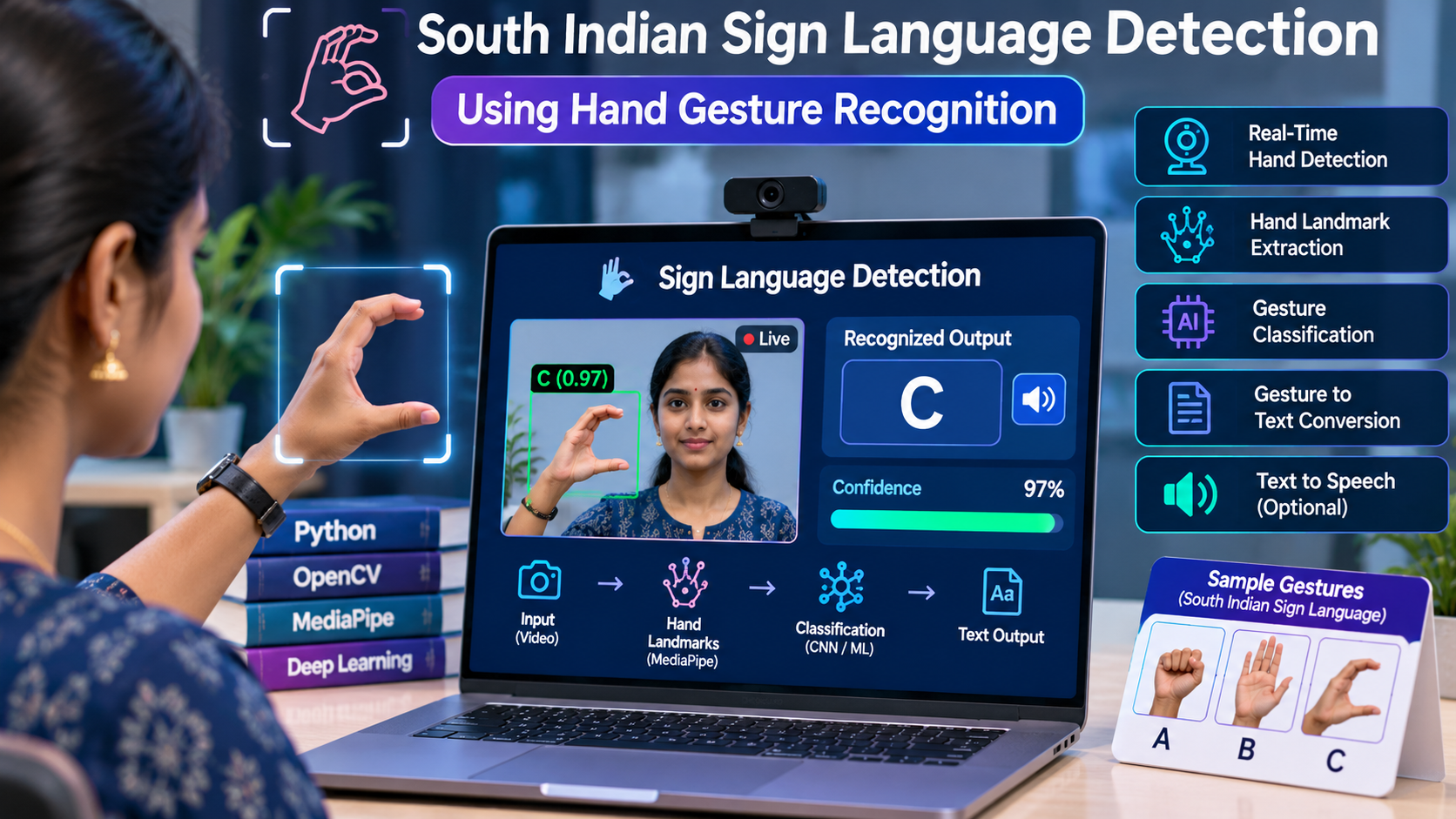
Introduction to South Indian Sign Language Detection
Communication is an essential part of everyday life, but people with hearing and speech disabilities may face challenges when communicating with individuals who are unfamiliar with sign language. Sign language provides an important visual communication method through hand movements, gestures, and facial expressions. Artificial Intelligence and Computer Vision offer opportunities to develop technology that can recognise selected sign language gestures and convert them into understandable text.
South Indian Sign Language Detection Using Hand Gesture Recognition is an AI-based academic project that focuses on identifying predefined hand gestures through image processing and machine learning techniques. The system captures hand movements using a webcam or camera, extracts relevant hand features, and classifies the gestures using a trained recognition model.
The detected gesture can then be displayed as corresponding text on the application screen. Depending on the dataset and implementation, the system can support selected signs, alphabets, numbers, or predefined communication phrases.
This project is suitable for BCA final-year students interested in Artificial Intelligence, Machine Learning, Python Programming, Computer Vision, Human-Computer Interaction, and assistive technology development.
Key Features & Benefits
Working Principle of Hand Gesture Recognition
The proposed sign language detection application follows a camera-based image acquisition and gesture classification workflow. The camera continuously captures hand images or video frames, which are processed to identify the gestures.
The system can be implemented through the following stages:
1. Image Acquisition: Capture hand gestures through a webcam or connected camera.
2. Hand Detection: Identify the hand region in the captured image using computer vision techniques.
3. Image Preprocessing: Resize images, normalize input data, and prepare the hand region for feature extraction.
4. Hand Landmark Detection: Use MediaPipe Hands or a similar computer vision framework to identify important hand landmarks, including fingertips and finger joints.
5. Feature Extraction: Extract hand coordinates, finger positions, and other relevant geometric features.
6. Gesture Classification: Apply a trained machine learning or deep learning model to classify the detected gesture into one of the supported sign categories.
7. Text Conversion: Display the corresponding recognized gesture as text on the application interface.
8. Real-Time Recognition: Process successive camera frames to provide continuous gesture recognition.
For dynamic gestures that depend on movement over time, the system can be extended with sequence-based models such as LSTM or other temporal deep learning architectures.
Implementation Guide
Technologies Used in Sign Language Recognition
The project combines programming, computer vision, and machine learning technologies to develop an intelligent gesture recognition application.
Programming Language: Python is used for image processing, model development, and gesture classification.
Computer Vision: OpenCV is used for camera access, image processing, frame handling, and real-time visualisation.
Hand Landmark Detection: MediaPipe Hands can identify hand landmarks and extract useful information about finger positions.
Machine Learning: Scikit-learn can be used to develop classification models such as Random Forest, Support Vector Machine, and K-Nearest Neighbours.
Deep Learning: TensorFlow, Keras, or PyTorch can be used to build neural networks for gesture classification.
Frontend Development: HTML, CSS, JavaScript, or Streamlit can be used to create an interactive application.
Backend Development: Flask or FastAPI can connect the gesture recognition model with the web application.
Database: MySQL or MongoDB can optionally store user details, recognition history, and application records.
Development Tools: Jupyter Notebook, Google Colab, VS Code, and Git can support model development, testing, and project management.
Students should use a properly labelled dataset containing the target sign vocabulary. If the project covers regional South Indian signs, the dataset should document the specific sign conventions and regional variations being supported.
Technical Specifications
Key Features and Real-World Applications
An AI-based hand gesture recognition system can provide several useful features for accessible communication and computer vision applications.
Real-Time Hand Detection: Detect hands from live webcam input and identify their positions.
Gesture Recognition: Recognise predefined hand gestures using trained machine learning or deep learning models.
Hand Landmark Extraction: Identify finger joints and hand coordinates for gesture analysis.
Gesture-to-Text Conversion: Display recognised gestures as corresponding letters, words, or predefined phrases.
Live Camera Interface: Provide an interactive screen for viewing camera input and recognition results.
Multiple Gesture Support: Expand the application to recognise additional gestures by collecting and training with more labelled samples.
Prediction Confidence: Display the model's confidence score for supported gesture predictions.
Recognition History: Optionally save previously recognised gestures for later reference.
Future Voice Output: Integrate text-to-speech functionality to convert recognised text into audio.
Possible Applications
Assistive communication applications.
Educational sign language learning tools.
Human-computer interaction systems.
Gesture-controlled computer applications.
Accessibility-focused software.
AI-based communication research.
It is important to distinguish a gesture classification prototype from complete sign language translation. Full sign language understanding may require hand movement, facial expressions, body posture, grammar, and context. Recognition accuracy also depends on the supported vocabulary and regional sign language dataset.
Conclusion & Next Steps
Advantages, Future Enhancements and Conclusion
South Indian Sign Language Detection Using Hand Gesture Recognition is a practical BCA final-year project that demonstrates how Artificial Intelligence and Computer Vision can support accessibility-focused applications.
One major advantage is that the application can recognise selected gestures through a standard camera without requiring specialised wearable hardware. Hand landmark detection can also simplify feature extraction by converting visual hand movements into structured coordinate information.
The project provides students with practical knowledge of Python programming, image processing, machine learning, deep learning, dataset preparation, and real-time application development.
Future Enhancements
The system can be improved through several advanced features:
Recognition of a larger vocabulary of regional sign language gestures.
Dynamic gesture recognition using LSTM or other sequence models.
Text-to-speech conversion for recognised communication.
Speech-to-text integration for two-way communication.
Mobile application development for Android devices.
Improved recognition under different lighting and background conditions.
Facial expression and body posture analysis.
Development of a multilingual communication interface.
For better performance, students should collect diverse hand gesture samples from different users, use separate training and testing participants where possible, and evaluate the model using accuracy, precision, recall, and F1-score.
Conclusion
South Indian Sign Language Detection Using Hand Gesture Recognition is an interesting BCA final-year project combining Artificial Intelligence, Machine Learning, and Computer Vision. By integrating camera-based hand detection, landmark extraction, and gesture classification, students can develop an interactive prototype that recognises selected hand gestures and converts them into text. The project provides valuable experience in developing technology for accessible communication.
Build Your AI and Computer Vision Project with Aislyn Technologies
Aislyn Technologies, Bangalore, provides project development guidance and technical support for students interested in BCA, Artificial Intelligence, Machine Learning, Python, Computer Vision, and Deep Learning projects.
Contact Details
Aislyn Technologies, Bangalore
Phone: +91 97395 94609
Email: info@aislyntech.com
Website: https://aislyn.in
Contact us today to start building your BCA final-year project in Artificial Intelligence and Computer Vision with our expert support!