Abstract
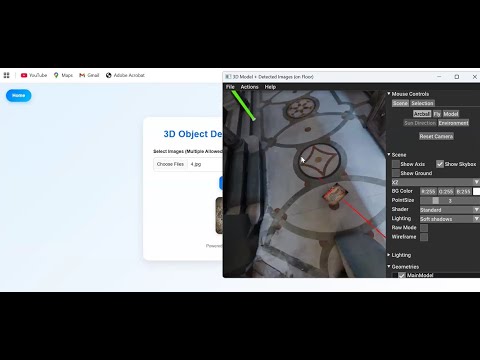
The rapid advancement in computer vision has significantly transformed the way visual information is interpreted, analyzed, and utilized in real-time applications. Among various deep learning-based object detection models, YOLOv5 stands out due to its optimized architecture, high-speed inference capability, and adaptability to custom datasets. This project focuses on designing and implementing a comprehensive, interactive object detection and visualization system that integrates a custom-trained YOLOv5 model with an advanced 3D rendering environment using Open3D. The primary objective of the system is to allow users to upload multiple images through a Flask-based web interface and automatically analyze them for object detection. Each uploaded image is processed by the YOLOv5 model, which identifies relevant objects based on the dataset used for training. The detection results are then converted into textured visual outputs, which are spatially projected around a central 3D anatomical model for enhanced interpretability.
A significant innovation in this work is the integration of 2D detection results into a 3D interactive space. Unlike traditional systems that simply display bounding boxes on flat images, this system places each processed image on individual 3D planes arranged in a circular pattern around a GLB-based 3D model. This method allows end-users, researchers, and analysts to explore object detection results from multiple viewpoints in an immersive spatial environment. Open3D’s rendering and visualization engine enables dynamic rotation, zooming, panning, and real-time manipulation of both the 3D model and the detection planes. The project also incorporates a full user management system with registration, login, and session control, enabling secure and personalized usage of the application.
Introduction
Forensic investigation has evolved significantly with the rapid advancement of artificial intelligence, computer vision, and three-dimensional visualization technologies. Traditional forensic examination largely depended on manual observation, photographic evidence, and expert interpretation, which were often time-consuming, prone to human error, and limited by the quality and angle of captured images. In modern digital forensics, there is a growing need for automated tools capable of analyzing multiple images, detecting evidence with high accuracy, and presenting the results in an interpretable, immersive manner. This need has motivated the development of intelligent systems that not only detect forensic objects but also contextualize them in a spatial environment that assists investigators in reconstructing real-world crime scenes. The integration of deep learning–based object detection with advanced 3D visualization opens new possibilities for forensic interpretation, offering richer insights compared to conventional 2D analysis.
In recent years, YOLOv5 has emerged as one of the most powerful and efficient models for real-time object detection. Its ability to perform fast inference, handle diverse datasets, and accurately detect objects in challenging environments makes it highly suitable for forensic applications where clarity, precision, and reliability are essential. Forensic images often contain complex scenes with multiple objects, varying lighting conditions, and non-ideal angles. YOLOv5’s optimized architecture enables the system to detect relevant forensic evidence even under such constraints. In this project, a custom-trained YOLOv5 model is used to detect important objects from multiple uploaded images. These objects can include forensic markers, tools, biological traces, weapons, footwear patterns, or any evidence related to a crime scene, depending on the dataset used for training. By using annotated forensic datasets, the model learns to identify evidence consistently, reducing the dependency on manual detection and increasing the overall efficiency of forensic workflows.
However, detecting evidence in 2D images alone is not always sufficient for complete forensic interpretation. Investigators often require a deeper understanding of the spatial relationships between objects at a crime scene—how far apart they were placed, their angles, their positions relative to structural elements, and how they might interact within a three-dimensional context. This necessity brings forward the importance of 3D visualization in forensic science. While traditional methods rely on static 2D photographs or schematic diagrams, a 3D visualization system provides a dynamic and interactive representation, enabling investigators to examine the evidence from any viewpoint. Open3D, a powerful open-source 3D rendering library, provides the computational foundation for creating such interactive environments. Its ability to load, manipulate, and visualize complex 3D models makes it ideal for reconstructing scenes or visualizing detected objects in a detailed spatial environment.
This project combines these two powerful technologies—YOLOv5-based forensic detection and Open3D-based 3D visualization—into a unified forensic analysis system deployed through a Flask web application. The system begins by allowing users to upload multiple images captured at a forensic site. These images are analyzed by the YOLOv5 model, which detects evidence and produces image outputs containing bounding boxes and confidence scores. Instead of presenting these outputs as simple 2D images, the project enhances the analytical process by converting each detection result into a 3D textured plane. These planes are then arranged in a circular spatial layout around a central 3D GLB model, which can represent the crime scene structure, forensic mannequin, room environment, or any model relevant to the investigation. This circular positioning allows multiple detection results to be viewed simultaneously from a unified spatial perspective, giving investigators an organized, immersive overview of all detected evidence.
The integration of YOLOv5 and Open3D creates an experience that goes beyond standard forensic software. Investigators can rotate, zoom, and manipulate the 3D space to observe how detected evidence relates to the central model and to each other. This spatial arrangement can help in understanding the sequence of events, evidence distribution patterns, proximity of objects, and possible interactions. For example, if the system is used in a forensic laboratory to analyze images of weapons, bloodstains, or fingerprints, the 3D visualization allows examiners to compare different detection outputs without losing context. This is particularly helpful in complex cases involving multiple crime scene photographs taken from different angles or locations. The immersive environment assists forensic experts in correlating evidence more efficiently and in forming accurate interpretations.
The project also incorporates a secure user management system, ensuring that only authorized forensic analysts can upload images and access results. The Flask backend provides a seamless interface for managing user sessions, handling image uploads, processing detections, and launching the 3D visualization environment. The combination of web-based functionality with local 3D rendering offers a convenient yet powerful forensic analysis workflow. Users can interact with the system through a simple browser interface, while the heavy computational tasks such as running YOLOv5 inference and loading the 3D model are handled internally. This structure ensures usability even for professionals with limited technical expertise, making the system accessible and practical in real forensic environments.
Objectives
1. To develop an AI-driven forensic object detection system using a custom-trained YOLOv5 model that can accurately identify crime-related evidence from multiple images.
2. To reduce manual workload and minimize human error in forensic image analysis through automated, consistent, and unbiased object detection.
3. To process multiple crime scene images in a single workflow and generate detection outputs efficiently for large-scale forensic investigations.
4. To transform 2D detection outputs into 3D textured surfaces that enhance the visual interpretation of forensic evidence.
5. To integrate Open3D for creating an immersive 3D visualization environment that arranges detection images in a circular spatial layout around a GLB crime scene model.
Block Diagram