Autonomous driving technology is transforming the way intelligent transportation systems understand and respond to road environments. Self-driving vehicles need to process visual information from cameras and identify important objects and regions, such as roads, lanes, vehicles, pedestrians, traffic signs, and obstacles. Accurate scene understanding helps autonomous systems interpret their surroundings and make informed driving decisions.
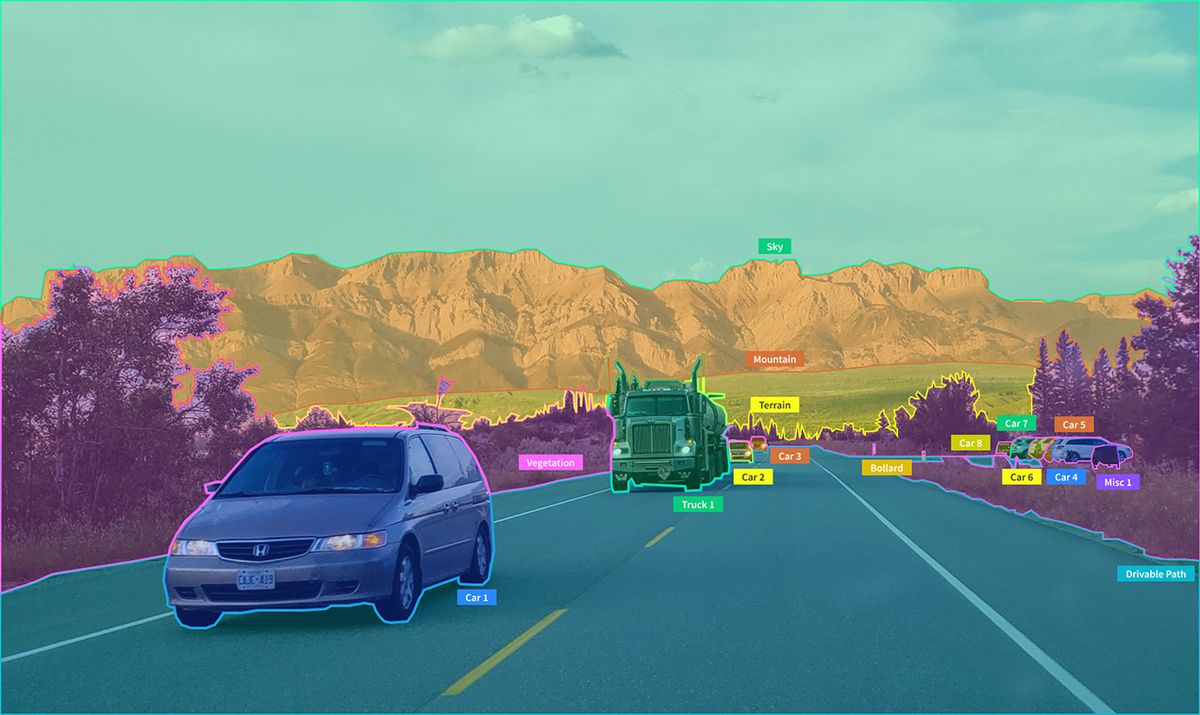
The Road Semantic Segmentation in Autonomous Cars Using Layer-Wise Training project explores a deep learning approach for classifying individual pixels in road-scene images. Unlike basic object detection, which identifies objects using bounding boxes, semantic segmentation assigns a class label to each pixel. This produces a detailed understanding of the road environment.
The project uses layer-wise training to develop a semantic segmentation model. This approach provides an opportunity to study deep neural network training, feature extraction, image processing, and computer vision techniques used in autonomous driving research.
Key Features & Benefits
Project Overview and Working Principle
The proposed system takes road-scene images or video frames as input and processes them using a deep learning segmentation model. During preprocessing, images are resized, normalized, and prepared for model training. Corresponding pixel-level annotation masks provide the expected classes for supervised learning.
A convolutional neural network or encoder-decoder architecture extracts visual features from the input image. The segmentation network then generates a pixel-level prediction map in which different colours represent classes such as road, sidewalk, vehicle, pedestrian, building, vegetation, and sky.
Layer-wise training can be implemented by training selected network layers or groups of layers in stages. For example, an initial stage can train the segmentation head while keeping a pretrained feature extractor frozen. Later stages can gradually unfreeze selected layers and fine-tune the complete model using a suitable learning rate.
The final output is a segmented road-scene image that can be compared with its ground-truth mask to evaluate model performance.
Implementation Guide
Technologies and Algorithms Used
Python is the primary programming language for developing the image processing and deep learning workflow.
Key technologies include:
Python: Main programming language for model development.
TensorFlow or PyTorch: Deep learning frameworks for building and training segmentation models.
OpenCV: Image loading, resizing, preprocessing, and visualisation.
NumPy: Numerical operations and image array processing.
Matplotlib: Displaying input images, predicted masks, and training graphs.
Scikit-learn: Supporting evaluation and data preparation tasks.
Google Colab: Optional cloud environment for GPU-based model training.
Possible model architectures include U-Net, SegNet, DeepLabV3+, and Fully Convolutional Networks (FCN). Suitable road-scene datasets include Cityscapes and BDD100K, subject to their licence and usage conditions.
Performance can be measured using mean Intersection over Union (mIoU), pixel accuracy, class-wise precision, recall, and inference time.
Technical Specifications
Features and Applications
The project can include the following important features:
Road Image Processing: Loads and prepares road-scene images for segmentation.
Pixel-Level Classification: Assigns semantic labels to individual image pixels.
Layer-Wise Training: Trains selected model layers in stages for controlled fine-tuning.
Road Region Identification: Separates road surfaces from surrounding scene elements.
Vehicle and Pedestrian Segmentation: Identifies important road users when supported by the selected dataset classes.
Segmentation Visualisation: Displays colour-coded output masks over input images.
Model Evaluation: Measures performance using mIoU and other segmentation metrics.
Video Frame Processing: Demonstrates segmentation on consecutive road-scene frames.
Potential research applications include autonomous driving, intelligent transportation systems, driver assistance research, road scene analysis, and computer vision-based traffic monitoring.
Conclusion & Next Steps
Advantages, Future Scope, and Conclusion
Semantic segmentation provides detailed information about road environments by classifying every pixel instead of simply locating objects. Layer-wise training offers a structured way to fine-tune deep learning networks and experiment with pretrained feature extractors. Together, these techniques create a useful academic project for understanding modern computer vision systems.
Future improvements can include real-time inference optimisation, lightweight segmentation architectures, edge-device deployment, improved performance in poor lighting and adverse weather, and testing on larger road-scene datasets. The model can also be extended to support additional classes and temporal information from video sequences.
Important note: This project is an educational and research prototype. Its segmentation results should not be used as the sole basis for real-world vehicle control or safety-critical autonomous driving. Such systems require extensive testing, validation, redundancy, and compliance with applicable automotive safety standards.
In conclusion, the Road Semantic Segmentation in Autonomous Cars Using Layer-Wise Training project demonstrates how Python, deep learning, and computer vision can be combined to understand road environments. It is a practical final-year project for exploring image segmentation, neural network fine-tuning, and autonomous driving research.






















.jpeg)


