Introduction to Human Following Robot Using Arduino
Robotics and embedded automation are transforming the way machines interact with humans and their surrounding environments. Human-following robots are an interesting application of mobile robotics in which a robot detects a nearby person and automatically adjusts its movement to follow them.
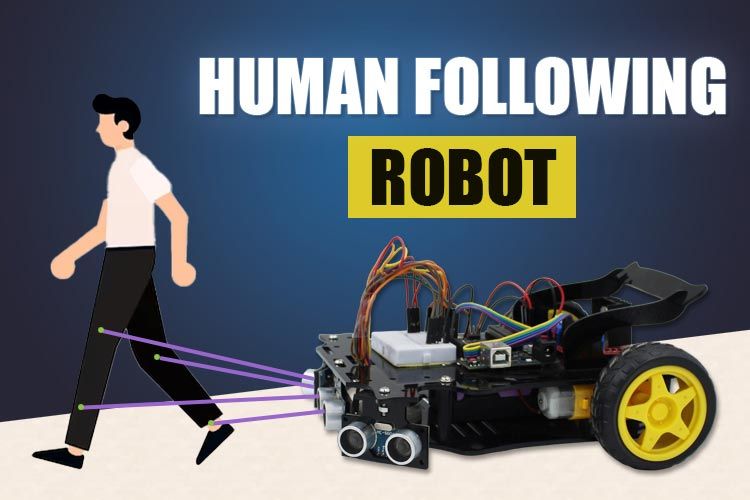
The Human Following Robot Using Arduino and Ultrasonic Sensors is an embedded systems project designed to demonstrate automatic human-following behavior using distance measurement and motor control. The system uses ultrasonic sensors to measure the distance between the robot and nearby objects. Based on the detected distance, an Arduino microcontroller controls the movement of the robot through a motor driver circuit.
When a person moves within the configured detection range, the robot can move forward while maintaining a suitable distance. If the person moves closer or farther away, the controller adjusts the motor operation according to the programmed conditions. The robot can also stop or change direction when an obstacle or movement condition is detected.
This project provides practical knowledge of Arduino programming, ultrasonic distance measurement, motor driver interfacing, embedded control systems, and mobile robotics. It is suitable for students interested in developing low-cost autonomous robotic applications.
Key Features & Benefits
Project Concept and Working Methodology
The primary objective of this project is to design a mobile robot that can detect and follow a nearby person using ultrasonic sensors and Arduino-based motor control.
The system consists of an Arduino board, ultrasonic sensors, a motor driver, DC motors, and a robot chassis.
1. Ultrasonic Sensor Initialization: Ultrasonic sensors are connected to the Arduino to measure the distance between the robot and nearby objects.
2. Distance Measurement: The sensors transmit ultrasonic pulses and calculate the distance using the time taken for the reflected signals to return.
3. Arduino Processing: The Arduino receives distance measurements and compares them with predefined distance thresholds.
4. Human Following Detection: When an object is detected within the configured following range, the controller identifies the movement condition based on the sensor readings.
5. Motor Driver Control: The Arduino sends control signals to the motor driver, which operates the connected DC motors.
6. Forward Movement: When the detected distance is greater than the minimum following distance and within the configured detection range, the robot moves forward.
7. Stop Operation: When the detected object comes too close, the robot stops to maintain a safe distance.
8. Direction Control: Additional ultrasonic sensors can be installed on the left and right sides to help the robot identify direction and adjust its movement.
9. Obstacle Detection: The system can monitor nearby obstacles and stop or change direction when an obstruction is detected.
10. Continuous Monitoring: The Arduino repeatedly reads sensor values and updates motor operations to maintain the programmed following behavior.
An important design consideration is that ultrasonic sensors detect nearby objects rather than identify humans. Therefore, the basic system follows a detected target based on distance measurements. More advanced human identification can be introduced using cameras or other sensing technologies.
Implementation Guide
Key Features and Real-World Applications
The Arduino-based human following robot demonstrates several important features of embedded robotics and automated movement control.
Key Features:
Arduino-based robotic control.
Ultrasonic distance measurement.
Automatic forward movement.
Distance-based motor control.
Adjustable following distance.
Automatic stopping functionality.
Obstacle detection support.
Left and right direction control using multiple sensors.
DC motor interfacing.
Motor driver integration.
Real-time sensor monitoring.
Low-cost robotic implementation.
Expandable embedded system architecture.
Real-World Applications:
Smart Shopping Assistance: Human-following robot concepts can be developed for carrying shopping bags and supporting customers in retail environments.
Healthcare Assistance: Mobile robotic platforms can be explored for transporting lightweight supplies in hospitals and healthcare facilities.
Industrial Material Handling: Autonomous following robots can assist in transporting tools and materials within controlled industrial environments.
Personal Assistance Robots: Human-following technology can be integrated into robotic platforms designed to carry personal belongings.
Educational Robotics: The project provides an effective demonstration of sensor integration, motor control, and autonomous robotic movement.
Warehouse Automation: More advanced versions can be developed for assisting workers with material transportation and indoor navigation.
These applications demonstrate how distance sensing and embedded control can support the development of intelligent mobile robotic systems.
Technical Specifications
Technologies and Hardware Requirements
The project can be implemented using Arduino programming and commonly available electronic components.
Hardware Requirements:
Arduino Uno or Arduino Nano.
Ultrasonic Sensors (HC-SR04).
L298N Motor Driver Module.
DC Geared Motors.
Robot Chassis.
Robot Wheels.
Caster Wheel.
Battery Pack.
Jumper Wires.
Breadboard or PCB.
Power Supply Circuit.
Power Switch.
Software Requirements:
Operating System: Windows 10/11 or Linux.
Programming Language: Embedded C/C++.
Microcontroller Platform: Arduino.
Development Environment: Arduino IDE.
Circuit Simulation: Proteus Design Suite.
Circuit Design: Fritzing.
Serial Monitoring: Arduino Serial Monitor.
Circuit Documentation: Arduino Libraries and Datasheets.
Working Principle of Ultrasonic Sensors:
The HC-SR04 ultrasonic sensor calculates distance by transmitting an ultrasonic pulse and measuring the time required for its echo to return.
The distance is calculated using:
Distance = (Time × Speed of Sound) / 2
The division by two accounts for the outgoing and returning journey of the sound wave.
The Arduino uses these measurements to determine the movement conditions and send appropriate signals to the motor driver.
Motor Control:
The L298N motor driver acts as an interface between the Arduino and DC motors. It allows the controller to manage motor direction and movement.
Depending on the sensor readings, the Arduino can control the robot through different operating conditions:
Forward: Move toward the detected target.
Stop: Maintain the minimum following distance.
Left: Adjust direction when the target is detected toward the left.
Right: Adjust direction when the target is detected toward the right.
Reverse: Move backward when required by the programmed control logic.
The system can be improved by using multiple sensors, filtering unstable distance readings, and introducing suitable motor speed control.
Conclusion & Next Steps
Advantages, Future Scope, and Conclusion
Advantages of the Project
The Arduino human-following robot offers several advantages for learning and developing embedded robotic systems.
Low-cost robotic implementation.
Simple Arduino-based programming.
Automatic movement based on distance measurements.
Contactless object detection.
Adjustable following distance.
Easy integration with DC motors.
Supports obstacle detection.
Expandable sensor configuration.
Useful for practical robotics education.
Provides hands-on embedded systems experience.
Future Enhancements
The project can be upgraded with modern robotics and Artificial Intelligence technologies.
Integration of camera-based human detection using YOLO.
Person identification using computer vision.
Bluetooth or Wi-Fi-based robot monitoring.
ESP32 integration for wireless communication.
GPS integration for outdoor robotic applications.
LiDAR-based distance measurement.
Integration of AI-based human tracking.
Automatic speed adjustment based on target distance.
Rechargeable battery monitoring.
ROS integration for advanced robotic navigation.
An advanced version can combine ultrasonic sensors with camera-based human detection to distinguish people from other nearby objects and improve target-following reliability.
Conclusion
Human Following Robot Using Arduino and Ultrasonic Sensors is a practical Embedded Systems and Robotics project that demonstrates automatic movement using distance measurement and microcontroller-based motor control.
By combining Arduino, ultrasonic sensors, motor drivers, and DC motors, the system provides a simple approach to developing a mobile robot that follows a detected nearby target. The project helps students understand sensor interfacing, embedded programming, motor control, obstacle detection, and autonomous robotic movement.
It also provides a foundation for exploring advanced robotics technologies such as AI-based human detection, wireless monitoring, intelligent navigation, and autonomous assistance systems.
Contact Aislyn Technologies – Bangalore
Aislyn Technologies
📞 Phone: +91 97395 94609
📧 Email: info@aislyntech.com
🌐 Website: https://aislyn.in
Looking to develop an Arduino, Embedded Systems, Robotics, IoT, or Automation project? Contact Aislyn Technologies for expert project development guidance, circuit design, hardware integration, source code assistance, and customized final-year project solutions in Bangalore.