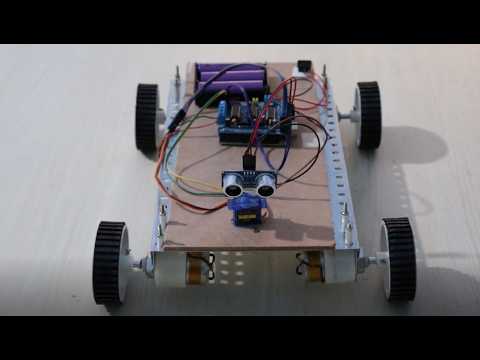
Abstract: The rapid advancement in robotics has led to the development of intelligent systems capable of autonomous navigation. This project presents the design and implementation of an Obstacle Avoiding Robot Car, utilizing an Arduino microcontroller, an ultrasonic sensor, and a servo motor for real-time obstacle detection and avoidance. The robot autonomously navigates its environment by detecting obstacles in its path and making decisions on the optimal route to avoid collisions. This project is a step towards developing more complex autonomous systems that can operate in dynamic environments with minimal human intervention.
Introduction:
The development of autonomous robotic systems has gained significant attention in recent years due to their potential applications in various fields, including industrial automation, exploration, and personal assistance. An Obstacle Avoiding Robot is a fundamental example of such a system, where the robot is designed to navigate an environment without human guidance, avoiding any obstacles in its path.
The importance of obstacle avoidance in robotics cannot be overstated, as it ensures the robot's ability to operate in unpredictable environments. This project utilizes an Arduino microcontroller, which is known for its ease of use and flexibility, making it an ideal choice for prototyping robotic systems. The integration of an ultrasonic sensor allows the robot to detect obstacles by measuring the distance to objects, while a servo motor enables the sensor to scan the surrounding area.
This project builds upon basic robotics principles, combining them with modern microcontroller technology to create a simple yet effective autonomous system. The use of a motor driver shield further enhances the robot's capabilities by providing precise control over the movement of the DC motors, allowing for smooth and responsive navigation.
The Obstacle Avoiding Robot Car project is not only an educational tool but also a foundation for more advanced robotic systems that could be used in various applications. This project aims to demonstrate the feasibility of creating an autonomous navigation system that is both cost-effective and efficient, contributing to the ongoing development of intelligent robotic systems.
Objectives:
• Design and Develop an Obstacle Avoiding System: Create a robotic car capable of autonomously navigating by avoiding obstacles.
• Implement Real-Time Obstacle Detection: Develop a system using an ultrasonic sensor for accurate obstacle detection.
• Enable Environmental Scanning: Integrate a servo motor to rotate the ultrasonic sensor for wider area scanning.
• Develop an Efficient Navigation Algorithm: Create an algorithm for the Arduino to process sensor data and make navigation decisions.
• Test and Optimize Performance: Evaluate and refine the robot’s performance in various environments to ensure effective navigation.
• Demonstrate Practical Application: Showcase the robot’s ability to operate autonomously in real-world scenarios.
• Demo Video
• Complete project
• Full project report
• Source code
• Complete project support by online
• Life time access
• Execution Guidelines
• Immediate (Download)
Software Details
1. Arduino IDE
Used for writing, compiling, and uploading code to the Arduino board
Supports C/C++ based Arduino programming
Provides Serial Monitor for debugging
2. Embedded C / Arduino Programming Language
Used to develop the obstacle detection and navigation algorithm
Controls sensor readings, servo movement, and motor driver logic
3. Arduino Libraries Used
• Servo Library
Controls the SG90 servo motor rotation
• NewPing Library (Optional)
Used for efficient ultrasonic sensor distance measurement
4. Operating Platform
Windows / Linux / macOS (for running Arduino IDE)
5. Serial Communication
Used for debugging and monitoring sensor readings
Baud rate typically set to 9600 bps
6. Algorithm Used
Distance-based Obstacle Detection Algorithm
Conditional Decision-Making Logic (If–Else statements)
Basic Autonomous Navigation Logic
Immediate Download:
1. Synopsis
2. Rough Report
3. Software code
4. Technical support
Hardware Kit Delivery:
1. Hardware kit will deliver 4-10 working days (based on state and city)
2. Packing and shipping changes applicable (based on kit size, state ,city)
Only logged-in users can leave a review.
No reviews yet. Be the first to review this product!