Abstract
The Smart Drought Detection System using Satellite Data and Real-Time AI Weather Analysis integrates IoT hardware with intelligent data processing and machine learning models to provide early drought prediction and continuous monitoring. The hardware unit is built around an ESP8266 microcontroller, which collects real-time environmental data from sensors such as the DHT11 temperature and humidity sensor, soil moisture sensor, and rain sensor. The system also includes an LCD display to show local real-time readings of temperature, humidity, soil moisture, and rainfall status for immediate field-level monitoring. The collected sensor data is transmitted to the ThingSpeak cloud platform for storage, visualization, and analysis. In regions with limited internet connectivity, a GSM module ensures timely drought alerts are delivered to users via SMS.
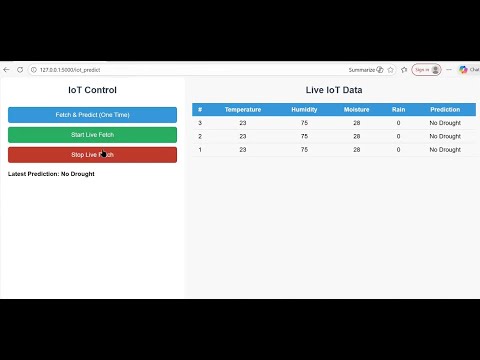
By combining ground sensor data with satellite-based weather indicators and processing it through machine learning algorithms such as XGBoost and Random Forest, the system can accurately detect and predict drought conditions and their severity. Feature scaling techniques such as MinMaxScaler are applied to improve model performance, while trained models are deployed for real-time and future drought prediction. This hardware-driven IoT solution, integrated with AI-based predictive models and supported by a local LCD display, provides a cost-effective, scalable, and efficient system for proactive water resource management and sustainable agricultural planning.
Introduction
Drought is a severe environmental challenge that significantly affects agriculture, water resources, and the livelihoods of millions of people worldwide. Early detection and continuous monitoring are essential to minimize its adverse impacts on crops, livestock, and rural communities. Conventional drought assessment methods primarily depend on manual field observation and historical weather records, which are often time-consuming, less accurate, and incapable of providing real-time insights or future predictions.
The Smart Drought Detection System using Satellite Data and Real-Time AI Weather Analysis addresses these limitations by integrating IoT hardware, cloud computing, and advanced machine learning models for accurate and timely drought monitoring. The system utilizes an ESP8266 microcontroller to collect real-time environmental data from sensors such as the DHT11 temperature and humidity sensor, soil moisture sensor, and rain sensor. An LCD display provides immediate on-site visualization of sensor readings, enabling farmers to monitor field conditions without relying solely on cloud access. The collected data is transmitted to the ThingSpeak cloud platform for secure storage, real-time visualization, and historical analysis. In regions with limited internet connectivity, a GSM module ensures reliable drought alerts are delivered via SMS.
By combining ground-based sensor data with satellite-derived weather indicators and processing them using machine learning algorithms such as XGBoost and Random Forest, the system can effectively detect, classify, and predict drought conditions and their severity. Data preprocessing techniques, including feature engineering and scaling, enhance model accuracy and reliability. The integration of IoT sensing, LCD visualization, cloud analytics, GSM communication, and AI-driven prediction provides a cost-effective, real-time, and scalable solution for proactive agricultural management and sustainable water resource planning.
Objectives
The main objective of the Smart Drought Detection System using Satellite Data and Real-Time AI Weather Analysis is to develop a real-time, automated, and intelligent system for early drought detection. The specific objectives are:
1. To monitor environmental parameters such as temperature, humidity, soil moisture, and rainfall using IoT sensors (DHT11, soil moisture sensor, and rain sensor).
2. To display real-time sensor readings locally on an LCD display for immediate monitoring.
3. To transmit real-time data to a cloud platform (ThingSpeak) via ESP8266.
4. To send alerts via GSM module in areas with limited internet connectivity.
5. To integrate satellite weather data with ground sensor data for comprehensive drought analysis.
6. To analyze collected data using machine learning algorithms for accurate prediction of drought severity and trends.
7. To provide timely alerts and notifications to farmers and authorities for proactive water resource management and crop protection.
8. To develop a cost-effective and scalable system that can be implemented in agricultural regions to reduce the impact of drought.
Block Diagram