Introduction: Early Diagnosis of Cognitive Decline via Deep Learning
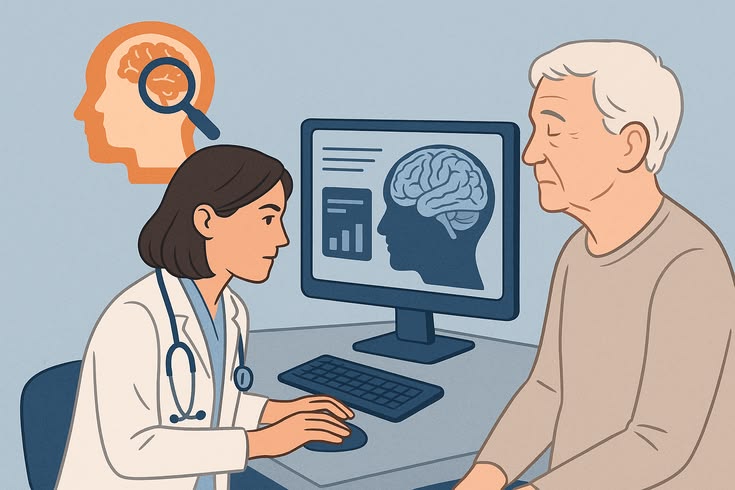
Dementia, including Alzheimer’s disease, affects tens of millions of people worldwide. It is characterized by the progressive deterioration of memory, executive function, and cognitive skills. Early and accurate detection of dementia is critical—it allows healthcare providers to implement therapeutic interventions that slow disease progression and improve quality of life.
Traditionally, dementia diagnosis relies on manual clinical evaluations, neuropsychological tests (such as MMSE and MoCA scores), and manual examination of neuroimaging scans like Structural MRI or PET scans. These methods can be time-consuming, subjective, and dependent on expert radiological availability.
The Deep Learning-Based Dementia Detection System Using Medical Data project leverages modern artificial intelligence to automate cognitive assessment and neuroimage analysis. By processing multimodal medical inputs—including structural Brain MRI scans, tabular clinical parameters, and cognitive testing metrics—the system accurately classifies health states into categories such as Cognitively Normal (CN), Early Mild Cognitive Impairment (EMCI), Late Mild Cognitive Impairment (LMCI), and Alzheimer's Disease (AD).
For final-year engineering students, this medical AI project bridges deep neural network design, medical imaging pipelines, and web applications into an impactful healthcare deliverable.
Key Features & Benefits
System Pipeline & Operational Workflow
The system processes multimodal patient data through a structured machine learning and computer vision pipeline:
Stage 1: Multi-Modal Data Input — The system receives patient MRI scans (DICOM/NIfTI format or 2D image slices) alongside clinical metadata (age, gender, MMSE score, APOE4 gene presence).
Stage 2: Image & Data Preprocessing — MRI scans undergo skull stripping, intensity normalization, slice extraction, and spatial alignment. Tabular clinical data is cleaned, imputed, and scaled.
Stage 3: Feature Extraction Network — Convolutional Neural Networks (CNNs) extract structural spatial patterns (such as hippocampal atrophy or ventricular enlargement), while dense neural layers encode tabular clinical parameters.
Stage 4: Feature Fusion Layer — Deep image feature representations are merged with clinical vector embeddings to create a comprehensive patient health profile.
Stage 5: Deep Learning Classification Engine — Combined feature vectors are evaluated using models like ResNet, DenseNet, or Multi-Layer Perceptrons (MLP) with softmax activation.
Stage 6: Output & Diagnostic Dashboard — The system presents multi-class classification probabilities, risk levels, and visual saliency maps (Grad-CAM) through an interactive web UI for clinicians and researchers.
Implementation Guide
Key Features & Essential Technologies
Combining deep learning backends with user-friendly web interfaces creates a robust, end-to-end diagnostic support tool.
Multimodal Data Analysis: Combines 2D/3D neuroimaging features with clinical patient history for high-accuracy predictions.
Grad-CAM Explainability: Generates visual heatmaps on MRI scans to show exact brain regions influencing the model's decision.
Multi-Class Disease Staging: Categorizes cognitive health across distinct progressive stages (Normal, MCI, Dementia).
Secure Web Dashboard: Provides an intuitive interface for doctors and radiographers to upload scans, view prediction summaries, and export diagnostic reports.
Recommended Technology Stack:
Frontend: HTML5, CSS3, JavaScript, React.js or Bootstrap
Backend Framework: Python 3.x, Flask, FastAPI, or Django
Deep Learning Frameworks: PyTorch, TensorFlow, Keras, Scikit-Learn
Medical Image Processing: OpenCV, NiBabel, SimpleITK, MONAI, NumPy
Datasets: ADNI (Alzheimer's Disease Neuroimaging Initiative), OASIS (Open Access Series of Imaging Studies)
Database: MySQL, PostgreSQL, or MongoDB
Technical Specifications
Step-by-Step Implementation Guide for Students
Follow this structured technical roadmap to implement this project effectively:
Dataset Acquisition & Preprocessing:
Acquire approved medical image datasets such as OASIS or ADNI. Extract key 2D axial slice views from 3D NIfTI volumes, crop images to the brain region, and normalize voxel intensities ($0 - 1$).
Deep Learning Model Architecture:
Select a proven architecture like ResNet-50 or DenseNet-121. Fine-tune pre-trained weights (Transfer Learning) on brain MRI slices to classify dementia severity stages.
Model Explainability & Fusion:
Implement Grad-CAM (Gradient-weighted Class Activation Mapping) to highlight structural atrophy regions. Combine image outputs with clinical tabular metadata using a dual-branch neural network.
Web Application Integration:
Build a web interface using Flask or FastAPI. Create endpoints for drag-and-drop MRI upload, automated image preprocessing, model inferencing, and dynamic report generation.
Conclusion & Next Steps
Future Scope & Industry Applications
Artificial Intelligence in neuroimaging and clinical analytics offers immense growth across modern medical sectors:
Clinical Decision Support Systems (CDSS): Assisting radiologists and neurologists with rapid, objective second opinions during routine brain scans.
Remote Healthcare & Telemedicine: Enabling rural clinics to screen early cognitive impairment scans prior to specialist referrals.
Pharmaceutical & Clinical Trials: Accelerating patient selection and monitoring disease progression during clinical drug trials.
Building a Deep Learning-Based Dementia Detection System Using Medical Data provides engineering students with critical skills in biomedical image analysis, neural network optimization, explainable AI (XAI), and full-stack web application development.
Contact Details
Aislyn Technologies, Bangalore
📞 Phone: +91 97395 94609
📧 Email: info@aislyntech.com
🌐 Website: https://aislyn.in
Contact us today to start building your Embedded project in Bangalore with our expert support!