Introduction to COVID-19 Detection Using Transfer Learning
Artificial Intelligence and Deep Learning have become important technologies in medical image analysis and healthcare research. One interesting application is the classification of chest medical images to investigate patterns associated with respiratory diseases. COVID-19 Detection Using Transfer Learning is an academic project that explores how pretrained deep learning models can be adapted for medical image classification tasks.
Transfer learning is a machine learning approach in which a model trained on a large dataset is reused as the starting point for a different but related task. Instead of training a deep neural network entirely from scratch, developers can use pretrained architectures and fine-tune selected layers using a domain-specific dataset.
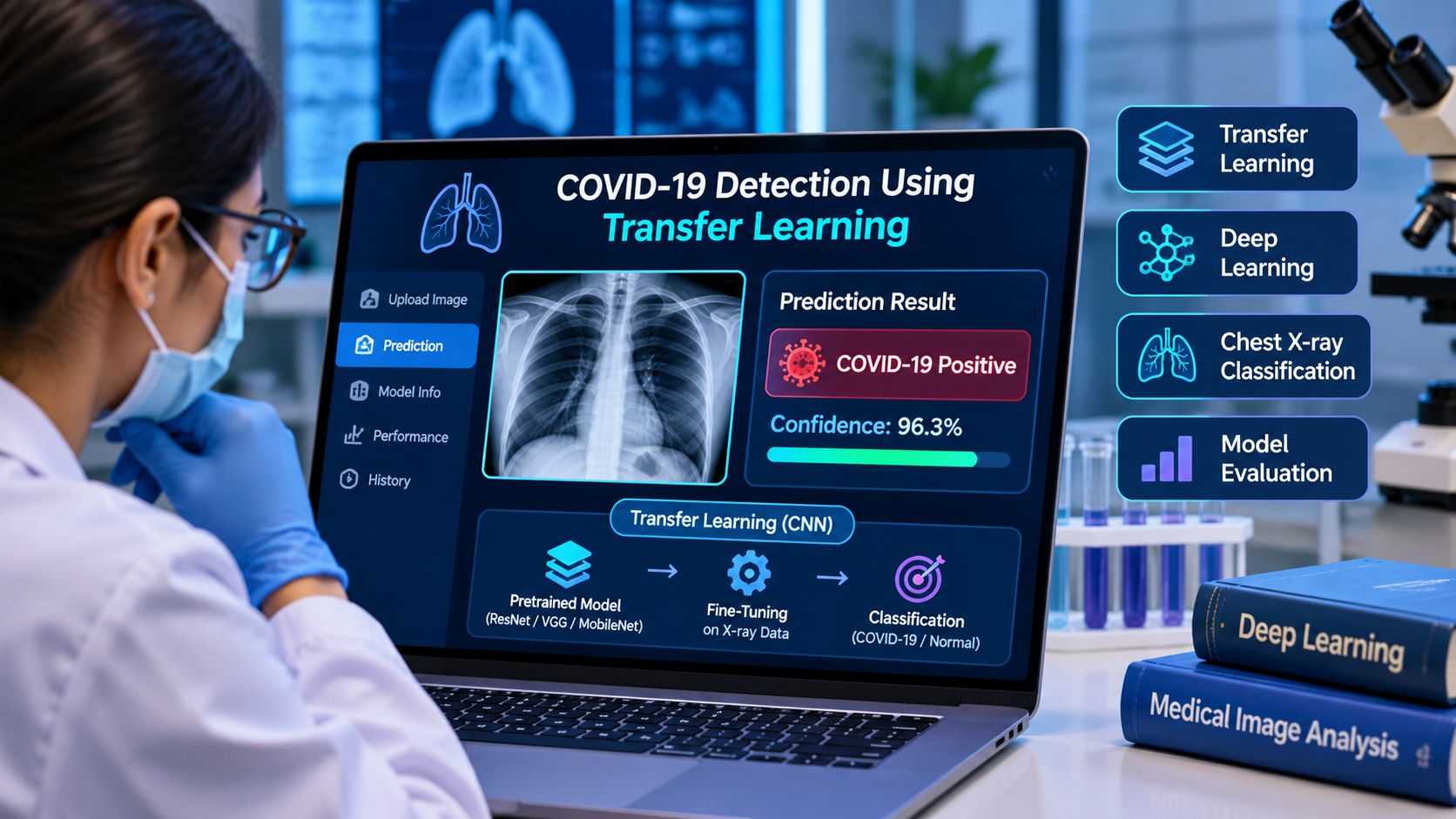
In this project, chest X-ray images can be used as input to a trained image classification model. The model learns visual features and attempts to classify images into predefined categories, such as COVID-19 positive and non-COVID-19 samples, depending on the dataset and experimental design.
This project is suitable for MCA and computer science students interested in Artificial Intelligence, Machine Learning, Deep Learning, Computer Vision, and healthcare technology research.
Key Features & Benefits
Working Principle of the Transfer Learning Model
The proposed system follows an image preprocessing and deep learning classification workflow. A medical image is uploaded through the application interface and processed before being passed to the trained transfer learning model.
The major implementation stages include:
1. Dataset Collection: Collect appropriately labelled chest X-ray images from publicly available research datasets with documented usage permissions.
2. Image Preprocessing: Resize images to the input dimensions required by the selected neural network. Apply normalization and suitable preprocessing operations.
3. Transfer Learning Architecture: Select a pretrained architecture such as MobileNetV2, ResNet50, VGG16, or EfficientNet as the feature extraction model.
4. Model Fine-Tuning: Replace or customize the classification layer and train the model using the selected medical image dataset.
5. Image Classification: Pass an unseen image through the trained network to obtain predicted class probabilities.
6. Result Visualization: Display the predicted category and model confidence information through a web-based interface.
7. Model Evaluation: Evaluate performance using appropriate metrics such as accuracy, precision, recall, F1-score, sensitivity, specificity, and a confusion matrix.
The dataset should be divided carefully into training, validation, and testing sets. Images from the same patient should not be distributed across different sets, as this can produce misleading evaluation results.
Implementation Guide
Technologies and Tools Used
The project combines Python programming, medical image processing, and transfer learning techniques.
Programming Language: Python is used for dataset preparation, model development, training, and prediction.
Deep Learning Frameworks: TensorFlow, Keras, or PyTorch can be used to implement transfer learning architectures.
Pretrained Models:
MobileNetV2 for lightweight image classification.
ResNet50 for deeper feature extraction.
VGG16 for CNN-based image classification.
EfficientNet for efficient model scaling and feature learning.
Image Processing: OpenCV, Pillow, and NumPy can be used for image loading, resizing, and preprocessing.
Data Analysis: Pandas, Matplotlib, and Scikit-learn help with dataset analysis, performance evaluation, and visualization.
Backend Development: Flask or FastAPI can provide APIs for image uploads and model predictions.
Frontend Development: HTML, CSS, JavaScript, React.js, or Streamlit can be used to create the application interface.
Database: MySQL or MongoDB can optionally store user information and prediction records.
Students can select an architecture based on dataset size, hardware availability, training time, and model performance.
Technical Specifications
Key Features and Applications
A transfer learning-based COVID-19 image classification project can demonstrate several important AI capabilities.
Medical Image Upload: Allow users to upload supported chest X-ray images through an application interface.
Automated Image Classification: Process uploaded images using a trained deep learning model.
Pretrained Model Integration: Reuse established CNN architectures to reduce the need for training a complete network from scratch.
Prediction Confidence: Display the model's class probabilities to communicate its prediction output.
Prediction History: Optionally maintain previous image classification results in a database.
Interactive Dashboard: Provide a simple interface for uploading images and viewing model outputs.
Possible Research Applications
Medical image classification research.
Transfer learning experiments.
Deep learning model comparison.
Healthcare AI education.
Computer vision research.
Medical dataset analysis.
An important limitation is that a model trained on chest X-ray images cannot independently confirm whether a patient has COVID-19. Its output is an experimental classification result, not a clinical diagnosis. Clinical decisions require qualified medical professionals and validated diagnostic procedures.
Conclusion & Next Steps
Advantages, Future Scope and Conclusion
COVID-19 Detection Using Transfer Learning provides MCA students with an opportunity to explore the practical implementation of pretrained deep learning models in medical image analysis.
One major advantage of transfer learning is that it allows developers to reuse features learned by existing neural networks. This can reduce training requirements compared with developing a large CNN entirely from scratch, although actual performance depends on dataset quality, model selection, and fine-tuning strategy.
The project can be extended with explainable AI techniques such as Grad-CAM to visualize image regions that influence a model's prediction. Other improvements may include comparing different pretrained architectures, developing a lightweight model for mobile deployment, and creating an interactive medical image analysis dashboard.
For reliable research, students should use well-documented datasets, avoid patient-level data leakage, evaluate models on independent test data, and report sensitivity and specificity alongside accuracy. Dataset bias and differences in image acquisition conditions should also be considered.
Conclusion
COVID-19 Detection Using Transfer Learning is an interesting MCA final-year project that combines artificial intelligence, deep learning, computer vision, and medical image analysis. By integrating pretrained CNN architectures with medical image datasets, students can develop an academic classification prototype and gain practical experience in modern AI development techniques.
Build Your MCA AI Project with Aislyn Technologies
Aislyn Technologies, Bangalore, provides project development guidance and technical support for MCA, computer science, Artificial Intelligence, Machine Learning, and Deep Learning final-year projects.
Contact Details
Aislyn Technologies, Bangalore
Phone: +91 97395 94609
Email: info@aislyntech.com
Website: https://aislyn.in
Contact us today to start building your MCA final-year project in Artificial Intelligence and Deep Learning with our expert support!

























.png)


