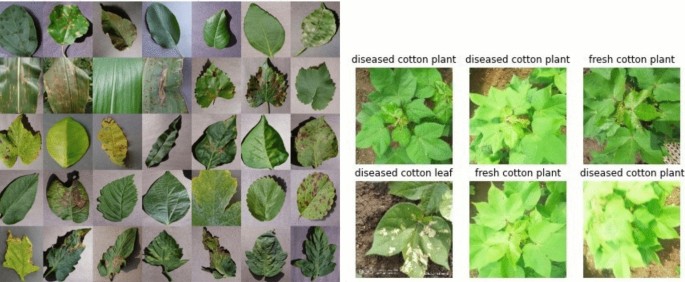
Agriculture plays a significant role in food production and economic development. However, plant diseases can affect crop quality, reduce agricultural productivity and create financial challenges for farmers. Identifying diseases at an early stage is important for selecting suitable management practices and reducing potential crop losses.
Traditional plant disease identification often depends on visual inspection by farmers or agricultural specialists. Although this approach is useful, identifying similar-looking diseases across different crops can be challenging. Manual examination may also become time-consuming when large numbers of plants need to be monitored.
Deep learning and computer vision provide new opportunities for automated plant disease identification. Convolutional Neural Networks (CNNs) can learn visual patterns from leaf images and classify them into predefined disease categories.
The Deep Learning-Based Plant Leaf Disease Detection and Management System is an intelligent agricultural application designed to analyze plant leaf images and identify possible disease categories. The system processes an uploaded or captured leaf image, applies preprocessing operations and uses a trained deep learning model to predict the corresponding class.
Depending on the dataset and model architecture, the application can identify healthy leaves and selected disease categories. The results can be presented through a user-friendly interface, along with relevant disease information and general management guidance.
The main objective is to develop an AI-assisted plant disease analysis system that supports precision agriculture through image classification, automated analysis and accessible digital information.
Key Features & Benefits
Existing System and Proposed System
Existing System
Traditional plant disease identification primarily depends on manual observation and expert knowledge. Farmers examine visible symptoms such as leaf spots, discoloration, yellowing and unusual patterns.
However, conventional approaches may involve several challenges:
Similar symptoms can occur across different plant diseases.
Early-stage symptoms may be difficult to recognize visually.
Manual examination can take considerable time.
Disease identification may depend on the availability of agricultural specialists.
Monitoring large farms manually can be difficult.
Environmental conditions can change the appearance of disease symptoms.
Proposed System
The proposed system uses deep learning and image processing to classify plant leaf images automatically.
A trained CNN model analyzes the visual characteristics of an input image and predicts the most likely class among the categories included in its training dataset.
The application can include an image upload interface, preprocessing module, trained model, prediction component and result dashboard. It can also provide general information about the predicted disease and possible management practices.
Main Objectives
Develop an automated plant leaf disease classification system.
Process leaf images using image preprocessing techniques.
Train a deep learning model using labelled plant image datasets.
Identify healthy and diseased leaf categories supported by the dataset.
Display prediction results through a user-friendly interface.
Provide general disease information and responsible management guidance.
Evaluate the model using suitable classification metrics.
Implementation Guide
Proposed Methodology and Working Process
The proposed system follows a deep learning pipeline that converts leaf images into disease classification results.
1. Dataset Collection
The first stage involves collecting labelled plant leaf images from suitable agricultural datasets or authorized image sources.
The dataset should contain healthy and diseased examples for the selected crop categories. Each image must have an appropriate class label.
Public datasets such as PlantVillage can be considered for academic model development. However, images collected under controlled conditions may not fully represent real agricultural environments.
2. Image Preprocessing
The collected images are prepared before training and prediction.
Preprocessing operations may include:
Image resizing to the model's required input dimensions.
Pixel normalization.
Noise reduction where necessary.
Colour-channel conversion when required by the model.
Image quality checks.
These operations help maintain consistent input during model training and inference.
3. Data Augmentation
Data augmentation can increase training-image diversity by applying transformations such as rotation, horizontal flipping, zooming, cropping and brightness adjustments.
Augmentation should be applied only to the training data. Validation and test images should remain separate to provide a reliable performance evaluation.
4. Deep Learning Model Development
A Convolutional Neural Network (CNN) can be developed to learn visual features from plant leaf images.
The network generally contains:
Convolutional layers for extracting image features.
Activation functions such as ReLU.
Pooling layers for reducing feature dimensions.
Fully connected layers for classification.
A Softmax output layer for multiclass prediction.
Transfer learning using architectures such as MobileNetV2, EfficientNet or ResNet can also be evaluated. These pretrained models can provide a useful starting point when the available dataset is limited.
5. Model Training
The training dataset is supplied to the CNN model, which learns patterns associated with the selected disease categories.
The model parameters are updated through backpropagation and an optimization algorithm such as Adam. Training performance can be monitored using loss and accuracy values.
6. Disease Classification
When a user uploads a leaf image, the application applies the same preprocessing operations used during model development.
The trained model analyzes the image and generates class probabilities. The class with the highest predicted probability can be displayed as the model's predicted category.
The application should also support an uncertain or out-of-scope result when confidence is insufficient or the image does not match supported classes.
7. Result Display and Management Guidance
The prediction is displayed through a web interface or dashboard. The result may include the uploaded image, predicted disease category, model confidence and general information about the condition.
Management guidance should be based on reliable agricultural references and should not recommend chemical treatments without crop-specific and locally appropriate verification.
System Workflow
Plant Leaf Image Collection → Image Preprocessing → Dataset Preparation → Data Augmentation → CNN Model Training → Model Evaluation → Image Upload → Disease Prediction → Result Display → General Management Guidance
Technical Specifications
Technologies, Features and Applications
Technologies Used
Programming Language: Python
Deep Learning Framework: TensorFlow and Keras or PyTorch
Image Processing: OpenCV and Pillow
Data Processing: NumPy and Pandas
Machine Learning Utilities: Scikit-learn
Visualization: Matplotlib
Model Architectures: CNN, MobileNetV2, EfficientNet or ResNet
Frontend: HTML, CSS and JavaScript
Backend: Flask or Streamlit
Development Environment: Jupyter Notebook, Google Colab or Visual Studio Code
Major Features
Leaf Image Upload: Allows users to upload plant leaf images through a web interface.
Image Preprocessing: Resizes and normalizes images to match the model's input requirements.
Automated Disease Classification: Uses a trained deep learning model to identify supported disease categories.
Healthy Leaf Identification: Classifies healthy leaves when the category is included in the training dataset.
Prediction Confidence Display: Shows the model's confidence scores for the predicted categories.
Disease Information: Provides general information about the identified disease.
Management Guidance: Displays educational guidance for disease prevention and management using suitable agricultural references.
Prediction Dashboard: Presents uploaded images, classification results and analysis information.
Expandable Model Architecture: Supports additional crop categories and disease classes when suitable training data is available.
Conclusion & Next Steps
Conclusion
The Deep Learning-Based Plant Leaf Disease Detection and Management System demonstrates how artificial intelligence and computer vision can support modern agricultural research. By combining image preprocessing, CNN-based classification and a user-friendly interface, the application can analyze plant leaf images and identify disease categories included in its training dataset.
The project provides practical experience in Python programming, deep learning, image processing, model training and web application development. It also creates opportunities to integrate advanced architectures, image segmentation, mobile applications and environmental data analysis.
This project is suitable for MCA students interested in artificial intelligence, machine learning, computer vision and precision agriculture. It demonstrates how deep learning can contribute to agricultural technology and support the development of intelligent crop monitoring solutions.
Important Note: The model's predictions are dependent on the quality and diversity of the training dataset. A model trained on controlled laboratory images may perform differently on real field images. Predictions should be treated as decision-support information, not as a confirmed agricultural diagnosis. Disease management decisions should be verified with qualified agricultural experts.