Abstract
Human posture and activity recognition using visual data has gained significant importance in recent years due to its applications in healthcare, fitness monitoring, rehabilitation, surveillance, and human–computer interaction. Yoga practice, in particular, requires precise posture alignment to obtain maximum physical and mental benefits, while incorrect execution may lead to injuries. Similarly, automated recognition of human activities such as walking, sitting, standing, and lying plays a crucial role in monitoring daily behavior and physical movement.
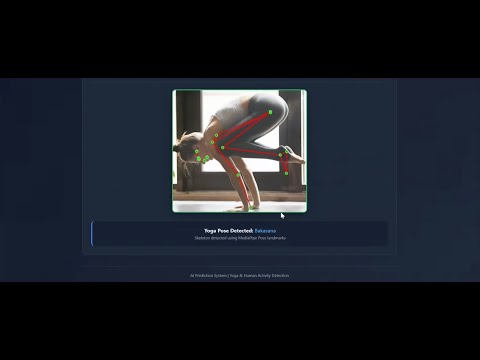
This project proposes an integrated deep learning–based system for yoga pose recognition and human activity recognition using image and video data. A Convolutional Neural Network (CNN) is employed to classify yoga poses from static images, while an EfficientNet-B0 architecture is utilized for recognizing human activities from video frames and live webcam input. To enhance interpretability, MediaPipe pose estimation is incorporated to extract human body keypoints and generate skeletal visualizations. The trained models are deployed through a Flask-based web application that supports image upload, video upload, and real-time webcam detection. The proposed system aims to deliver an accurate, interpretable, and accessible solution for intelligent fitness guidance and activity monitoring.
Keywords
Yoga Pose Recognition, Human Activity Recognition, Deep Learning, Convolutional Neural Network, EfficientNet-B0, MediaPipe Pose Estimation, Computer Vision, Flask Web Application
1. Introduction
In recent years, the availability of affordable imaging devices and the rapid growth of artificial intelligence have enabled the development of intelligent systems capable of analyzing complex human behavior. Vision-based human understanding systems are increasingly preferred over sensor-based systems because they do not require additional hardware to be worn by the user, making them more comfortable and scalable. Camera-based systems can capture rich spatial information, allowing deep learning models to learn posture and movement patterns directly from visual data.
Yoga pose recognition is an emerging application within this domain, as yoga involves a wide range of static and semi-dynamic postures that differ subtly in body alignment. Small deviations in joint angles or limb positions can significantly change the correctness of a yoga pose. Human instructors are traditionally responsible for posture correction, but such supervision is not always available, especially in self-guided home practice scenarios. Automated yoga pose recognition systems can bridge this gap by continuously monitoring posture and providing feedback without requiring constant human intervention.
Human activity recognition complements yoga pose recognition by enabling broader understanding of physical behavior. Activities such as walking, sitting, standing, lying, and clapping represent fundamental human actions that are important indicators of health, mobility, and daily routine. In healthcare monitoring and elderly care, automated detection of activities can help identify abnormal behavior or reduced mobility. Integrating both yoga pose recognition and human activity recognition into a single framework allows the system to support multiple real-world use cases using a unified architecture.
Despite the availability of advanced deep learning techniques, deploying such systems in real-world environments remains challenging. Issues such as model interpretability, computational efficiency, and user accessibility must be carefully addressed. This project aims to overcome these challenges by combining efficient deep learning architectures with pose estimation and web-based deployment, resulting in a practical and user-friendly system.
Objectives
• To design and develop an automated system for recognizing yoga poses and human activities using deep learning and computer vision techniques.
• To collect and organize image and video datasets suitable for supervised learning in yoga pose recognition and human activity recognition.
• To perform effective preprocessing of visual data, including resizing, normalization, and color space conversion, to improve model robustness and accuracy.
• To implement a Convolutional Neural Network (CNN) for accurate classification of multiple yoga poses from static images.
• To develop a human activity recognition model using the EfficientNet-B0 architecture for identifying activities such as walking, sitting, standing, lying, and clapping.
• To integrate MediaPipe pose estimation for extracting human body keypoints and generating skeleton visualizations for better posture interpretation.
• To combine yoga pose recognition and human activity recognition into a unified and modular system architecture.
• To deploy the trained models through a Flask-based web application that supports image upload, video upload, and live webcam detection.
• To provide real-time visual feedback to users by displaying recognized poses, activity labels, and skeletal overlays.
• To evaluate the performance of the system using accuracy, loss analysis, and qualitative visual assessment.
• To ensure system scalability and adaptability for future enhancements such as posture correction feedback, temporal activity analysis, and mobile or edge-device deployment.
Block Diagram
Hardware Requirements:
The system requires a multi-core processor, minimum 8 GB RAM, optional GPU support for faster training, sufficient storage capacity, and a webcam for live detection.
Software Requirements:
The software requirements include Python programming language, TensorFlow, Keras, OpenCV, MediaPipe, NumPy, Scikit-learn, Matplotlib, and Flask framework, running on a compatible operating system such as Windows or Linux.