ABSTRACT
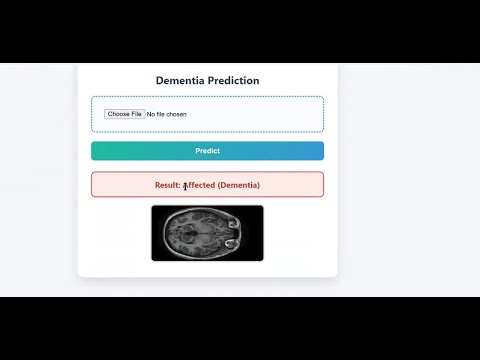
Dementia is a progressive neurological disorder that affects memory, cognitive ability, and daily functioning, significantly impacting patients, caregivers, and healthcare systems worldwide. Early detection of dementia plays a crucial role in slowing disease progression, enabling timely medical intervention, and improving patient quality of life. Traditional diagnostic methods often rely on manual clinical assessments, neuropsychological tests, and expensive imaging procedures, which can be time-consuming, subjective, and inaccessible in resource-limited settings. To address these challenges, this project presents a deep learning–based automated dementia detection system using medical image analysis. The proposed system leverages transfer learning with the MobileNetV2 convolutional neural network architecture to classify brain images into dementia-affected and normal categories with high efficiency and accuracy. The model is trained using a structured dataset of labeled images, employing data augmentation techniques such as rotation, shifting, zooming, and flipping to improve generalization and reduce overfitting. The training process utilizes binary cross-entropy loss, Adam optimization, early stopping, and model checkpointing to ensure optimal performance and stability. Once trained, the best-performing model is saved and reused for real-time inference. To enhance usability, the system is implemented with two user interfaces: a standalone desktop-based Tkinter application for local image testing and a Flask-based web application that supports user registration, authentication, image upload, and online prediction. The web platform stores user credentials securely using an SQLite database and provides an intuitive interface for dementia prediction results.
INTRODUCTION
Dementia is a chronic and progressive neurological disorder characterized by the deterioration of cognitive functions such as memory, reasoning, language, and problem-solving abilities, which significantly interferes with an individual’s daily activities and quality of life. It is not a single disease but a collective term encompassing various conditions, including Alzheimer’s disease, vascular dementia, and Lewy body dementia. According to global health organizations, dementia has become one of the leading causes of disability and dependency among older adults worldwide, with millions of new cases reported each year. The rapid growth of the aging population has further intensified the prevalence of dementia, creating a substantial burden on healthcare systems, caregivers, and society as a whole. Early and accurate diagnosis is therefore essential to delay disease progression, plan effective treatment strategies, and provide appropriate support to patients and their families. Traditional dementia diagnosis relies heavily on clinical evaluations, patient history, neuropsychological tests, and medical imaging techniques such as Magnetic Resonance Imaging (MRI) and Computed Tomography (CT) scans. While these methods are effective, they often require expert interpretation, are time-consuming, and may not always be accessible in rural or resource-constrained regions. Moreover, early-stage dementia symptoms can be subtle and easily overlooked, leading to delayed diagnosis and reduced treatment effectiveness. Human-based assessment methods are also susceptible to subjectivity and variability among clinicians, which can affect diagnostic consistency. These limitations highlight the growing need for automated, accurate, and scalable diagnostic tools that can assist healthcare professionals in identifying dementia at earlier stages.
In recent years, advances in artificial intelligence (AI) and machine learning have opened new possibilities in the field of medical diagnostics. Deep learning, a subset of machine learning, has demonstrated exceptional performance in image classification, pattern recognition, and feature extraction tasks. Convolutional Neural Networks (CNNs), in particular, have shown remarkable success in analyzing medical images by automatically learning hierarchical features directly from raw data. These models eliminate the need for manual feature engineering and can capture complex spatial patterns that are often imperceptible to the human eye. As a result, deep learning-based approaches are increasingly being adopted for the detection of neurological disorders, including dementia, using brain imaging data. Medical image analysis plays a critical role in dementia diagnosis, as structural and functional changes in the brain are key indicators of cognitive decline. Brain images often reveal patterns such as cortical thinning, hippocampal atrophy, and ventricular enlargement, which are associated with dementia progression. However, analyzing these features manually requires extensive expertise and may vary depending on the clinician’s experience. Automated image-based diagnostic systems powered by deep learning offer a promising alternative by providing consistent, objective, and reproducible results. These systems can process large volumes of data efficiently, making them well-suited for large-scale screening and early detection applications.
Transfer learning has emerged as an effective technique in deep learning, especially when working with limited medical datasets. Instead of training a model from scratch, transfer learning utilizes pre-trained models that have already learned rich feature representations from large-scale datasets such as ImageNet. By fine-tuning these models for specific medical tasks, high accuracy can be achieved with reduced training time and computational cost. MobileNetV2 is one such lightweight and efficient CNN architecture designed for high performance with low computational complexity. Its depthwise separable convolutions and inverted residual structure make it particularly suitable for deployment in real-world applications, including web-based and desktop systems. The use of MobileNetV2 in dementia detection enables efficient feature extraction while maintaining strong classification performance. This project focuses on the development of a deep learning–based dementia detection system using the MobileNetV2 architecture for binary classification of brain images into normal and dementia-affected categories. The system incorporates data preprocessing and augmentation techniques to enhance model robustness and generalization. Image augmentation methods such as rotation, shifting, zooming, and horizontal flipping are applied to address class imbalance and reduce overfitting.
OBJECTIVES
The primary objective of this project is to design and develop an intelligent, automated dementia detection system that leverages deep learning and medical image analysis to accurately classify brain images into normal and dementia-affected categories, thereby supporting early diagnosis and clinical decision-making. The project aims to utilize transfer learning with a lightweight yet powerful convolutional neural network architecture, specifically MobileNetV2, to achieve high classification accuracy while maintaining computational efficiency and reduced training time. Another key objective is to implement effective data preprocessing and augmentation techniques, including normalization, rotation, shifting, zooming, and flipping, in order to enhance the diversity of the training dataset, reduce overfitting, and improve the generalization capability of the model when exposed to unseen data. The project also seeks to optimize the training process by carefully selecting suitable loss functions, optimization algorithms, learning rates, and regularization strategies such as dropout, early stopping, and model checkpointing to ensure stable convergence and optimal performance.
In addition to model development, a major objective of this project is to create a user-friendly and accessible system that bridges the gap between complex deep learning models and real-world healthcare applications. This includes developing a standalone desktop-based application using Tkinter that allows users to easily upload medical images and obtain real-time dementia predictions without requiring advanced technical knowledge. Another important objective is to design and implement a web-based application using the Flask framework that supports secure user registration, authentication, image uploading, and prediction visualization. By integrating an SQLite database for user management, the project aims to ensure controlled access and basic data security, making the system more suitable for practical deployment. The project also intends to maintain consistency between training and deployment environments by reusing the same trained model for both desktop and web interfaces, thereby ensuring reliability and reproducibility of results.
Block Diagram