Communication is an essential part of everyday life, but language differences and speech or hearing disabilities can sometimes create barriers between individuals. Hand gestures and sign languages provide an important communication method for people who use visual expressions instead of spoken words. With advancements in Artificial Intelligence (AI), Computer Vision, and Deep Learning, automated hand gesture recognition systems are becoming increasingly useful for improving accessible communication.
The Hand Gesture Detection for Multi-Language Recognition Using Convolutional Neural Network (CNN) is an AI-based project designed to recognize hand gestures from images or live camera input and convert the identified gestures into meaningful text or language-based output.
The proposed system uses Convolutional Neural Networks to learn visual patterns from hand gesture images. After recognizing a gesture, the application maps the predicted class to its corresponding word or expression and provides an option to display the result in supported languages.
By combining image processing, deep learning, and multilingual translation technologies, this project aims to make gesture-based communication more accessible and convenient.
Understanding Hand Gesture Recognition Technology
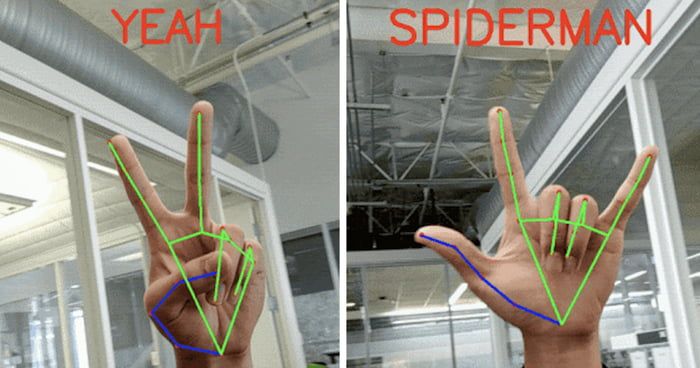
Hand gesture recognition is a computer vision technique that enables machines to understand human hand movements and gestures using images or video frames.
Traditional communication systems primarily depend on spoken or written language. However, gesture recognition introduces another communication method by interpreting visual hand patterns.
In the proposed system, a camera captures the user's hand gesture. The captured image is processed and passed to a trained CNN model, which identifies the gesture based on learned image features.
The recognized gesture is then mapped to a corresponding word, phrase, or expression. A multilingual processing module can translate the recognized output into the selected target language.
Main Objectives
Develop an AI-powered hand gesture recognition application.
Recognize hand gestures using a Convolutional Neural Network.
Process real-time images captured through a webcam.
Convert recognized gestures into meaningful text.
Support multiple output languages through translation integration.
Improve accessibility and communication through intelligent visual recognition.
The system provides an opportunity to explore how deep learning can be applied to gesture-based human-computer interaction.
Key Features & Benefits
CNN-Based Gesture Detection and Multilingual Recognition
Convolutional Neural Networks are deep learning architectures commonly used for image classification and visual recognition tasks.
CNN models automatically learn important visual features from training images, including edges, shapes, textures, and patterns. These features help the model distinguish between different hand gestures.
CNN-Based Recognition Process
1. Image Acquisition
The system captures hand gesture images using a webcam or an uploaded image.
2. Image Preprocessing
The captured image is resized, normalized, and converted into the required input format before being passed to the trained model.
3. Feature Extraction
The CNN architecture uses convolutional layers to identify important visual patterns in the hand image.
4. Gesture Classification
Pooling layers and fully connected layers process the extracted features to predict the corresponding gesture class.
5. Text Generation
The predicted gesture label is mapped to its corresponding word or expression using a predefined gesture dictionary.
Multilingual Recognition and Translation
After identifying a gesture, the system generates a text representation of the recognized output. A language translation module can convert this text into different supported languages.
For example, if a recognized gesture represents a greeting, the application can display its equivalent in English, Tamil, Hindi, or other configured languages.
The multilingual functionality makes the application more flexible for users from different linguistic backgrounds.
It is important to note that the gesture recognition model must be trained with an appropriate dataset for the intended gesture vocabulary or sign language. Translation alone does not make a model capable of understanding every sign language, since sign languages have their own grammar, vocabulary, and regional variations.
Implementation Guide
Key Features of the Proposed System
The proposed application combines deep learning and language processing to provide an interactive gesture recognition experience.
1. Real-Time Hand Gesture Detection
The system captures live camera input and identifies hand gestures using computer vision techniques.
2. CNN-Based Image Classification
A trained Convolutional Neural Network classifies the input gesture based on visual features learned from the training dataset.
3. Image Upload Support
Users can upload existing hand gesture images for recognition without requiring a live camera.
4. Multilingual Text Output
Recognized gesture labels can be displayed in multiple supported languages using a translation module.
5. Automated Gesture-to-Text Conversion
The application converts recognized hand gestures into meaningful textual output.
6. User-Friendly Interface
An interactive interface allows users to select a language, capture images, upload gestures, and view recognition results.
7. Prediction Confidence
The system can display the model's prediction confidence to help users understand how strongly the model supports its classification.
8. Expandable Gesture Dataset
New gesture categories and language mappings can be added by collecting suitable training samples and updating the recognition model.
Technical Specifications
Technologies and Implementation Methodology
The project can be developed using Python and modern deep learning libraries. The following technologies are suitable for building the proposed application.
Software Requirements
Python: Main programming language for implementing the recognition system.
TensorFlow/Keras: Used to design, train, and evaluate the CNN model.
OpenCV: Used for webcam integration, image capture, and image preprocessing.
NumPy: Supports numerical operations and image array processing.
Pandas: Used for dataset organization and data analysis.
Matplotlib: Used to visualize training accuracy, loss, and model performance.
Scikit-learn: Supports dataset splitting and classification evaluation.
Streamlit or Flask: Used to develop the interactive web application.
Translation API or multilingual language module: Used to convert recognized text into supported languages.
Hardware Requirements
Computer or laptop.
Webcam or external camera.
Minimum 8 GB RAM recommended for development.
Internet connection for cloud-based translation services, if used.
System Implementation Process
Step 1: Dataset Collection
Collect hand gesture images representing the required gesture categories. The dataset should contain sufficient examples with variations in lighting, background, hand orientation, and distance.
Step 2: Dataset Preprocessing
Resize the images into a consistent input dimension, normalize pixel values, and organize them according to their respective gesture labels.
Step 3: CNN Model Development
Build a CNN architecture containing convolutional layers, activation functions, pooling layers, and fully connected layers for gesture classification.
Step 4: Model Training
Train the CNN model using the prepared dataset. Monitor training and validation accuracy and loss to evaluate learning performance.
Step 5: Gesture Prediction
Load the trained model and provide new images or live camera frames as input. The model predicts the corresponding gesture category.
Step 6: Text Mapping
Convert the predicted class into a meaningful word or expression using the gesture label mapping system.
Step 7: Multilingual Translation
Pass the recognized text to the translation module and generate the equivalent output in the user's selected language.
Step 8: Result Display
Display the detected gesture, recognized text, selected language, and translated output through the application interface.
Conclusion & Next Steps
Applications, Advantages, and Future Enhancements
Real-World Applications
Hand gesture recognition technology has several potential applications in accessibility, education, healthcare, and intelligent human-computer interaction.
Accessible Communication: Helps develop communication tools for people who use supported sign or gesture vocabularies.
Educational Institutions: Supports interactive learning applications for gesture-based communication.
Healthcare: Can assist in developing communication interfaces for patients who have difficulty communicating through speech.
Public Service Centers: Provides alternative interaction methods for visitors using supported gestures.
Smart Devices: Enables gesture-based control of compatible digital devices.
Human-Computer Interaction: Allows users to interact with computers through visual hand movements.
Advantages
Provides an alternative method of digital communication.
Uses CNN models for automated image classification.
Supports live camera-based gesture detection.
Converts recognized gestures into readable text.
Can provide translated output in multiple languages.
Can be expanded with additional gesture categories.
Combines computer vision and deep learning in one application.
Future Enhancements
The project can be enhanced by integrating more advanced deep learning models and real-time gesture tracking techniques.
Future development may include continuous gesture recognition, sentence-level sign language interpretation, hand landmark detection, multilingual speech output, and mobile application integration.
Additional improvements can use MediaPipe for hand landmark extraction and combine CNN or recurrent neural network architectures to understand sequences of hand movements.
Transformer-based models and advanced video recognition techniques can also be explored for recognizing complex gesture sequences and improving contextual understanding.
The system can further be extended with offline translation support, cloud-based model deployment, and personalized gesture recognition.
Conclusion
Hand Gesture Detection for Multilingual Recognition Using Convolutional Neural Networks demonstrates the application of Artificial Intelligence, Computer Vision, and Deep Learning in accessible communication systems.
By combining CNN-based gesture classification with multilingual text translation, the proposed system provides a flexible method for converting recognized hand gestures into understandable language output.
The integration of real-time camera input, image preprocessing, gesture classification, and language processing makes this project a useful exploration of modern AI technologies.
With further improvements in continuous gesture recognition, sign language datasets, and multilingual communication, this technology has the potential to support more inclusive and intelligent human-computer interaction.
Contact Aislyn Technologies
Aislyn Technologies, Bangalore
Phone: +91 97395 94609
Email: info@aislyntech.com
Website: https://aislyn.in
Contact us today to start building your AI, Machine Learning, Deep Learning, and software development projects with our expert support!