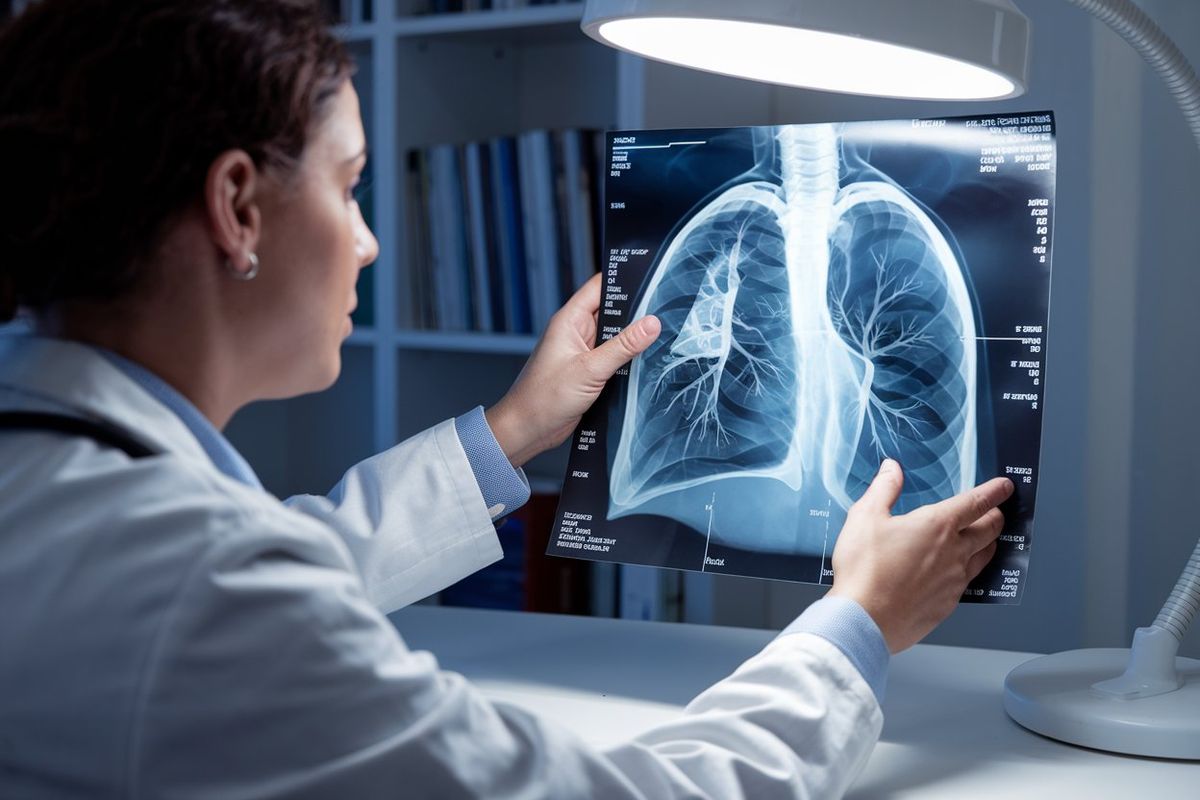
Lung tumor detection using Machine Learning is an Artificial Intelligence-based healthcare project that focuses on analyzing medical images to identify patterns associated with lung abnormalities. With the development of AI and medical image processing technologies, machine learning models are increasingly being explored for computer-assisted analysis of medical imaging data.
The Lung Tumor Detection Using Machine Learning project aims to develop an intelligent application that processes lung CT scan images and classifies them based on patterns learned from a labeled dataset.
Traditional medical image analysis requires specialized knowledge and careful examination of scan images. Machine learning provides an additional computational approach by learning image characteristics from previously collected and labeled samples.
This project uses Python, image processing techniques, and machine learning algorithms to build a lung image classification system. The application can provide classification results through a user-friendly interface and display relevant analysis information.
It is an educational project suitable for BCA final-year students interested in Artificial Intelligence, Machine Learning, Python programming, Computer Vision, and healthcare technology.
Importantly, this project is an academic prototype and is not intended to replace professional radiologists, clinical diagnosis, or medical evaluation.
Key Features & Benefits
Project Overview and Objectives
The primary objective of this project is to develop a machine learning-based application for analyzing lung CT scan images and identifying image patterns associated with different lung conditions.
The system uses a labeled medical image dataset to train a machine learning model. During training, the algorithm learns relevant image characteristics and relationships between input images and their corresponding dataset labels.
After training, the model can process a new image and generate a predicted classification based on the patterns it has learned.
Key Project Objectives:
Collect and organize labeled lung CT scan image datasets.
Perform image preprocessing and normalization.
Extract relevant visual characteristics from medical images.
Train machine learning models using labeled image samples.
Classify lung images based on the trained model.
Evaluate classification performance using appropriate metrics.
Develop a user-friendly interface for image submission.
Display prediction results and relevant classification information.
Implementation Guide
Major Features and Modules
The Lung Tumor Detection System consists of several modules that manage image processing, model training, classification, and result visualization.
1. User Authentication Module
Provides a login interface for authorized users to access the application. It can help manage user accounts and protect application records.
2. Dataset Management Module
Handles the collection and organization of lung CT scan images. The dataset contains labeled samples that are used for model training and evaluation.
3. Image Upload Module
Allows users to upload CT scan images through the web application. The uploaded images are passed to the preprocessing pipeline for further analysis.
4. Image Preprocessing Module
Prepares medical images before classification. Common operations include resizing, normalization, noise reduction, and image format conversion.
5. Feature Extraction Module
Extracts useful visual information from medical images. Depending on the implementation, this may involve texture, intensity, shape, or deep image features.
6. Machine Learning Model Training Module
Trains classification algorithms using the prepared dataset. Possible approaches include Support Vector Machine, Random Forest, K-Nearest Neighbors, and Convolutional Neural Networks.
7. Lung Image Classification Module
Processes uploaded images using the trained model and generates a predicted class based on the available training labels.
8. Result Visualization Module
Displays the classification output and relevant information through an organized interface. The system can also display confidence scores when supported by the model.
9. Prediction History Module
Can maintain previous image analysis records, including upload dates and generated classification results.
Technical Specifications
Technologies Used and System Implementation
The project combines Python programming, machine learning algorithms, and medical image processing technologies.
Programming Language
Python – Implements image preprocessing, machine learning algorithms, model evaluation, and backend operations.
Machine Learning and Deep Learning
Scikit-learn – Supports machine learning model development and evaluation.
Support Vector Machine (SVM) – Performs classification using learned feature representations.
Random Forest – Combines multiple decision trees for classification.
K-Nearest Neighbors (KNN) – Classifies samples based on neighboring data points.
Convolutional Neural Network (CNN) – Learns spatial and visual features directly from medical images.
Image Processing Technologies
OpenCV – Supports image reading, resizing, filtering, and preprocessing.
Pillow – Handles medical image-related image manipulation.
NumPy – Performs numerical operations on image data.
Matplotlib – Displays images and evaluation visualizations.
Web Development Technologies
Flask – Connects the trained machine learning model with the web application.
MySQL or SQLite – Can store user details, image metadata, and prediction history.
System Implementation Workflow
The implementation starts with collecting a suitable labeled lung CT scan image dataset. The collected images are divided into training, validation, and testing datasets.
Next, image preprocessing operations are performed to maintain consistent dimensions and pixel values. Depending on the selected model, relevant image features are extracted or learned automatically during training.
The prepared dataset is then used to train the selected machine learning or deep learning algorithm. The trained model is evaluated using an independent test dataset.
Performance can be measured using accuracy, precision, recall, F1-score, confusion matrix, and sensitivity and specificity where appropriate.
After model training, the selected model is saved using Joblib, Pickle, or the framework's model-saving functionality.
Flask loads the trained model and provides an interface for uploading lung CT scan images. When an image is submitted, the application applies the same preprocessing steps used during training and passes the processed image to the model.
Finally, the application displays the predicted dataset class and relevant model output.
Conclusion & Next Steps
Advantages, Applications and Future Enhancements
Advantages of the Project
Demonstrates AI-based medical image analysis.
Automates image classification using trained models.
Supports experimentation with different machine learning algorithms.
Provides a centralized image analysis interface.
Helps students understand computer vision concepts.
Combines machine learning with practical web development.
Provides opportunities for further healthcare AI research.
Potential Applications
The underlying technologies can be explored in several research and educational areas:
Medical image classification research.
Computer-assisted radiology research.
Lung CT scan image analysis.
Healthcare artificial intelligence applications.
Medical image dataset analysis.
Deep learning-based computer vision research.
Future Enhancements
The project can be extended with advanced AI and image processing techniques.
Implement advanced CNN architectures for image classification.
Explore transfer learning using ResNet, VGG16, or EfficientNet.
Introduce Grad-CAM visualization to highlight image regions influencing model predictions.
Support DICOM medical image formats.
Develop an interactive medical image visualization dashboard.
Compare multiple machine learning and deep learning algorithms.
Integrate secure cloud-based image storage.
Improve model evaluation using independent and diverse datasets.
Explore explainable AI techniques for understanding model predictions.
Develop a mobile-friendly application interface.
Conclusion
Lung Tumor Detection Using Machine Learning demonstrates the application of Artificial Intelligence and Computer Vision in medical image analysis. By combining Python, image preprocessing techniques, and classification algorithms, the project provides an academic platform for exploring automated lung CT scan image classification.
The application helps students understand dataset preparation, feature extraction, model training, classification, and web application integration.
This project is a useful BCA final-year project for students interested in Machine Learning, Deep Learning, Python development, Computer Vision, and healthcare technology.
Frequently Asked Questions
1. What is Lung Tumor Detection Using Machine Learning?
It is an AI-based project that analyzes lung medical images and classifies them using patterns learned from a labeled dataset.
2. Which programming language is used in this project?
Python is commonly used for image processing, machine learning, model training, and application development.
3. Which machine learning algorithms can be used?
SVM, Random Forest, KNN, and CNN are possible approaches depending on the dataset and implementation.
4. What is the role of OpenCV?
OpenCV helps perform image preprocessing operations such as resizing, filtering, and image transformation.
5. Is this project suitable for BCA final-year students?
Yes. It combines Python programming, machine learning, image processing, and database integration.
6. Can this system replace medical diagnosis?
No. An academic image classification model cannot replace professional medical diagnosis. Clinical use requires extensive validation, regulatory compliance, and evaluation by qualified healthcare professionals.
Contact Details
Aislyn Technologies, Bangalore
Phone: +91 97395 94609
Email: info@aislyntech.com
Website: https://aislyn.in
Contact us today to start building your Machine Learning, Artificial Intelligence, Deep Learning, and Embedded Projects in Bangalore with our expert support!