IoT-Based Smart Energy Meter Using Arduino and Embedded C
Solar Tracking System Using Arduino with Source Code
Automatic Power Factor Correction Using a Microcontroller
IoT-Based Transformer Monitoring Using ESP32
Electric Vehicle Battery Monitoring and Protection System
BLDC Motor Speed Control Using a Microcontroller
Smart Street Light Control Using Arduino and LDR
Solar PV Monitoring System Using IoT
Automatic Electricity Theft Detection and Alert System
Power Consumption Monitoring Using ESP32 and a Web Dashboard
Three-Phase Induction Motor Monitoring System
IoT-Based Electrical Fault Detection and Notification
Automatic Load Shedding Using a Microcontroller
Wireless Power Transfer Demonstration System
Smart Home Energy Monitoring and Control Using IoT
Battery Charging and Overvoltage Protection System
Hybrid Solar and Wind Energy Monitoring System
Power Quality Monitoring Using Sensors and a Microcontroller
PLC-Based Industrial Motor Control Project
IoT-Based Substation Monitoring System
Regenerative Braking Demonstration for Electric Vehicles
Automatic Power Factor Monitoring and Correction
Arduino-Based Voltage, Current, and Power Monitoring
AI-Based Electrical Fault Classification Using Python
MATLAB Simulink-Based Power System Fault Analysis
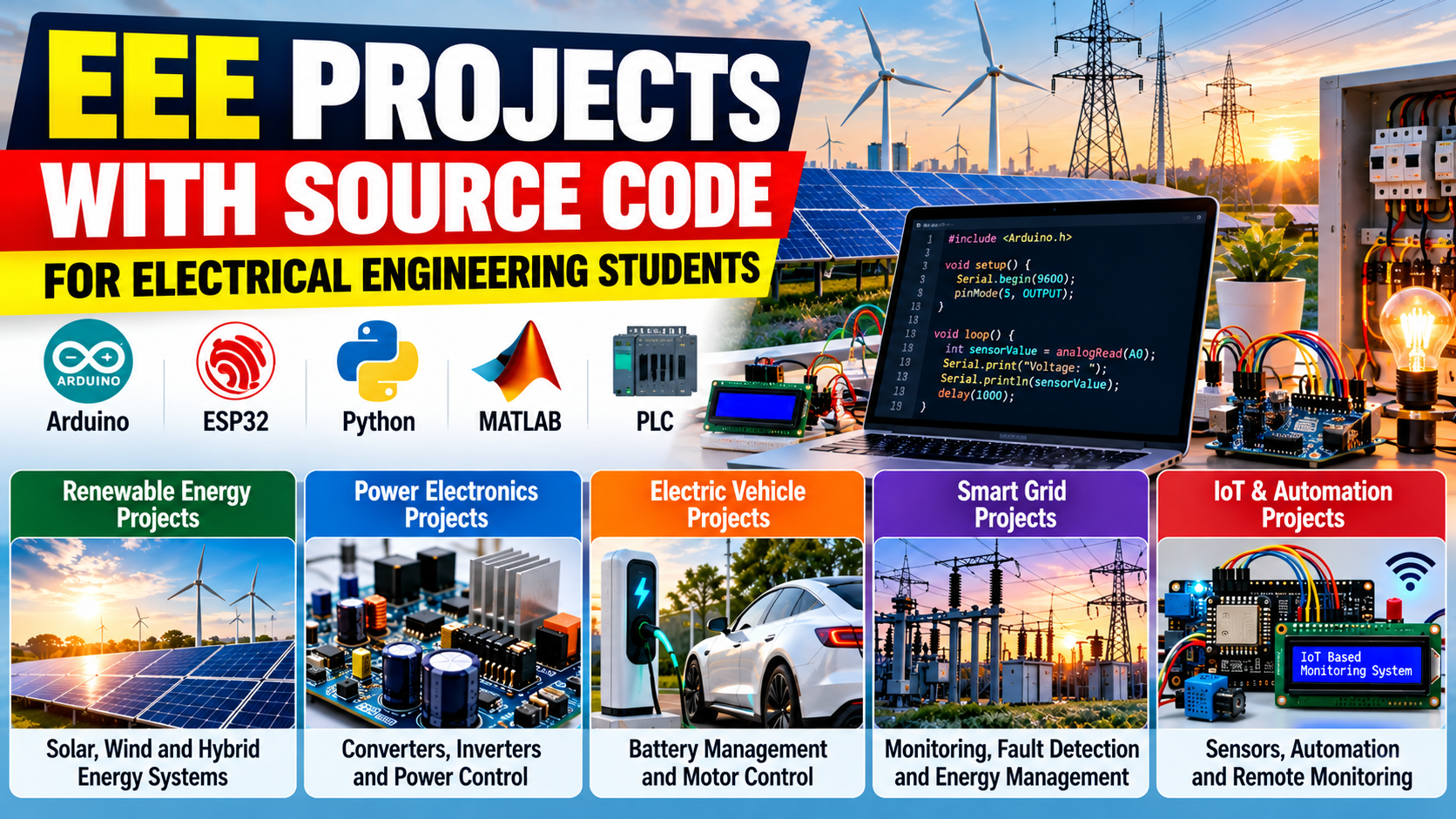
These EEE project ideas combine electrical engineering concepts with programming, embedded systems, IoT, simulation, and automation. Depending on the project, source code may be developed using Arduino IDE, Embedded C, Python, MATLAB, Simulink, or PLC programming environments. The availability and scope of source code depend on the selected project and its implementation requirements.
Key Features & Benefits
Applications of EEE Projects with Source Code
Power Monitoring and Energy Management: Source-code-based energy meters and power monitoring systems help students understand voltage, current, power consumption, and energy usage.
Renewable Energy: Solar tracking, solar PV monitoring, and hybrid energy systems demonstrate techniques for monitoring renewable energy generation and improving energy utilization.
Electric Vehicle Technology: Battery monitoring, charging protection, BLDC motor control, and regenerative braking projects introduce students to electric mobility systems.
Industrial Automation: PLC-based motor control, electrical equipment monitoring, and automated load management help students understand industrial control applications.
IoT-Based Electrical Systems: ESP32 and Arduino projects can send sensor readings to dashboards, display live electrical parameters, and generate alerts when configured thresholds are exceeded.
Electrical Protection: Fault detection, overvoltage protection, transformer monitoring, and power quality analysis help demonstrate electrical system safety and reliability concepts.
Simulation and Analysis: MATLAB and Simulink projects support the modelling and analysis of electrical machines, converters, power systems, and control strategies.
Implementation Guide
Who Can Benefit and Project Domains
Who Can Benefit?
BE and B.Tech Electrical and Electronics Engineering students.
ME and M.Tech students working on advanced electrical engineering projects.
Diploma students learning electrical systems and microcontroller programming.
Final-year students preparing academic project demonstrations.
Students learning Arduino, Embedded C, Python, IoT, MATLAB, and Simulink.
Researchers exploring electrical monitoring, renewable energy, power electronics, and automation.
Major Project Domains
Embedded Systems: Arduino, ESP32, microcontrollers, Embedded C, and sensor interfacing.
Power Systems: Fault detection, transformer monitoring, electrical protection, and load management.
Renewable Energy: Solar tracking, solar PV monitoring, wind energy, and hybrid generation.
Power Electronics: Converters, inverters, power factor correction, and battery protection.
Electrical Machines: BLDC motor control, induction motor monitoring, and speed control.
Electric Vehicles: Battery monitoring, charging systems, regenerative braking, and motor control.
IoT and Smart Grids: Smart meters, remote monitoring, energy management, and connected electrical equipment.
AI and Software: Python-based fault classification, predictive monitoring, data analysis, and MATLAB/Simulink simulations.
Technical Specifications
Why Choose Aislyn Technologies?
Aislyn Technologies, Bangalore, provides technical guidance for students exploring EEE projects with source code and practical electrical engineering applications.
Project Selection: Get guidance in choosing a project according to your academic requirements, technical interests, and implementation goals.
Source Code Guidance: Understand the program structure, logic, libraries, and configuration required for suitable Arduino, ESP32, Python, or MATLAB-based projects.
Hardware and Component Guidance: Learn about the sensors, controllers, electrical components, and modules required for your selected project.
Simulation Support: Explore modelling, circuit analysis, and control-system simulation where appropriate.
Integration and Testing: Understand how to connect software with hardware, test sensor readings, troubleshoot errors, and evaluate system performance.
Documentation Guidance: Organize your objectives, methodology, source-code explanation, circuit diagrams, and test results for academic presentation.
Students can discuss the source code, hardware requirements, software tools, and implementation scope available for their chosen topic with Aislyn Technologies.
Conclusion & Next Steps
Contact Aislyn Technologies, Bangalore
Aislyn Technologies
Bangalore, Karnataka, India
Phone: +91 97395 94609
Email: info@aislyntech.com
Website: https://aislyn.in
Looking for EEE projects with source code for your final-year engineering project? Contact Aislyn Technologies, Bangalore, to discuss projects involving Arduino, Embedded C, ESP32, IoT, renewable energy, electric vehicles, power electronics, electrical monitoring, and industrial automation.
Share your project title, preferred programming language, hardware requirements, and academic objectives to explore a suitable project and the technical guidance available.














.png)
.jpeg)


