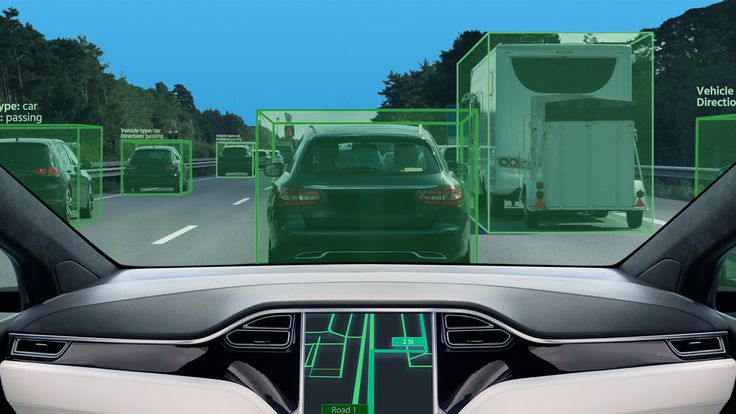
Advanced Driver Assistance Systems (ADAS) are becoming an important part of modern automotive technology. These systems use cameras, sensors, and intelligent algorithms to help drivers understand their surroundings and improve road safety. Object detection is one of the key technologies used in ADAS because it enables a vehicle to identify nearby objects such as cars, pedestrians, motorcycles, traffic signs, and obstacles.
The Real-Time Object Detection for ADAS and Autonomous Driving Assistance System project focuses on detecting road objects from camera images or video streams. Computer vision and deep learning techniques are used to recognize different object categories and display their locations through bounding boxes.
This project demonstrates how artificial intelligence can support intelligent transportation systems and provide a foundation for advanced driver assistance applications.
Key Features & Benefits
Working Methodology
The system captures road scenes using a camera or recorded video. Each frame is passed to the object detection model for preprocessing and analysis.
A trained deep learning model, such as YOLO, processes the input frame and identifies objects belonging to its supported classes. The model generates bounding boxes, class labels, and confidence scores for detected objects.
The detection results are displayed on the video frame, allowing users to observe objects in the vehicle's surroundings. The system can process consecutive frames to demonstrate real-time object detection, depending on the hardware and model configuration.
Basic workflow:
Capture road images or video using a camera.
Read video frames continuously.
Preprocess each frame.
Pass the frame to the trained detection model.
Identify vehicles, pedestrians, and other supported objects.
Generate bounding boxes and confidence scores.
Display detection results on the video.
Implementation Guide
Features and Technologies
Key Features
Real-time road object detection.
Vehicle and pedestrian recognition.
Detection of motorcycles and other supported road objects.
Bounding box visualization.
Object class labels and confidence scores.
Video-based detection and analysis.
Performance monitoring through detection results.
Technologies Used
Programming Language: Python.
Deep Learning: YOLO.
Computer Vision: OpenCV.
Framework: PyTorch or Ultralytics.
Numerical Processing: NumPy.
Dataset: COCO or a custom road-object dataset.
Development Environment: Visual Studio Code or Google Colab.
The implementation begins with preparing a suitable object detection dataset containing road-related object categories. The dataset is annotated and divided into training and validation sets. A YOLO model is trained or fine-tuned using the selected dataset.
After training, the model is loaded into a Python application using OpenCV and the appropriate inference framework. The application reads camera input or video files, processes frames, and displays detected objects with their bounding boxes and confidence scores.
The system's performance can be evaluated using precision, recall, mean Average Precision (mAP), and inference speed. Testing under different lighting, weather, and road conditions helps identify areas for improvement.
Integrate lane detection and lane departure warning.
Add vehicle distance estimation.
Implement collision-risk analysis.
Detect traffic signs and traffic signals.
Explore edge deployment using NVIDIA Jetson.
Combine camera input with LiDAR or radar sensors.
Optimize the model for low-latency processing.
Conclusion & Next Steps
Conclusion and References
The Real-Time Object Detection for ADAS project demonstrates how deep learning and computer vision can identify important objects in road environments. By processing camera images and video frames, the system recognizes supported object categories and displays their locations in real time.
This project is suitable for MCA students interested in artificial intelligence, autonomous driving, computer vision, and deep learning. It can be extended with lane detection, distance estimation, and multi-sensor integration to explore more advanced driver assistance applications.
Note: This project is an educational prototype and should not be used as a standalone safety system in real vehicles without extensive validation and safety certification.