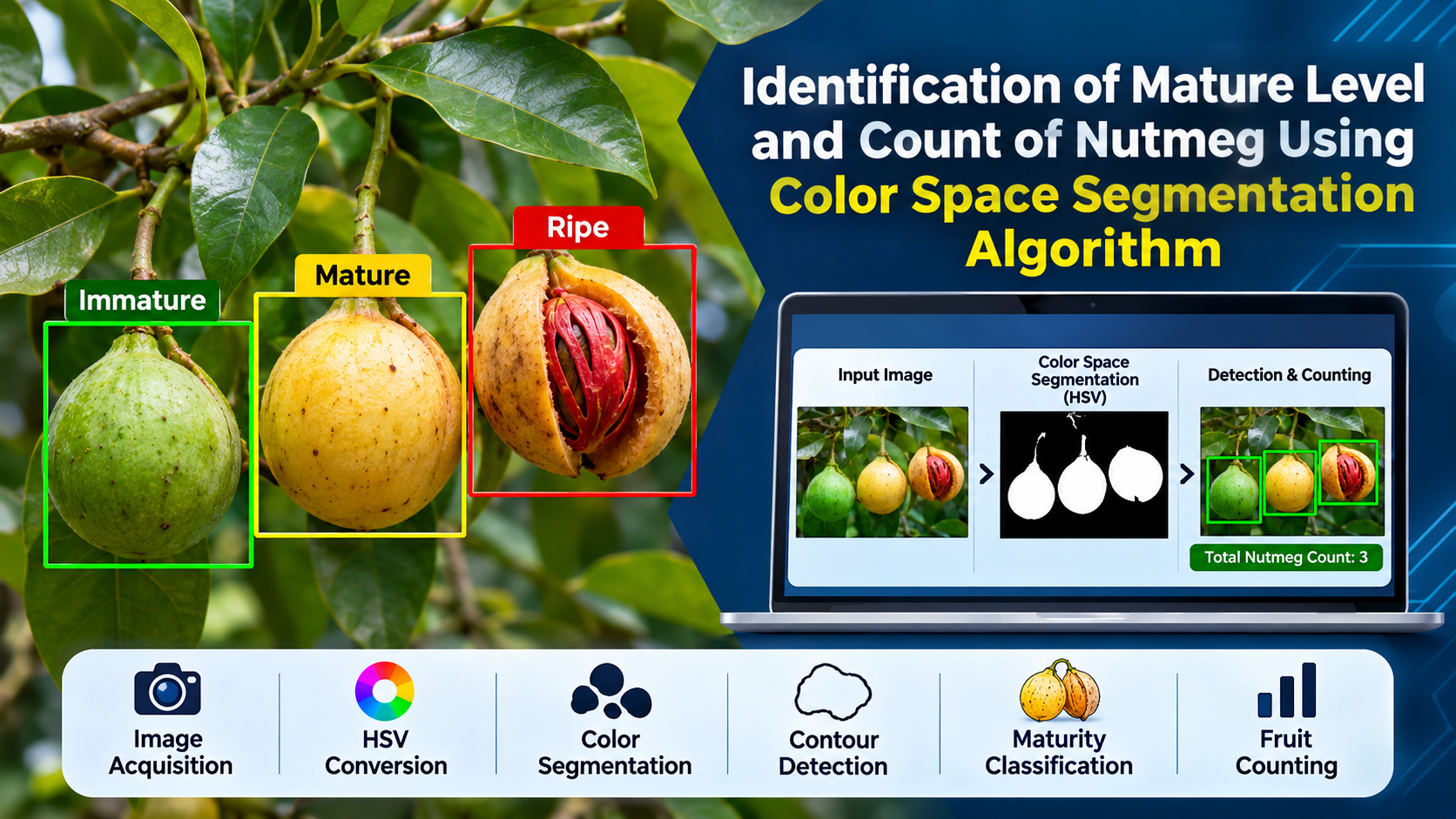
Nutmeg Maturity Detection and Counting Using Color Space Segmentation
Introduction
Agriculture plays a significant role in food production and economic development. Identifying the maturity level of agricultural products is an important activity because harvesting fruits at the correct stage directly affects their quality, market value and storage life. Traditionally, farmers identify fruit maturity through manual observation, which requires experience and considerable time, particularly when handling large quantities of crops.
Nutmeg is an important spice crop widely cultivated for its aromatic seeds and surrounding fruit flesh. Determining its maturity level and counting the number of fruits manually can be challenging in large-scale agricultural environments.
To address these challenges, the Identification of Mature Level and Count of Nutmeg Using Color Space Segmentation Algorithm project introduces an image-processing-based solution for automatically analyzing nutmeg fruits.
The proposed system uses digital image processing and color space segmentation techniques to identify nutmeg fruits, estimate their maturity levels and calculate the number of detected fruits in an image.
What Is Nutmeg Maturity Detection Using Color Space Segmentation?
Nutmeg maturity detection is a computer vision application that analyzes fruit images to determine their maturity stages based on visible color characteristics.
The system captures an image using a digital camera and processes it using image-processing algorithms. The image is converted into a suitable color space, such as HSV (Hue, Saturation and Value), to separate relevant color information from brightness variations.
Color thresholds are then applied to identify different regions of the fruit. Segmentation techniques separate the nutmeg fruits from the background, while contour detection and object analysis help calculate the total fruit count.
Depending on the image dataset and selected color thresholds, the system can classify fruits into predefined maturity categories.
## Why Is This Project Important in 2026?
Agriculture is increasingly adopting smart farming technologies, automated crop monitoring and computer vision-based quality assessment.
Image processing can help reduce repetitive manual inspection and provide consistent visual analysis. The integration of artificial intelligence, edge computing and automated agricultural monitoring creates opportunities for more efficient fruit sorting and harvesting support.
This project provides students with practical knowledge of image processing, color segmentation, object detection and agricultural automation.
Main Objectives
- Automatically identify nutmeg fruits from captured images.
- Analyze fruit color characteristics for maturity estimation.
- Separate fruits from complex backgrounds using segmentation.
- Count the number of detected nutmeg fruits.
- Reduce manual inspection effort.
- Provide visual results for agricultural monitoring and analysis.
- Develop a foundation for future AI-based fruit grading systems.
Key Features & Benefits
Working Principle of the Proposed System
The proposed nutmeg maturity detection system follows a sequence of image-processing operations to identify fruits, analyze their colors and calculate their quantity.
1. Image Acquisition
The process begins by capturing nutmeg fruit images using a digital camera, smartphone or other imaging device.
The captured image is supplied to the processing system for further analysis. Proper lighting, image resolution and background conditions can improve segmentation performance.
2. Image Preprocessing
The captured image may contain unwanted noise, shadows and background variations.
Preprocessing techniques are applied to improve image quality. These operations can include:
Image resizing.
Noise reduction.
Gaussian filtering.
Image enhancement.
Background preparation.
3. Color Space Conversion
The RGB image is converted into HSV color space.
HSV represents images using three components:
Hue: Represents the dominant color information.
Saturation: Represents the intensity or purity of the color.
Value: Represents image brightness.
HSV color space is useful for color-based segmentation because it separates color information from brightness, making threshold-based fruit identification easier under suitable lighting conditions.
4. Color Space Segmentation
The system applies selected color ranges to identify nutmeg fruit regions.
Different threshold values can be configured according to the visible color characteristics of the nutmeg maturity stages.
A binary mask is generated to separate relevant fruit regions from the background.
5. Morphological Operations
Morphological image-processing techniques improve the segmented output.
Common operations include:
Erosion to remove small unwanted regions.
Dilation to expand relevant segmented regions.
Opening to eliminate small noise objects.
Closing to fill small gaps within segmented areas.
These operations help produce cleaner fruit regions for subsequent analysis.
6. Contour Detection
After segmentation, the system identifies object boundaries using contour detection.
Contours help determine the location and shape of individual nutmeg fruits. Area filtering can remove very small regions that are unlikely to represent actual fruits.
7. Nutmeg Counting
The system identifies individual segmented fruit regions and calculates their total number.
The detected fruit count can be displayed along with bounding regions or visual markings on the processed image.
Accurate counting depends on fruit separation. Overlapping or touching fruits may require additional watershed segmentation or instance segmentation techniques.
8. Maturity Level Identification
The segmented fruit regions are analyzed using their color characteristics.
Based on the selected dataset and experimentally determined color ranges, the system assigns maturity categories.
For example, the implementation may define immature, developing and mature categories. The actual color ranges must be calibrated using representative nutmeg samples rather than assuming that one fixed color represents maturity under every condition.
Suggested System Architecture
Input Image → Image Preprocessing → RGB to HSV Conversion → Color Thresholding → Morphological Operations → Contour Detection → Maturity Classification → Fruit Counting → Result Display
Major System Modules
Image Acquisition Module: Captures or uploads nutmeg images.
Preprocessing Module: Improves image quality and reduces unwanted noise.
Color Conversion Module: Converts RGB images into HSV color space.
Segmentation Module: Separates nutmeg regions using selected color thresholds.
Maturity Detection Module: Analyzes fruit color characteristics and assigns maturity categories.
Counting Module: Identifies individual fruit regions and calculates the total count.
Visualization Module: Displays processed images, maturity labels and counting results
Implementation Guide
Key Features of the Nutmeg Detection System
1. Automatic Fruit Identification
The system identifies nutmeg fruit regions from digital images using image-processing techniques, reducing the need for manual inspection.
2. Color-Based Maturity Analysis
Color space segmentation analyzes the visible color characteristics of nutmeg fruits to estimate their maturity stages.
3. Automatic Fruit Counting
The application detects individual fruit regions and calculates the number of visible nutmeg fruits in the input image.
4. Image Segmentation
Color thresholding separates the fruit regions from the background, helping improve the accuracy of subsequent image analysis.
5. Processed Image Visualization
The system displays segmented regions, detected contours and maturity classification results for easier interpretation.
6. Reduced Manual Inspection
Automated image analysis can reduce repetitive manual counting and visual classification tasks.
7. Expandable Architecture
The proposed system can be extended with machine learning, deep learning and real-time camera integration.
Technologies Used
Component
Suggested Technology
Programming Language
Python
Image Processing
OpenCV
Numerical Processing
NumPy
Image Visualization
Matplotlib
Color Space
HSV
Segmentation
Color Thresholding
Object Identification
Contour Detection
Classification
Rule-Based Color Analysis
Advanced Classification
CNN
Development Environment
VS Code / Jupyter Notebook
The basic implementation can use OpenCV and Python without requiring a deep learning model.
Latest Technology Trends in Agricultural Computer Vision – 2026
AI-Based Fruit Maturity Detection
Deep learning models such as Convolutional Neural Networks can learn visual characteristics from labeled fruit images and classify maturity stages.
YOLO-Based Fruit Detection
YOLO object detection models can identify multiple fruits in a single image and provide bounding boxes with confidence scores.
Instance Segmentation
Advanced segmentation models can separate individual fruits even when objects are close together or partially overlapping.
Edge AI in Smart Agriculture
Lightweight computer vision models can be deployed on edge devices such as Raspberry Pi and NVIDIA Jetson for localized image analysis.
Automated Fruit Grading
Computer vision systems can support automated agricultural sorting by analyzing fruit maturity, color, size and visual quality.
Precision Agriculture
Image-based monitoring can help farmers collect useful crop information and improve agricultural decision-making.
Real-World Applications
Nutmeg maturity monitoring in agricultural fields.
Automated fruit counting and harvesting support.
Agricultural research and experimental crop analysis.
Smart farming and precision agriculture.
Fruit sorting and grading systems.
Post-harvest quality assessment.
Computer vision-based agricultural automation.
These applications demonstrate how image processing can support more efficient agricultural monitoring and crop management.
Technical Specifications
Implementation Steps
The nutmeg maturity identification and counting system can be developed using Python and OpenCV through the following stages.
Step 1: Requirement Analysis
Identify the system requirements, maturity categories, image acquisition methods and expected counting functionality.
Step 2: Dataset Collection
Collect nutmeg fruit images representing different maturity stages. Include variations in lighting, background, fruit size and orientation to improve system reliability.
Step 3: Image Preprocessing
Load the captured images and apply resizing, filtering and enhancement techniques to prepare them for segmentation.
Step 4: HSV Color Conversion
Convert the input RGB image into HSV color space to analyze color characteristics independently of brightness.
Step 5: Color Threshold Selection
Determine appropriate HSV threshold ranges using sample images of immature and mature nutmeg fruits. Generate individual binary masks for the selected maturity categories.
Step 6: Image Segmentation
Apply thresholding and morphological operations to separate fruit regions from the background and remove unwanted noise.
Step 7: Object Detection and Counting
Extract contours from the segmented image, filter objects based on their area and calculate the number of individual fruits.
Step 8: Maturity Classification
Analyze the segmented regions and assign maturity labels according to the calibrated color ranges or a trained classification model.
Step 9: Result Visualization
Display the original image, segmented output, detected fruits, maturity categories and total fruit count.
Step 10: Testing and Evaluation
Test the application using different nutmeg images and evaluate classification accuracy, counting performance and segmentation quality.
Advantages of the Proposed System
Reduces manual fruit identification and counting efforts.
Can be implemented using standard computer hardware.
Supports future integration with smart farming applications.
Provides a foundation for automated fruit grading.
Limitations and Challenges
Lighting variations can affect color segmentation.
Similar colors between fruits and backgrounds may reduce detection performance.
Overlapping fruits can cause counting errors.
Fixed color thresholds may not work for every nutmeg variety.
Shadows and reflections can affect maturity estimation.
Color alone may not represent the actual biological maturity of every fruit.
Future Scope
The system can be enhanced by integrating deep learning-based fruit classification and object detection algorithms.
YOLO models can be used to detect multiple nutmeg fruits in real-time camera feeds, while instance segmentation models can separate overlapping fruits more effectively.
A mobile application can also be developed to allow farmers to capture fruit images and receive maturity estimates directly.
Integration with Raspberry Pi, edge AI devices and automated agricultural sorting equipment can further improve the practical applications of the proposed system.
In future versions, additional parameters such as fruit size, shape, texture and spectral characteristics can be incorporated to improve maturity assessment and quality grading.
Conclusion & Next Steps
Conclusion
The Identification of Mature Level and Count of Nutmeg Using Color Space Segmentation Algorithm project presents an image-processing-based approach for automated agricultural fruit analysis.
By combining image acquisition, HSV color conversion, threshold-based segmentation, morphological operations and contour detection, the proposed system can identify nutmeg fruit regions, estimate their maturity categories and calculate the number of detected fruits.
This project demonstrates how computer vision can reduce repetitive manual agricultural inspection and support efficient crop monitoring.
For students, the project provides practical experience in Python programming, OpenCV, digital image processing, color segmentation and object counting. It also creates opportunities to explore advanced technologies such as YOLO, CNN-based classification, instance segmentation and edge AI.
With further improvements in image acquisition, dataset quality and classification methods, the proposed approach can be extended into a practical agricultural monitoring and automated fruit grading solution.
Aislyn Technologies – Bangalore
Looking for expert guidance to develop your mini project or final-year project?
Aislyn Technologies provides technical guidance and project development support in Artificial Intelligence, Machine Learning, Image Processing, Computer Vision, IoT and Embedded Systems.
Phone: +91 97395 94609
Email: info@aislyntech.com
Website: https://aislyn.in
Contact us today to start building your Agriculture, AI and Computer Vision project in Bangalore with our expert support!