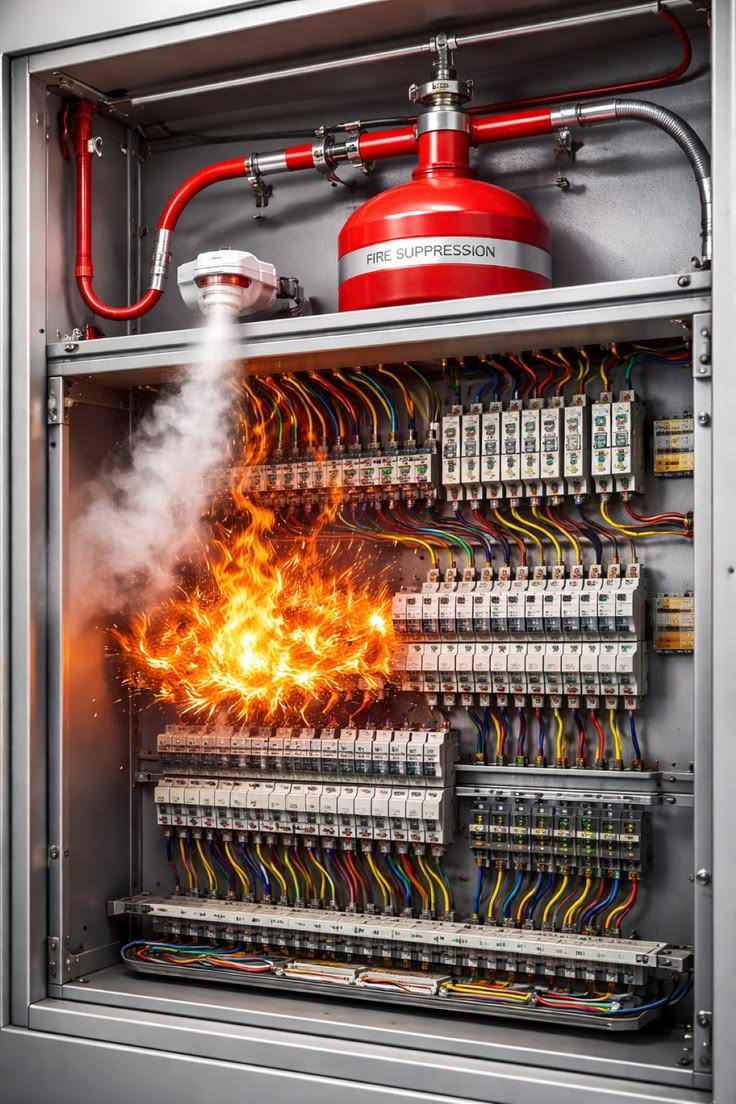
Introduction: Smart Industrial Safety & Automated Fire Hazard Mitigation
Fire hazards represent one of the most critical threats to industrial facilities, commercial buildings, residential spaces, and smart warehouse environments. Traditional fire alarm systems often rely on standalone smoke detectors or manual heat sensors that alert occupants only after a fire has already spread significantly. Delayed detection and lack of immediate automated suppression mechanisms lead to catastrophic property loss and severe safety risks.
The Fire Protection System Using Arduino with Smoke and Flame Detection project provides an automated, multi-sensor embedded solution for early-stage hazard identification and rapid response. By combining gas/smoke sensors (MQ-2) with optical infrared flame detectors, an Arduino microcontroller continuously monitors environmental parameters to catch combustion threats before they escalate. Upon detecting hazardous smoke concentrations or IR flame signatures, the system automatically triggers loud piezo buzzers, visual LED indicators, emergency water pump relay modules, and GSM/Wi-Fi alert notifications.
For Electrical, Electronics, and Computer Science engineering students, building an automated fire protection prototype provides vital hands-on experience in sensor fusion, microcontroller programming, relay actuator interfacing, emergency alert automation, and embedded systems engineering.
Key Features & Benefits
System Pipeline & Operational Workflow
The embedded system processes environmental telemetry through a multi-stage monitoring and emergency actuation pipeline designed for immediate response.
The process begins with Multi-Sensor Environmental Sensing, where MQ-2 gas/smoke sensor modules continuously measure ambient combustible gas and smoke levels, while IR flame sensor modules monitor infrared light wavelengths emitted by open flames.
Next, during Analog Signal Processing & Threshold Evaluation, the Arduino microcontroller samples incoming sensor voltage signals. The micro-controller compares these readings against pre-programmed safety thresholds to distinguish between normal atmospheric variations and active fire hazards.
This advances to Multi-Stage Hazard Logic Evaluation, where the system checks whether a single sensor or both sensors have been triggered. If only smoke is detected, a preliminary warning state is initiated; if both flame and heavy smoke are detected simultaneously, a full emergency response state is activated to prevent false alarms.
Following this, Actuator Activation & Local Emergency Response engages local safety hardware. The microcontroller triggers high-decibel piezo buzzers, activates flashing visual warning LEDs, and switches relay modules to drive automated water pumps or solenoid valves for instant fire suppression.
The system then enters Remote Alerting & Wireless Notification Dispatch, where an integrated GSM or Wi-Fi module (such as SIM800L or ESP8266) dispatches real-time SMS messages or cloud dashboard notifications to facility managers and emergency personnel.
Finally, the system outputs System Reset & Continuous Safety Logging, keeping emergency suppression systems active until sensor levels fall back below safety thresholds, while maintaining operational status logs on an LCD display.
Implementation Guide
Key Features & Essential Technologies
Developing an embedded fire protection platform balances rapid sensor response times with robust hardware switching capabilities. Key features include dual-sensor hazard detection (smoke and IR flame), dynamic threshold calibration, automated water pump relay suppression, high-decibel local alarms, emergency SMS notification dispatch, and real-time LCD status monitoring.
The recommended technology stack relies on C/C++ embedded programming within the Arduino IDE environment. Core hardware components include an Arduino Uno R3 or Nano microcontroller board, an MQ-2 smoke/gas sensor, an IR flame detector module, a 5V relay module, a 12V mini water pump motor, a piezo buzzer, a 16x2 I2C LCD display, and a SIM800L GSM module or ESP8266 Wi-Fi chip. Power management is handled via regulated DC power adapters or rechargeable Li-ion battery packs.
Technical Specifications
Step-by-Step Implementation Guide for Students
Follow this structured step-by-step roadmap to assemble, program, test, and deploy your final-year engineering project:
Hardware Assembly & Circuit Interfacing
Action: Mount the Arduino Uno, MQ-2 sensor, flame sensor module, relay board, and LCD screen onto a breadboard or custom PCB prototype base. Connect sensor output pins to Arduino analog and digital inputs, and link the relay control pin to a digital output driver.
Verification: Power up the circuit and verify that the LCD screen displays baseline initialization text and sensor status indicators.
Sensor Calibration & Threshold Setup
Action: Write an embedded calibration sketch to read raw analog values from the MQ-2 smoke sensor and digital signals from the flame sensor under normal ambient conditions. Set software trigger thresholds for smoke density and flame detection sensitivity.
Verification: Expose the MQ-2 sensor to a small smoke source (such as an incense stick) and observe output voltage spikes in the serial monitor to confirm correct threshold mapping.
Emergency Suppression & Alert Logic Development
Action: Program conditional control loops to handle hazard detection: if smoke or flame values exceed threshold limits, toggle relay output HIGH to activate the water pump, trigger the buzzer pattern, and send AT commands via the GSM module to dispatch emergency SMS alerts.
Verification: Trigger the flame sensor using a test lighter; verify that the relay clicks ON immediately, the pump activates, and the buzzer sounds without delay.
Field Testing & Reliability Optimization
Action: Perform end-to-end testing across various distance ranges and lighting conditions. Optimize delay timers in the code to ensure continuous water pump operation during active hazards while avoiding relay chatter.
Verification: Run a complete mock fire drill test to confirm that local alarms, automated water suppression, LCD status updates, and emergency SMS alerts trigger synchronously.
Conclusion & Next Steps
Future Scope & Industry Applications
Integrating automated embedded fire protection with modern IoT infrastructure offers substantial growth potential across safety engineering sectors:
IoT Smart Building Integration: Connecting fire protection nodes to central building management systems (BMS) over MQTT or Zigbee for automated HVAC shutdown and emergency door release.
Computer Vision AI Fire Detection: Combining physical sensor arrays with thermal camera vision models to detect flame boundaries across large factory floors.
Autonomous Firefighting Mobile Robots: Mounting smart sensor fusion systems onto mobile robotic platforms to enter hazardous environments and extinguish fires autonomously.
Building a Fire Protection System Using Arduino with Smoke and Flame Detection project arms electrical, electronics, and embedded systems students with essential expertise in sensor interfacing, microcontroller automation, relay control, emergency alerting, and practical safety engineering.
Contact Details
Aislyn Technologies, Bangalore
📞 Phone: +91 97395 94609
📧 Email: info@aislyntech.com
🌐 Website: https://aislyn.in
Contact us today to start building your Embedded project in Bangalore with our expert support!