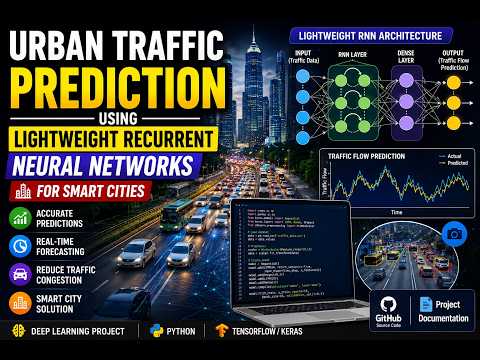
Urban traffic congestion has become a significant challenge in modern cities due to increasing population, rapid urbanization, and the growth in the number of vehicles on roads. Efficient traffic management requires accurate prediction of traffic conditions so that transportation systems can be optimized and congestion can be reduced. However, traffic prediction is a difficult task because traffic patterns are complex, dynamic, and often affected by unexpected events such as sensor failures or missing data. Traditional statistical models such as ARIMA and Kalman filters have been widely used for time series forecasting, but they are limited in capturing nonlinear patterns and complex temporal dependencies present in real-world traffic data. In recent years, deep learning techniques, especially recurrent neural networks such as Long Short-Term Memory (LSTM) and Gated Recurrent Unit (GRU), have shown promising results in traffic forecasting due to their ability to learn sequential patterns from time series data. This project proposes a lightweight recurrent neural network architecture for robust urban traffic forecasting that can effectively handle missing or incomplete sensor data. The proposed approach introduces enhanced recurrent models, namely Extended Long Short-Term Memory (xLSTM) and Extended Gated Recurrent Unit (xGRU), which incorporate improved gating mechanisms and efficient memory updates to enhance prediction performance while reducing computational complexity. In addition, a hybrid data imputation strategy is implemented to handle missing values in traffic sensor datasets by applying different techniques such as linear interpolation, temporal averaging, and seasonal decomposition based on the duration of missing intervals. The system utilizes multivariate traffic sensor data including average vehicle speed, road occupancy rate, and total vehicle count collected at regular time intervals. The processed data is then used to train the proposed deep learning models to predict future traffic conditions. Experimental results demonstrate that the proposed architecture improves forecasting accuracy while maintaining low computational cost compared to traditional RNN and Transformer-based models. The system is designed to be efficient and scalable, making it suitable for deployment in intelligent transportation systems and smart city applications. Overall, this project contributes to the development of reliable and efficient traffic prediction systems that can support better traffic management and reduce congestion in urban environments.
INTRODUCTION
Urban traffic congestion has become one of the most serious challenges faced by modern cities due to rapid urbanization, increasing population, and the continuous growth in the number of vehicles. As cities expand and transportation demands increase, road networks often become overloaded, leading to long travel times, increased fuel consumption, environmental pollution, and economic losses. Efficient traffic management has therefore become an essential requirement for developing smart cities and intelligent transportation systems. One of the most important components of traffic management is the ability to accurately predict traffic conditions in advance so that appropriate measures such as route optimization, traffic signal control, and congestion management can be implemented. Traffic prediction helps drivers, transportation authorities, and urban planners make informed decisions that can significantly reduce congestion and improve the overall efficiency of transportation systems. Traditionally, traffic forecasting has been performed using statistical time series models such as Autoregressive Integrated Moving Average (ARIMA), Kalman filtering, and exponential smoothing techniques. Although these models are useful for simple forecasting tasks, they are limited in their ability to capture the complex, nonlinear, and dynamic patterns present in real-world traffic data. Traffic conditions are influenced by many factors such as weather conditions, accidents, road construction, peak hour demand, and human driving behavior, making traffic flow highly unpredictable and difficult to model using conventional statistical methods.
In recent years, the development of machine learning and deep learning techniques has significantly improved the performance of traffic prediction systems. Deep learning models have the ability to automatically learn patterns and relationships from large volumes of data, making them suitable for modeling complex temporal patterns in traffic flow. Among these techniques, Recurrent Neural Networks (RNNs) have gained significant attention because they are specifically designed for sequential and time series data. Advanced variants of RNNs such as Long Short-Term Memory (LSTM) and Gated Recurrent Unit (GRU) have been widely used for traffic prediction tasks due to their ability to capture long-term dependencies in time series data and handle temporal relationships effectively. These models can analyze historical traffic data and generate accurate predictions of future traffic conditions. However, despite their advantages, traditional RNN-based models still face certain limitations when applied to real-world traffic datasets. One major challenge is the presence of missing or incomplete data caused by sensor failures, communication issues, or hardware malfunctions. Missing data can significantly reduce the accuracy of prediction models and may lead to unreliable forecasting results if not handled properly.
To address these challenges, this project focuses on developing a lightweight and robust traffic forecasting system that can effectively handle missing data while maintaining high prediction accuracy. The proposed system utilizes advanced recurrent neural network architectures such as Extended Long Short-Term Memory (xLSTM) and Extended Gated Recurrent Unit (xGRU), which are improved versions of traditional LSTM and GRU models. These enhanced architectures incorporate improved gating mechanisms and memory update strategies that enable the model to capture temporal dependencies more effectively while reducing computational complexity. In addition to the improved neural network architecture, the system also introduces a hybrid missing data imputation strategy that can intelligently handle different types of missing values in traffic datasets. The imputation framework uses techniques such as linear interpolation for short gaps, temporal averaging for medium gaps, and seasonal trend decomposition for long missing intervals. By combining advanced deep learning models with an effective missing data handling strategy, the proposed system aims to provide accurate and reliable traffic forecasting even in the presence of incomplete sensor data. The system uses multivariate traffic sensor data such as average vehicle speed, road occupancy rate, and vehicle count collected at regular intervals to train the prediction models. The predicted results can help transportation authorities monitor traffic conditions, detect congestion patterns, and implement better traffic control strategies. Therefore, the proposed approach contributes to the development of intelligent traffic prediction systems that support smart city infrastructure and improve the efficiency of urban transportation networks.
OBJECTIVES
To develop an efficient traffic forecasting system that can predict future traffic conditions using historical traffic sensor data.
To analyze traffic patterns using deep learning techniques such as recurrent neural networks (RNN), LSTM, or GRU for accurate time series prediction.
To handle missing or incomplete traffic sensor data by applying suitable data imputation techniques to improve dataset reliability.
To design a lightweight and computationally efficient model that can provide accurate predictions with reduced training time and fewer parameters.
To support intelligent transportation systems by providing reliable traffic predictions that help reduce congestion and improve traffic management in urban areas.
Block Diagram
SOFTWARE REQUIREMENTS
Operating System
Windows, Linux, or macOS can be used to develop and run the project. These operating systems provide the required environment for installing programming tools and running machine learning libraries.
Programming Language – Python
Python is used as the main programming language for implementing the traffic prediction model. It is widely used in data science and machine learning because of its simple syntax and powerful libraries.
NumPy
NumPy is used for numerical computations and mathematical operations on arrays. It helps in handling large datasets and performing matrix calculations required for machine learning models.
Pandas
Pandas is used for data manipulation and preprocessing. It helps in reading datasets, cleaning data, handling missing values, and organizing traffic data into structured formats.
TensorFlow / PyTorch
These are deep learning frameworks used to build and train neural network models such as LSTM, GRU, xLSTM, or xGRU. They provide efficient tools for model training and prediction.
Scikit-learn
Scikit-learn is used for data preprocessing, model evaluation, and performance measurement. It provides tools for splitting datasets, scaling data, and calculating metrics like RMSE.
Matplotlib
Matplotlib is used for visualizing the traffic data and prediction results using graphs and charts. It helps in analyzing model performance and understanding traffic trends.
Jupyter Notebook / VS Code
These development environments are used for writing and executing Python code. They make it easier to experiment with machine learning models and visualize outputs.